Promising Markets For
What are the product description and classification requirements for avocados?
Your product falls under HS code 08044000, fresh or dried avocados. Hass is the main avocado variety in Europe because it is suitable for ripening and long-distance transport. Lamb Hass is a Hass-type variety that can help extend the commercial season. [1, 2, 3]
Interviews with Lebanese exporters confirm that Hass and Lamb Hass are the most relevant varieties for the European channel, while Fuerte is viewed as more suitable for GCC and Turkey. For the Netherlands, exporters should therefore avoid a mixed-variety offer and focus on Hass-type fruit that can support ripening, shelf life and buyer specifications.
For the Dutch market, the product baseline is strict. Europe mainly wants Class I fruit, with popular Hass sizes 16 to 18, and with maturity that supports uniform ripening. The legal minimum dry matter for Hass is 21%, while many European importers and ripeners want around 22-23% for good eating quality. Buyers in the Netherlands also often expect low residue levels, in some cases below EU legal limits, plus food-safety certification such as GLOBALG.A.P. on farm and BRCGS or IFS at packhouse level. [2, 3, 5]
For Lebanon, maturity control is a key issue. Visual checks alone are not enough to judge the right harvest stage; laboratory measurements are important for export quality. This matters because Dutch buyers increasingly sell ready-to-eat avocados, so poor maturity control can damage the commercial result. [2, 3]
What is the market opportunity for Lebanese Hass and Lamb Hass avocados in the Netherlands?
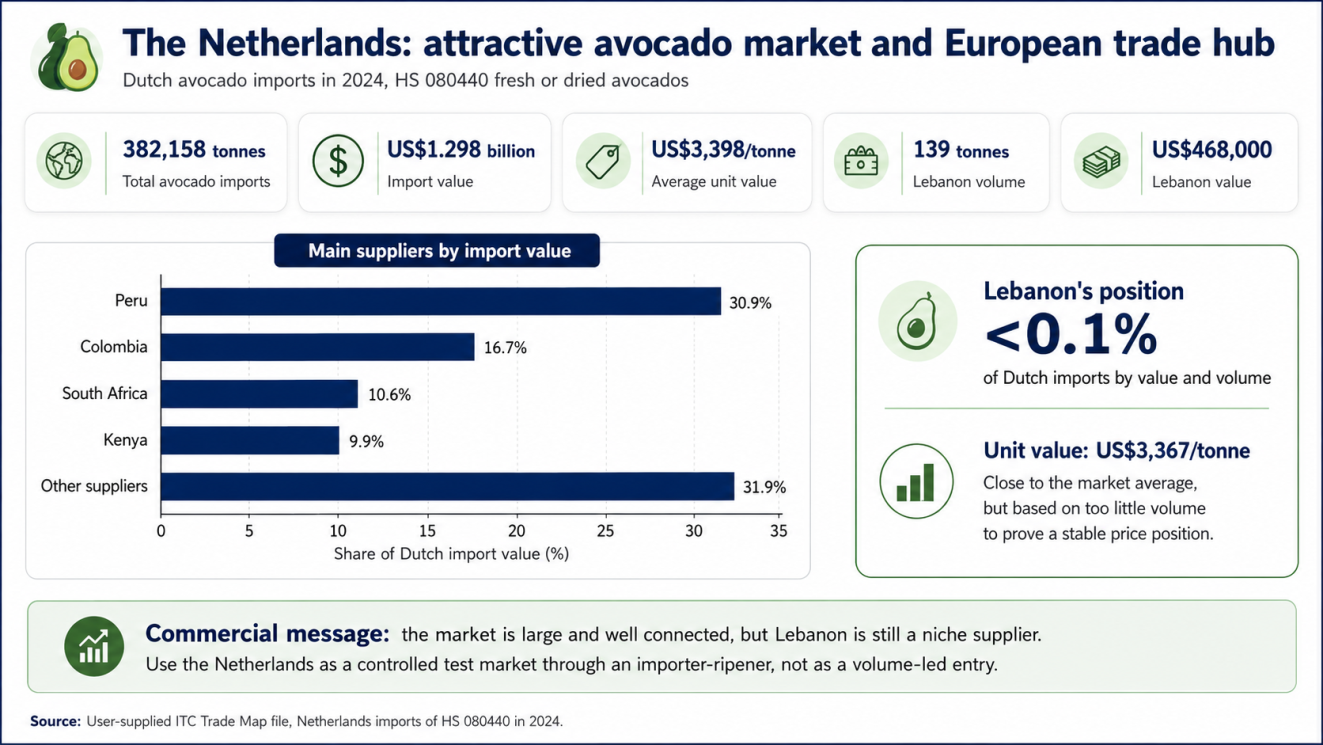
The Dutch market is attractive because it is both a buying market and a redistribution hub. The Netherlands acts as Europe’s main avocado trade hub; recent market reporting puts Dutch avocado imports at roughly 382,000-386,500 tonnes in 2024 and highlights large re-exports to Germany, France, Spain, Poland, Belgium and Scandinavia. Dutch traders are especially strong in ripening, packing and logistics, and ready-to-eat is a major retail format in the Netherlands. [4, 7, 9]
The long-term trend is strong, but the market has matured. According to ITC Trade Map annual data, Dutch avocado import value rose from US$540.2 million in 2018 to US$1.298 billion in 2024, while imported quantity grew more slowly than value from 2020 to 2024. Editorial assessment: This indicates that the market is still growing, but not in an easy volume-led way: price, specification and positioning matter more than simple tonnage. [7]
A second important point is concentration. Dutch buyers already have deep programmes with established origins. Peru, Colombia, South Africa, Kenya, Chile, Spain, Morocco and Israel dominate the market. Lebanon’s 2024 export base into the Netherlands was still too small to influence pricing, retail programming or buyer habits. Editorial assessment: This conclusion is based on supplier shares and Lebanon’s reported volume. [7]
The figure below shows why the Netherlands is attractive, but also why Lebanon should enter carefully. The Dutch avocado market is large and works as a European trade hub. However, most import value is controlled by established suppliers such as Peru, Colombia, South Africa and Kenya. Lebanon’s current share is still very small, so the first goal should be to prove quality, maturity control and reliability through a controlled importer-led trial. [2, 7]
Dutch avocado imports reached 382,158 tonnes in 2024, worth US$1.298 billion. Lebanon supplied 139 tonnes, worth US$468,000. Its unit value was close to the market average, but the volume is too small to prove a stable price position. Editorial assessment: The price-position conclusion is based on Lebanon’s small reported shipment volume. [7]
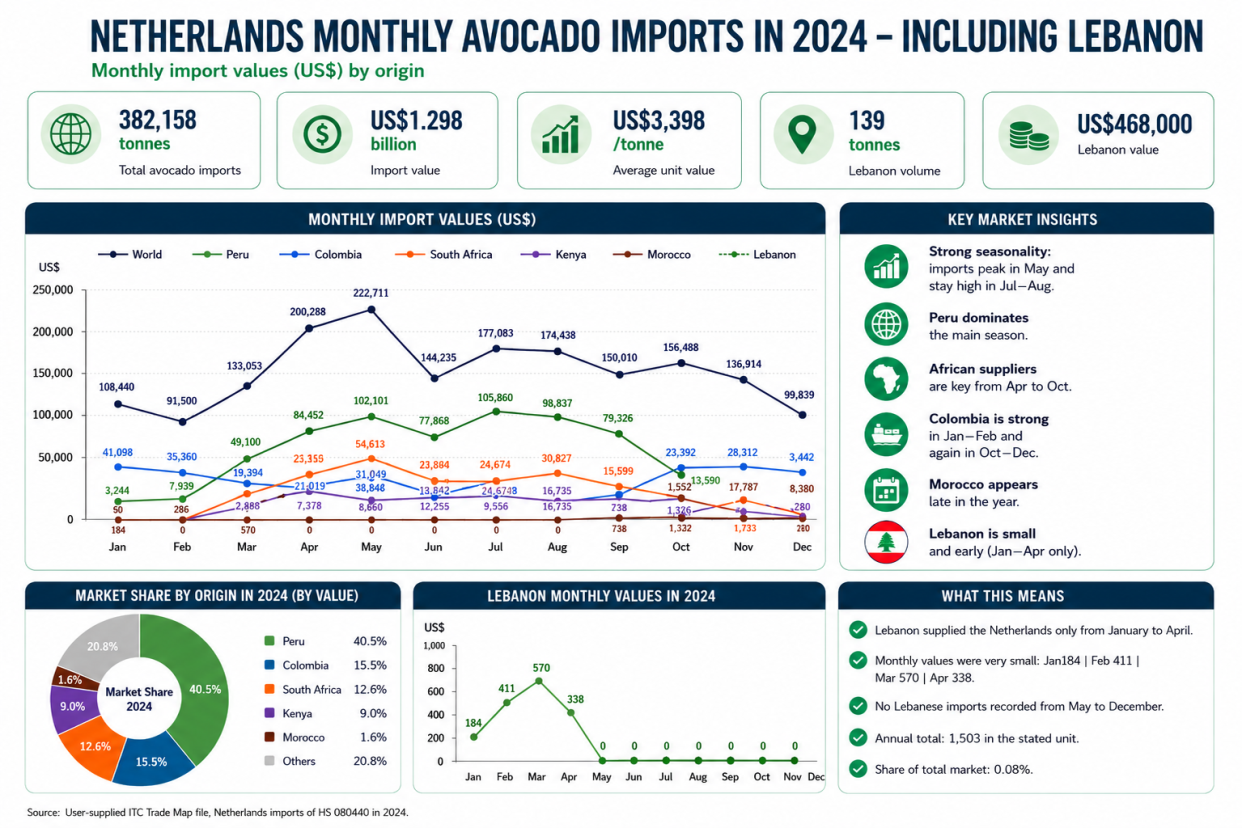
Your biggest market challenge is crowding in the same months you want to sell. The monthly Dutch value data for 2024 shows Colombia strongest in January and February, Peru surging from March to June, and South Africa and Kenya also becoming strong from April onwards. Spain, Israel and Morocco are important in the winter-to-spring bridge. Lebanon appears in the Dutch monthly file only from January to April by value. [7]
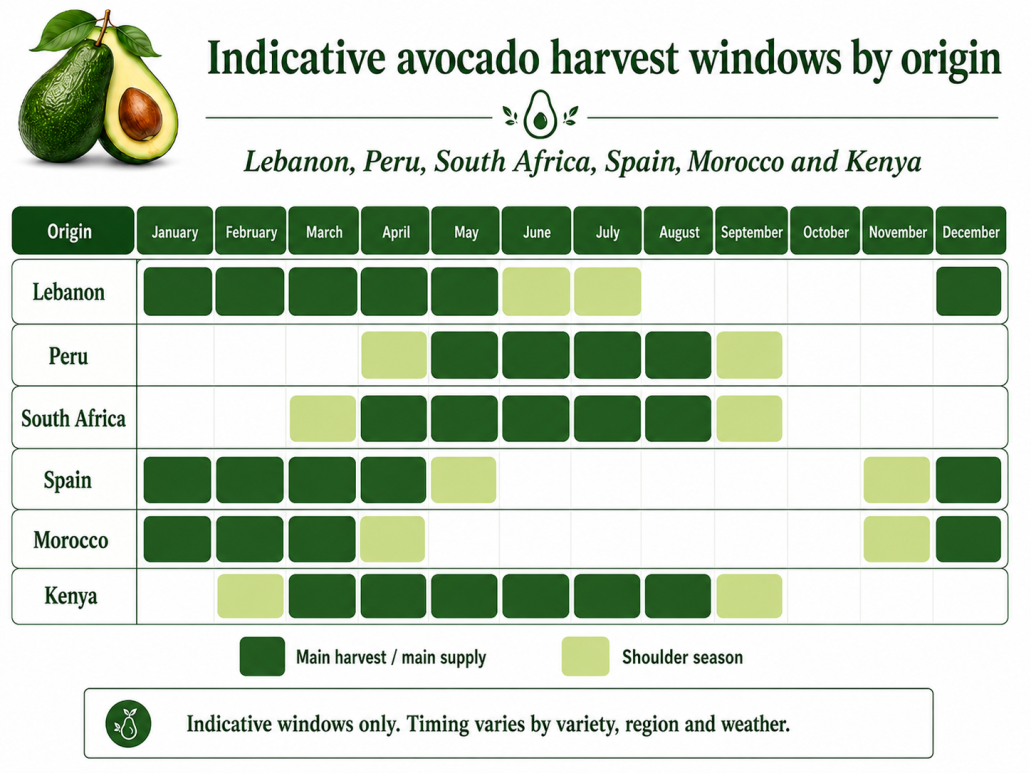
Lebanon’s main harvest window runs from December to May, with some later varieties such as Lamb Hass extending into June and July. That can support a winter-to-spring offer. Editorial assessment: Treat this as a commercial test, not a proven gap, because Dutch monthly trade data already show heavy competition in that broader period. [7, 10]
Interview feedback reinforces that the export window is critical. Lebanese exporters should not assume that the Netherlands has an open supply gap; instead, they should use the winter-to-spring period for controlled commercial testing. Kenya, Israel, Turkey and Egypt were repeatedly mentioned as relevant competitors, so Lebanon’s offer must be timed carefully and supported by quality evidence, not only by seasonality.
What does this mean for a Lebanese avocado exporter?
Your best commercial opportunity is not a large-volume push in June. Instead, focus on a smaller, controlled entry during a period when you can demonstrate quality, consistency and reliable service, typically in late winter to early spring. Use this window to collect buyer feedback and build credibility. [2, 7]
This is consistent with interview feedback: exporters should begin with a small, well-prepared shipment, obtain buyer feedback on ripening, maturity, residue results and claims, and only then scale gradually. The interviews suggest that credibility with European buyers depends less on one successful sale and more on repeated technical performance.
If you plan to market Lamb Hass later in the season, you must clearly show why a Dutch importer should choose your supply over Peru, South Africa or Kenya. Current public data indicate that there is no clear late-season gap, so success depends on proving your product’s value and reliability, rather than relying on timing alone. This is based on competitor availability shown in monthly import data. [7]
How should Lebanese exporters enter the Dutch avocado market?
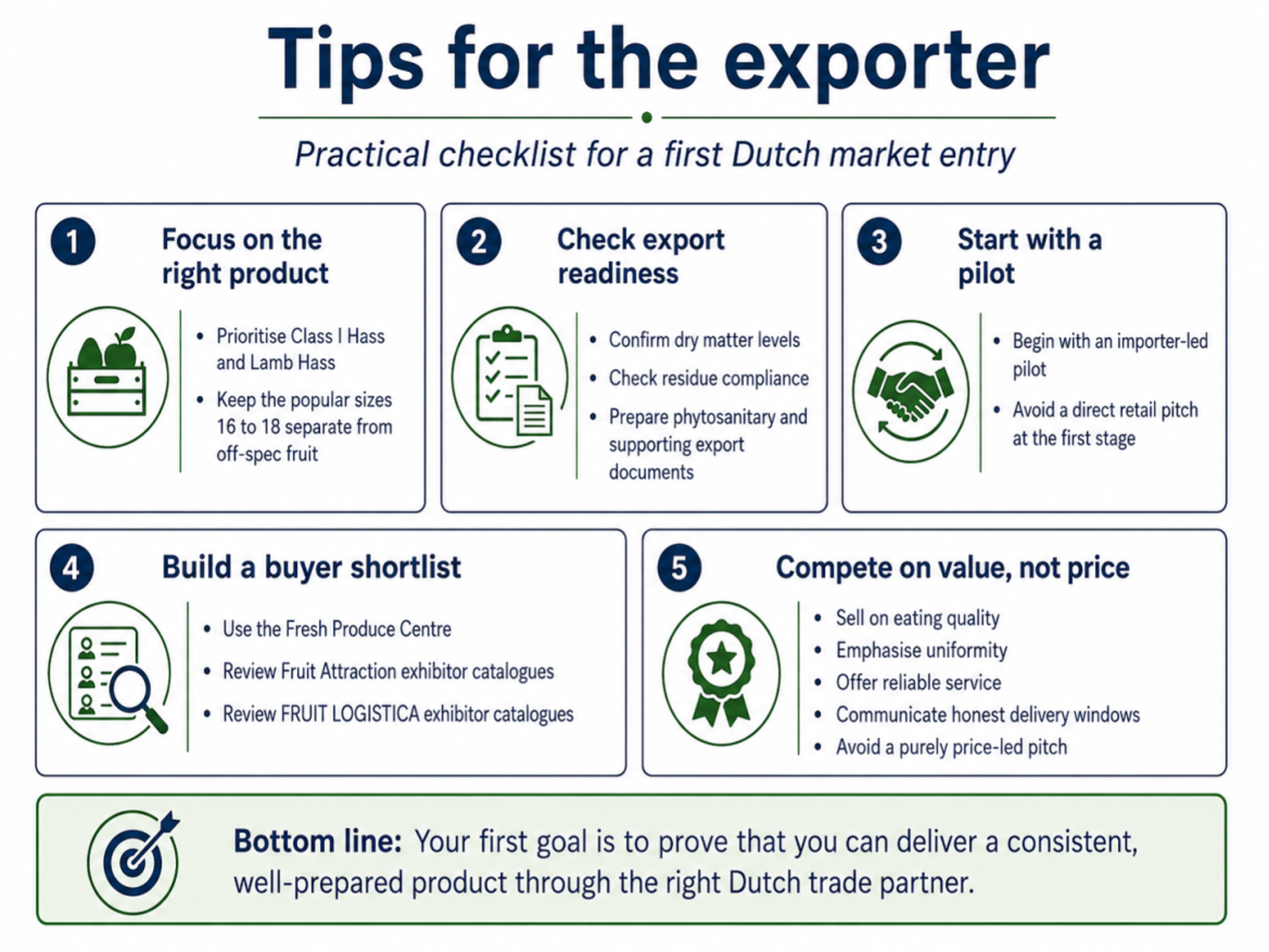
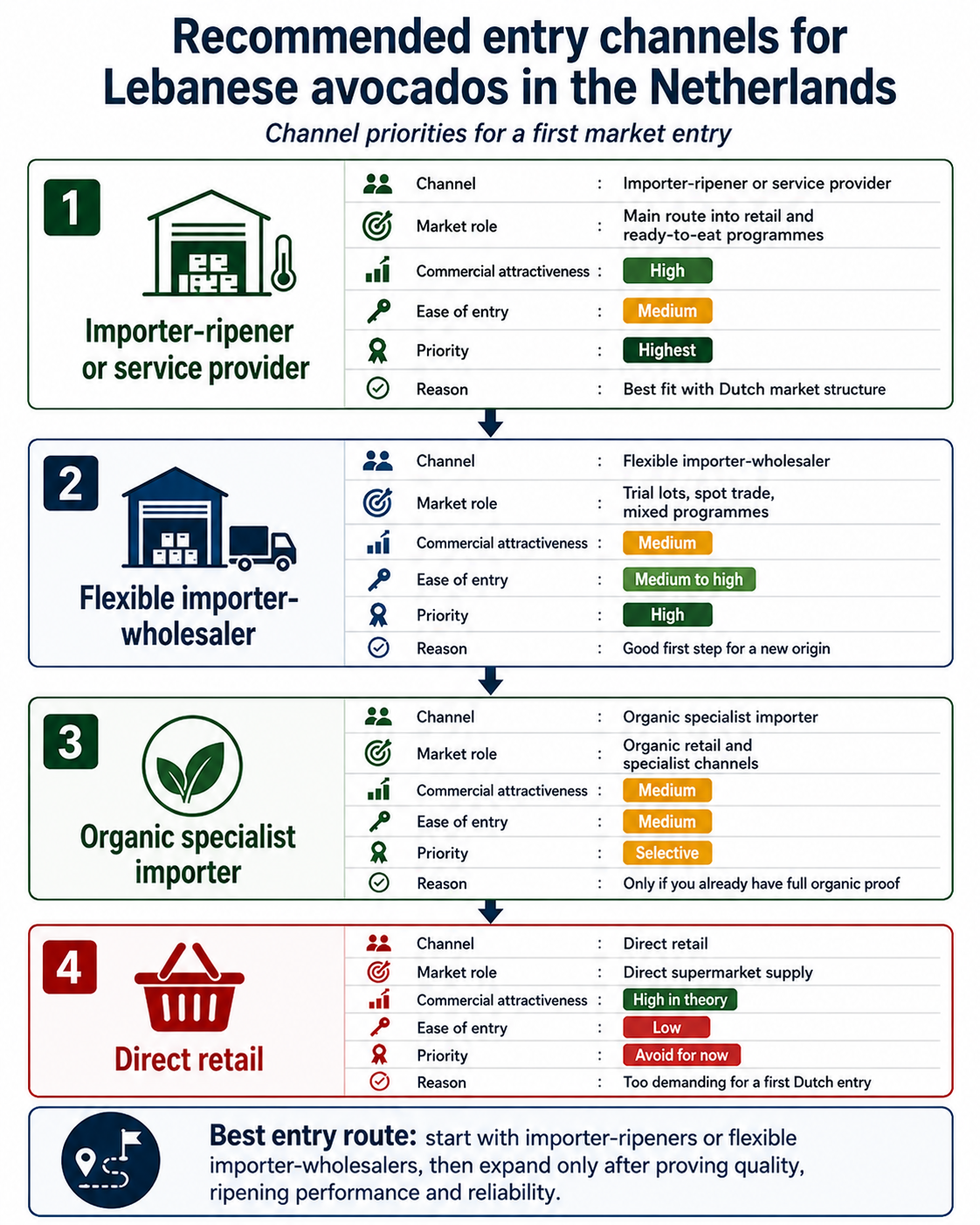
For a first entry into the Dutch avocado market, focus on importer-ripeners or flexible importer-wholesalers. These channels offer the most realistic access to supermarkets and other major retailers, which dominate avocado sales. [2]
The CBI study Entering the European market for avocados highlights that avocados are a retail-led product, with consumer sales largely driven by supermarkets and their service providers. Direct supply to supermarkets is generally difficult for new exporters unless they can guarantee year-round supply and maintain a local presence in Europe. [2]
Most new suppliers begin on the spot market with smaller importers or traders to establish credibility and gain experience. Once they have proven their reliability and quality, they may gradually progress into formal retail programmes. [2]
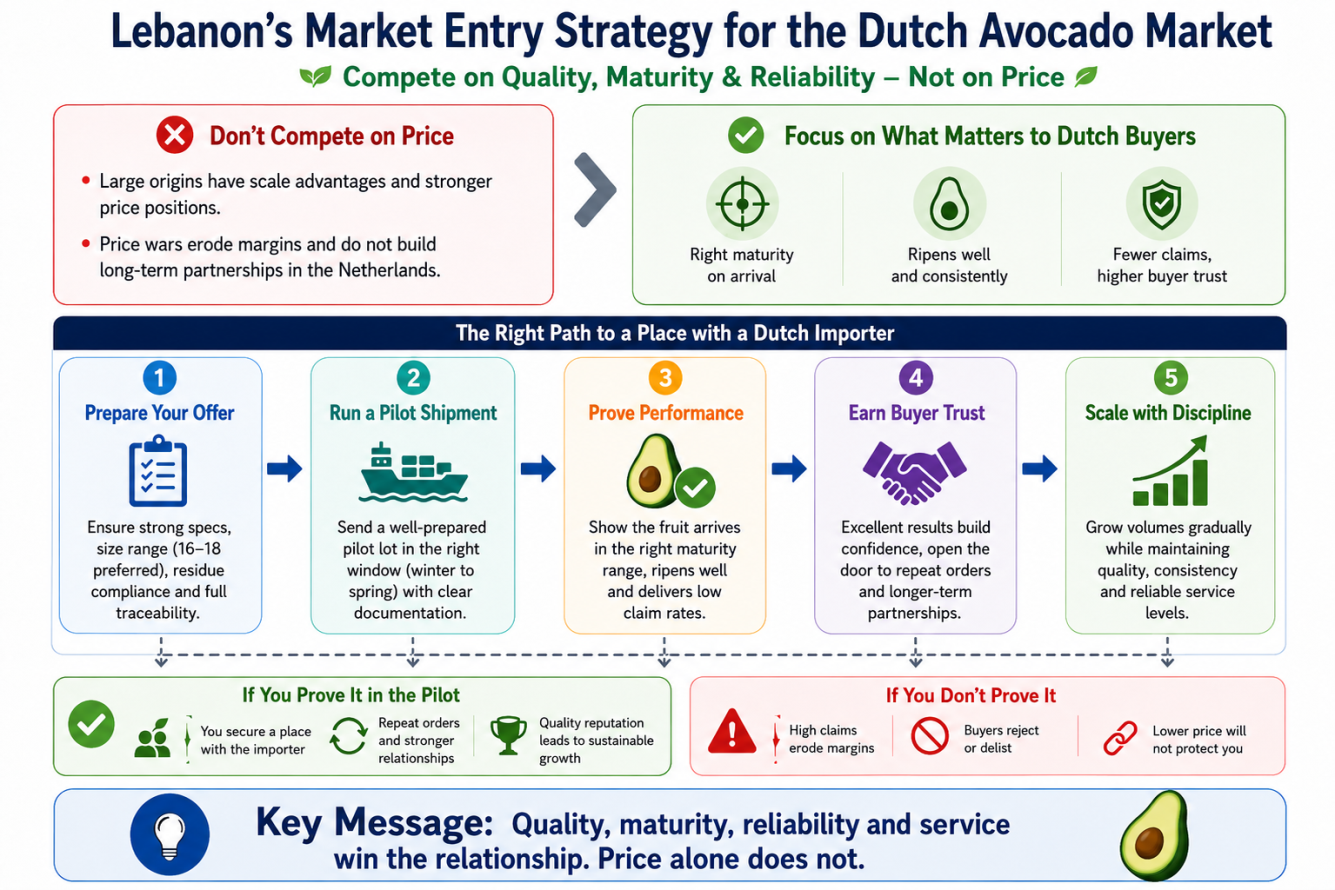
For Lebanese exporters, the first goal should be to prove quality, service and consistency through the right intermediary, rather than attempting direct retail from the outset. [2, 7]
These priorities point exporters first towards importers, ripeners and service providers, and warn that direct retail supply needs scale, continuity and a European base. [2]
Your channel choice should be simple. Start with one or two pilot lots, ask for written feedback, and use that result to decide whether you can move into a larger importer-ripener programme. Do not present yourself as a direct retail supplier until you can prove stable maturity, low claims and repeat supply. [2, 5]
Interview notes also point to the Netherlands as a practical entry route into Europe. This supports choosing an importer-ripener or flexible importer-wholesaler rather than attempting direct retail. The first Dutch partner should be able to test the product, report on ripening performance and guide the exporter on specifications before larger volumes are offered.
How can Lebanese exporters find potential buyers in the Netherlands?
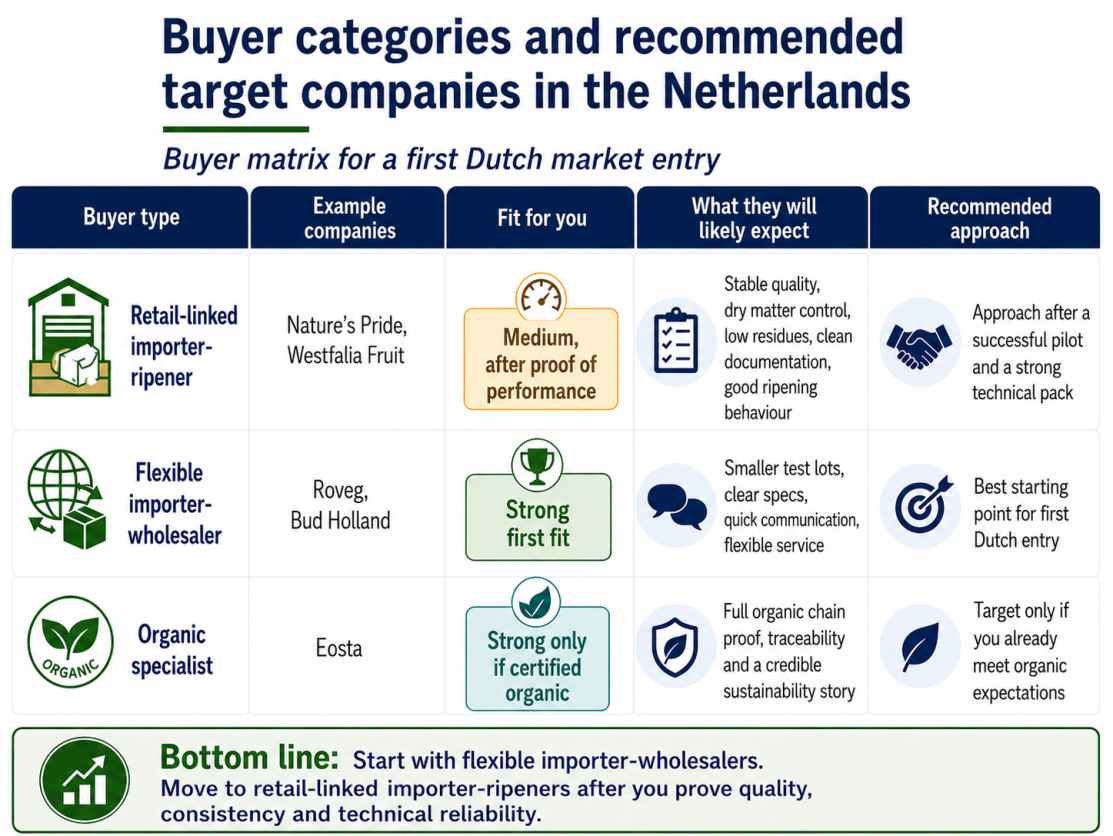
Build a short, realistic buyer list based on public company positioning, then validate the right contact person on official company pages and only then use LinkedIn for contact checking. The goal is not to create a long list. The goal is to build a shortlist of buyers whose public offer matches your likely scale, product and service level. [8, 11, 12, 14, 15, 16, 17, 18, 23]
These buyer examples are not confirmed prospects. They are public-fit examples based on official company pages. Nature’s Pride publishes year-round ready-to-eat avocado supply and focuses on Hass. Westfalia describes itself as a vertically integrated avocado company. Roveg highlights ripening facilities, mixed shipments and supply to supermarkets and wholesalers. Bud Holland markets ready-to-eat avocados under Readylicious. Eosta positions itself as an organic specialist working with more than 1,000 growers. [14, 15, 16, 17, 18]
To find more buyers, start with the official Fresh Produce Centre member directory, which lists Dutch companies active in import, export, packaging, storage and transhipment. Fresh Produce Centre states that it has more than 320 members across the fruit and vegetable sector. Use this as your first source for Dutch market mapping. [8]
Then use trade-fair exhibitor platforms to identify active avocado importers and distributors. Check the Fruit Attraction exhibitor platform for Spain and wider European fresh produce buyers, and use FRUIT LOGISTICA Online or the FRUIT LOGISTICA exhibitor information page to identify companies active in fresh produce, logistics and ripening. [11, 12]
You can also use commercial and trade-intelligence platforms to expand and verify your shortlist. Kompass is useful for searching B2B companies by sector, country and activity. ITC Trade Map helps you check trade flows and supplier patterns. [7, 22]
IPD can be useful as a benchmark for how European buyer matchmaking works, but be careful how you present it. The Import Promotion Desk is relevant for understanding buyer-supplier matching and trade-fair preparation, but its current fresh produce partner-country list does not include Lebanon. Do not present IPD as a direct support route for Lebanese avocado exporters unless that status changes. [19]
Finally, use LinkedIn only as a validation and contact tool. Check whether the company is active, identify relevant roles such as buyer, category manager or sourcing manager, and confirm contact names against the company’s official website before outreach.
Contacts should be verified against official company websites before outreach. [23]
How should Lebanese exporters promote their avocados in the Dutch market?
Your promotion should solve a buyer problem. A clear value proposition is: Lebanese Hass and Lamb Hass avocados with strong eating quality, disciplined maturity control and responsive service in a defined winter-to-spring window. This works because it focuses on what a Dutch importer manages every day: ripening performance, continuity and claim risk. It does not pretend that Lebanon can beat Peru on scale or price. [2, 5, 7]
Interview feedback supports this positioning. Lebanese avocados should be promoted on eating quality, maturity and careful selection, rather than on low price or large-scale supply. The commercial message should be disciplined: certified Hass/Lamb Hass, controlled maturity, clean residue results and responsive service for Dutch importer-ripeners.
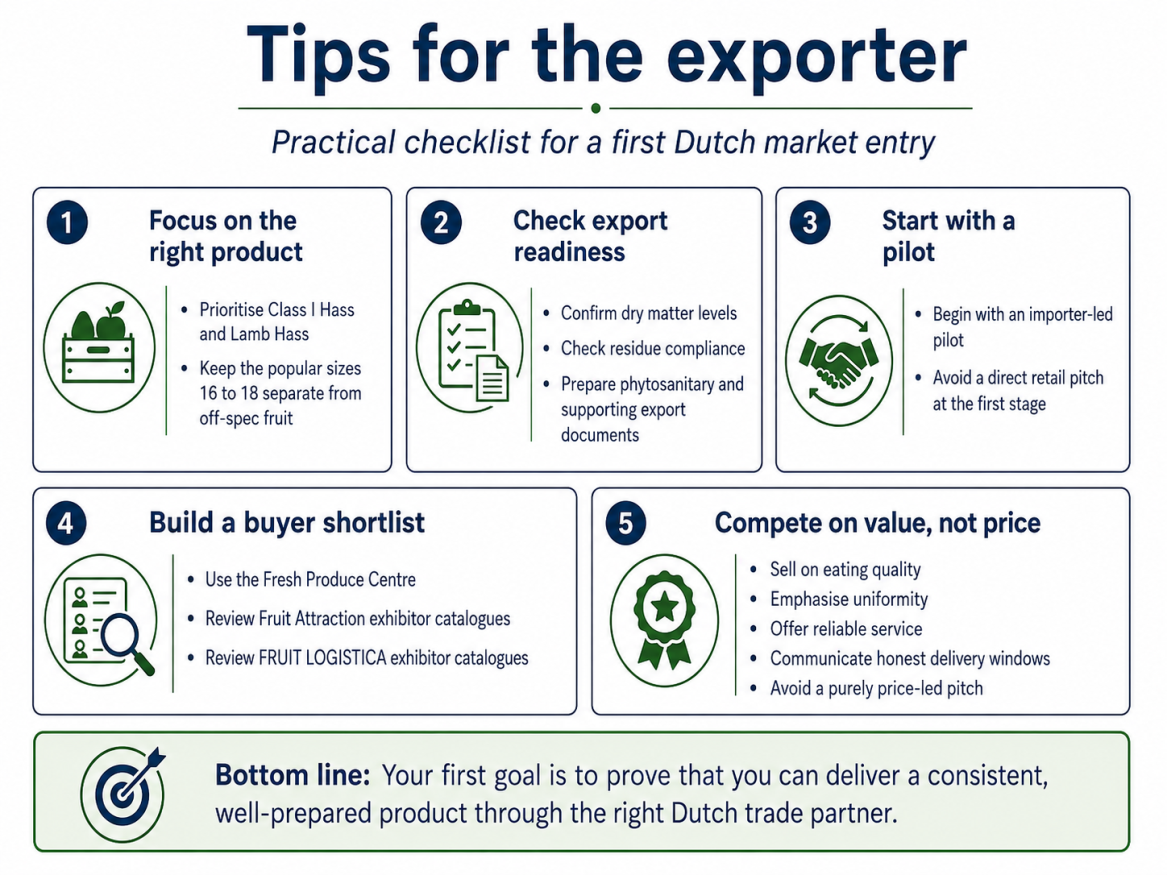
Do not claim year-round supply, organic status, low residues, premium sustainability or retailer readiness unless you can prove each point. The CBI avocado study Entering the European market for avocados says buyers often expect GLOBALG.A.P., packhouse food-safety systems and tight control over residues and maturity. The European Commission also requires phytosanitary certification and plant-health controls for relevant plant products entering the EU. [2, 6]
Make your website a trade tool, not a brochure. Show the product range, harvest window, weekly capacity, pack formats, dry matter method, certifications, residue controls, cold-chain basics and a clear export contact. For meetings, focus on the official exhibitor platforms of Fruit Attraction 2026 on 6 to 8 October 2026 and FRUIT LOGISTICA 2027 on 3 to 5 February 2027. If you have certified organic fruit, BIOFACH 2027 on 16 to 19 February 2027 is also relevant. [5, 11, 12, 13]
Based on interviews, the website and buyer presentation should also include: certified farm list or certification status, packhouse certification status, residue-testing protocol, dry-matter testing method, available Hass/Lamb Hass volumes by week, and the name of the responsible export contact. These details matter because Dutch buyers will need proof before they commit to repeated shipments.
Use the value proposition consistently across all promotional activities. Present the offer as: Lebanese Hass and Lamb Hass avocados with strong eating quality, disciplined maturity control and responsive service in a defined winter-to-spring window, supported by Lebanon’s fresh fruit identity: "Exquisite fruits and vegetables from the Mediterranean" and "Origin of Taste". [5, 10]
This message should guide your website, buyer presentation, trade-fair pitch, offer sheet and LinkedIn outreach. The Fresh fruits & vegetables from Lebanon / Lebfresh story can strengthen the offer by linking Lebanese avocados to Mediterranean terroir, varied microclimates, around 300 sunny days per year and proximity to Europe. [10]
You can include a green-sourcing angle, but only as an indicative comparison. Based on transport distance, the sea route from Beirut to Rotterdam is shorter than routes from Peru or Colombia. A simple reefer sea-freight estimate suggests around 55 kg CO₂e per tonne from Lebanon, compared with around 181 kg CO₂e per tonne from Peru and at least 145 kg CO₂e per tonne from Colombia. These figures are internal editorial estimates, not verified product carbon footprints or certified sustainability claims. Before using this comparison in buyer-facing material, verify the exact route, carrier data, reefer assumptions, emission factors and calculation method.
What should Lebanese exporters know about doing business in the Netherlands?
Dutch business culture tends to be direct, punctual and efficient. The U.S. International Trade Administration says honest discussion, quick replies and meeting discipline matter in Dutch business. It also notes that many Dutch executives take longer holidays in July and August and in late December, so those periods are weaker for outreach. English is widely used in commercial communication. [20]
The Culture Factor country-comparison tool adds a useful nuance. The Netherlands scores low on power distance and low on masculinity, which points to informal hierarchy, direct communication and a consensus style. Editorial assessment: In practice, be clear, prepared and factual. Send your specifications before the meeting. Confirm decisions by email. If something is still uncertain, say so. Dutch buyers usually prefer precise promises over polished sales language. [21]
Who are the main competitors and what is the price logic in the Dutch avocado market?
The main competition is not one country. It is a group of strong origins that together supply the Dutch market throughout the year. [2, 7]
Peru leads on scale and dominates the summer supply window. Colombia is strong in the Dutch winter window and provides good continuity. Morocco has grown quickly and benefits from its closer regional position. South Africa and Kenya are strong in spring and summer. Spain and Israel remain important nearby suppliers in the winter-to-spring period. [2, 7]
Interviewees also mentioned Israel, Turkey, Kenya and Egypt as practical competitors for Lebanese avocados. Israel and Turkey are relevant because of regional proximity and established channels, while Kenya is relevant because of its earlier window and established avocado export position. This confirms that Lebanon should not compete mainly on price; it should compete through selected lots, clean documentation, maturity control and reliable communication.
Dutch buyers already have supply options in almost every month. Lebanon should therefore not enter with a broad price-led message. It needs a focused offer based on quality, maturity control, reliable service and selected seasonal windows. [2, 7]
| Competitor | Main strength in the Dutch market | Relative price position | Relative quality or service position | Where Lebanon can still differentiate |
| Peru | Scale, programme volumes and summer dominance | Strong price pressure | Very professional | Not on price. Focus on niche timing, flexibility and small-lot service |
| Colombia | Strong winter access and good continuity | Mid | Established and trusted | Tighter lot selection, good communication and a clear technical story |
| Morocco | Fast growth and closer regional supply | Mid | Good proximity advantage | Eating quality, selected season slots and a Mediterranean origin story |
| South Africa and Kenya | Strong spring and summer supply growth | Mid to low | Mature export systems | Standout quality, careful timing and reliable ripening performance |
| Spain and Israel | Proximity, familiarity and quality in winter and spring | Often mid to high | Strong buyer trust | Equal maturity, cleaner residues and stable specifications |
This comparison combines Dutch import data with the seasonal competition view from the CBI study Entering the European market for avocados. [2, 7]
Price guidance should be used carefully. The CBI study Entering the European market for avocados gives indicative export prices of €6 to €14 per 4 kg box and importer wholesale prices of €7 to €16 per 4 kg box. It also notes that the best prices usually go to Class I Hass fruit in sizes 16 to 18. Importers generally need a margin before handling, ripening and packing costs. [2]
For Lebanese avocado exporters, price should not be the main entry strategy in the Dutch market. Larger origins such as Peru, Colombia, South Africa and Kenya are better placed to compete on scale and price. Lebanon’s stronger route is to prove product performance through a small pilot shipment, focusing on maturity, ripening behaviour, low claims and clean documentation. [2, 7]
What are the main commercial risks for exporting avocados to the Netherlands?
The first risk is compliance. The European Commission states that relevant plant products entering the EU need phytosanitary documentation and are subject to documentary, identity and plant-health checks. CBI adds that Dutch buyers often apply stricter private residue limits than the EU minimum and that retail-linked avocado buyers commonly expect GLOBALG.A.P. on farm and BRCGS or IFS-type systems in packing houses. [2, 5, 6]
Interview feedback makes this risk very concrete. Exporters reported that EU access can fail when pesticide-residue testing is incomplete or when MRL compliance is not fully documented. For the Netherlands, the roadmap should therefore require full pre-shipment residue testing, traceability to farm level and a documented corrective-action process before any pilot lot is loaded.
Interviews also suggest that variety choice and ripening behaviour must be controlled before export. Any fruit that turns black too quickly, ripens unevenly or does not meet Dutch ready-to-eat expectations should be excluded from the Netherlands offer until performance is verified through test lots.
The second risk is ripening performance. Ready-to-eat is now central in the Dutch market, so fruit that looks acceptable at loading but ripens unevenly can still fail commercially. The third risk is seasonal crowding. The fourth is volume credibility. Editorial assessment: Dutch supermarket programmes reward regular supply and low claims, not one-off opportunistic shipments. [2, 4, 7]
References
This numbered list is the source key for the inline references used in the roadmap. Source titles are hyperlinked.
1. EU TARIC / Combined Nomenclature. Avocados, fresh or dried, CN/HS 080440.
2. CBI. Entering the European market for avocados.
3. CBI. The European market potential for avocados.
4. CBI. The Dutch market potential for fresh fruit and vegetables.
5. CBI. Fresh fruit and vegetables: buyer requirements in Europe.
6. European Commission. Inspection of imported plants and plant products.
7. ITC Trade Map. Netherlands import data for HS 080440, annual and monthly data, 2018-2024.
8. Fresh Produce Centre. About us and member directory.
9. Fresh Produce Centre / GroentenFruit Huis. Avocado factsheet 2024.
10. Lebfresh. Fresh fruits & vegetables from Lebanon / Why Lebanon / product calendar.
11. Fruit Attraction / IFEMA Madrid. Fruit Attraction official event platform.
12. FRUIT LOGISTICA. Official event and planning pages.
13. BIOFACH. Official event pages.
14. Nature's Pride. Ready-to-eat avocado product page.
15. Westfalia Fruit. Company overview.
16. Roveg. About Roveg and facilities.
17. Bud Holland. Readylicious and avocado product pages.
18. Eosta / Nature & More. Organic avocados and company positioning.
19. IPD. Import fresh produce / partner-country information.
20. U.S. International Trade Administration. Netherlands - Business Travel.
21. The Culture Factor. Country Comparison Tool.
22. Kompass. B2B company-search platform.