
The Export of Avocados to Netherlands Legal Requirements & Standards
- Product description / classification: Which product(s)?
- Exporter quick checklist?
- What are the mandatory requirements?
- Quality requirements
- Labeling and Packaging
- What additional requirements do buyers often have?
- Required documents and records
- Top rejection risks before shipment
Product description / classification: Which product(s)?
| Harmonized System (HS) code | 08044000 Avocados, fresh or dried |
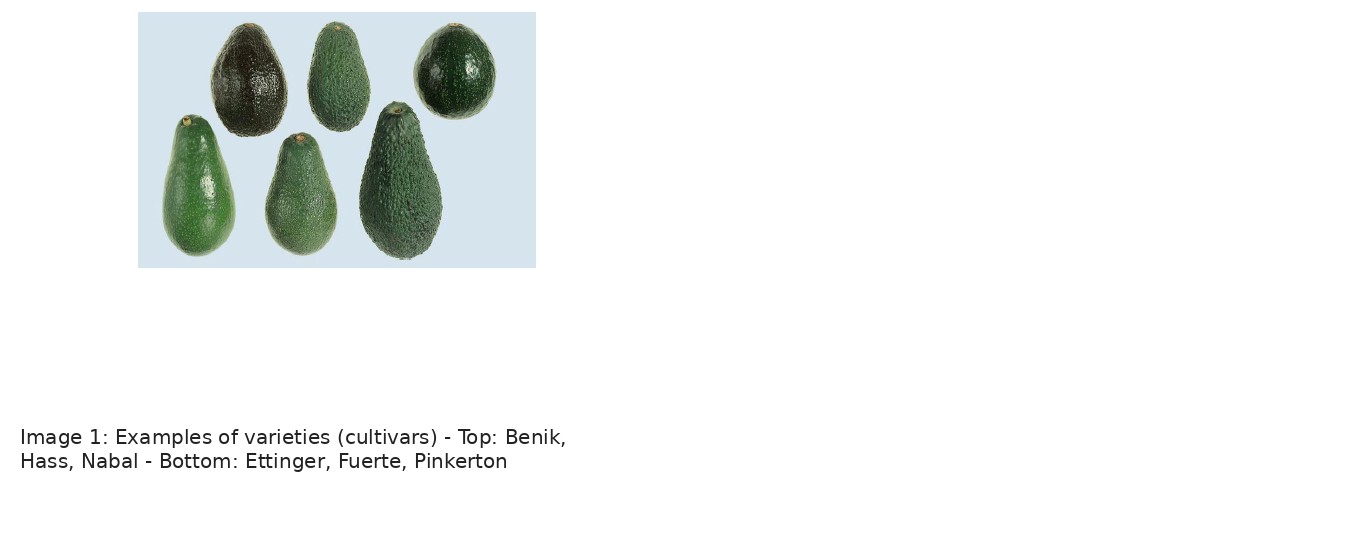
| Top varieties found in Lebanon? | Hass (Guatemalan) Fuerte (hybrid) Ettinger (hybrid) Pinkerton (hybrid) |
Product description / classification: Which product(s)?
Exporter quick checklist?
| Step | Exporter action | Evidence to keep | Responsible party |
|---|---|---|---|
| 1. Buyer specification | Confirm variety, class, size/count, carton weight, maturity target, residue limits, certifications and Incoterms. | Buyer specification, purchase order, email confirmation | Exporter / buyer |
| 2. Farm compliance | Use only approved pesticides, keep spray records and apply IPM. | Spray records, farm inputs log, GLOBALG.A.P. records where applicable | Grower / technical adviser |
| 3. Residue control | Test a representative sample before shipment and compare results with EU MRLs and buyer limits. | Lab report, sampling record, corrective actions | Exporter / lab |
| 4. Maturity check | Measure dry matter by variety and lot before harvest or packing. | Dry matter test sheet by lot | Grower / packhouse |
| 5. Packing and grading | Pack only uniform, clean, sound fruit that meets agreed class and sizing. | Packing list, grade records, photos, QC report | Packhouse |
| 6. Phytosanitary certificate | Apply for inspection and certificate through the Lebanese NPPO/competent plant health authority. | Phytosanitary certificate and inspection record | Exporter / authority |
| 7. Shipping documents | Ensure carton labels match invoice, packing list, certificate of origin, phytosanitary certificate and transport documents. | Complete document set | Exporter / freight forwarder |
| 8. Dutch entry preparation | Coordinate with the Dutch importer/forwarder for pre-notification and CHED-PP/TRACES or CLIENT Import procedures as applicable. | Importer confirmation, CHED-PP reference where applicable | Importer / forwarder |
What are the mandatory requirements?
When exporting Avocados to Netherlands, you have to comply with the requirements for food safety and product quality.Pesticides Residues
Avocados exported to the Netherlands must comply with EU Maximum Residue Levels (MRLs) under Regulation (EC) No 396/2005. The EU default MRL is 0.01 mg/kg when no specific MRL is set for a substance. Exporters should check the EU Pesticides Database for the specific active substances used in avocado production before every shipment.
Dutch supermarket channels often apply private residue limits that are stricter than EU law. In practice, suppliers should ask the buyer for the applicable residue protocol before harvest and should test well before loading.
- Before spraying: confirm whether the active substance is allowed for the target market and whether it has an avocado MRL.
- Before harvest: check pre-harvest intervals and update the spray record.
- Before shipment: obtain a residue laboratory report and compare results against both EU legal MRLs and buyer limits.
- Long-term: use Integrated Pest Management (IPM) to reduce chemical dependency and improve market acceptance.
Many retailers in the Netherlands, Germany, Austria, Scandinavia and the UK apply private pesticide-residue limits stricter than EU MRLs. CBI notes that some supermarkets, such as Lidl, may require residues as low as 33% of the legal limit. Exporters should confirm each buyer’s current residue policy and aim for the strictest standard to reduce the risk of rejection, delisting or claims.

Tips
- Use the EU Pesticide Database to find out the MRLs that are relevant for your products. You can select your product or a pesticide and the database shows the list of associated MRLs. Always check whether your buyers have additional requirements for MRLs and pesticide use.
- Apply integrated pest management (IPM) to reduce the amount of pesticide. IPM is an agricultural pest control strategy, which is also part of GLOBALG.A.P. Certification. It uses natural control practices such as the application of pests’ natural enemies. The fewer chemicals you use, the better your marketing position will be for export to Europe.
Contaminants - Avoiding contaminants
Avocados must comply with EU maximum levels for contaminants under Commission Regulation (EU) 2023/915. For avocados, the key heavy-metal limits to monitor are lead at 0.10 mg/kg and cadmium at 0.050 mg/kg. Exporters should keep laboratory evidence where risk is identified, especially in orchards near roads, industrial activities or contaminated water sources.
| Risk | EU control point | Exporter control | Evidence |
|---|---|---|---|
| Lead | Maximum level 0.10 mg/kg | Avoid contaminated water, dust and soil sources; test when risk exists. | Lab report / orchard risk assessment |
| Cadmium | Maximum level 0.050 mg/kg | Assess soil and irrigation water risks; avoid high-risk inputs. | Lab report / soil or water analysis |
| Foreign matter | Product must be clean and practically free of visible foreign matter. | Use clean crates, clean packing areas and good handling practices. | QC inspection record |
Tips
- Maintain good contact with your buyers, because they will often keep you up to date with changes in regulation, which affect the fresh fruit and vegetables business.
- Read more about contaminants on the website of the European Commission and find an overview of the maximum contaminant levels in the Annex of Regulation (EC) 1881/2006. Try to check this information on an annual basis.
- Find out more about the prevention and reduction of lead contamination in the Code of Practice published by the FAO Codex Alimentarius.
- Check the European Commission’s fact sheet on food contaminants managing food contaminants: how the EU ensures that our food is safe.
Microbiological criteria
For whole fresh avocados, microbiological safety is mainly controlled through good hygiene during harvesting, handling, packing, storage and transport.
If avocados are cut, peeled or sold as ready-to-eat products, they must comply with Regulation (EC) No 2073/2005 on microbiological criteria for foodstuffs, including relevant controls for Salmonella and E. coli. Non-compliant products may be refused entry, withdrawn from the market or subject to corrective action.
Lebanese exporters should follow the Codex Code of Hygienic Practice for Fresh Fruits and Vegetables as a practical hygiene guideline.
Tips
- Use clean water and clean harvest crates.
- Train workers on hygiene and handwashing.
- Keep fruit away from soil, pests and dirty surfaces.
- Clean packing equipment and storage areas.
- Do not pack damaged, rotten or contaminated fruit
Phytosanitary regulations
For Lebanese exports to the European Union, avocados must be accompanied by a phytosanitary certificate issued in Lebanon by the Export and Plant Quarantine Service This certificate confirms that the consignment has been officially inspected, is free from Union quarantine pests, meets the requirements for regulated non-quarantine pests, and complies with the EU plant health rules, including Regulation (EU) 2019/2072 consolidated version 23-7-2025).
Before shipping, Lebanese exporters should complete all phytosanitary procedures in Lebanon and make sure the avocados, packaging and documents are fully correct. On arrival in the Netherlands, the shipment may be checked again by Dutch authorities through document, identity and sometimes physical inspections.
In most cases, the Dutch importer or clearing agent will handle the arrival procedures, including pre-notification and import inspection requests through KCB import inspection procedures and, where required, TRACES / CHED-PP procedures. Lebanese exporters should coordinate closely with the Dutch buyer before dispatch and ensure that the phytosanitary certificate, invoice, packing list, carton labels and shipment details all match.
Tips
- Use the current EU plant health framework, not the old Directive: Regulation (EU) 2016/2031 and Implementing Regulation (EU) 2019/2072.
- Before shipping, verify in Annex XI and Annex XII whether your product needs a phytosanitary certificate for entry into the EU or for specific protected zones.
Organic niche requirements ?
Organic avocados are a niche opportunity, not a basic export requirement. Lebanese exporters should only market avocados as organic if the farm, packing and handling process are certified under EU organic rules — Regulation (EU) 2018/848 by an EU-recognised control body. For every organic shipment to the EU, an electronic Certificate of Inspection — e-COI must be issued in TRACES before the goods can be released in the EU. Without the e-COI, the shipment cannot be cleared as organic.
Tips
- Do not use “organic” on labels, invoices, packing lists or marketing material unless the lot is certified.
- Check which EU-recognised control body can certify organic avocado production and handling in Lebanon.
- Make sure the e-COI is prepared in TRACES before the shipment arrives in the EU.
- Ask the Dutch buyer whether private organic standards are required in addition to EU organic certification.
- Monitor phosphonic acid / Fosetyl-Al residues carefully, as these can create problems for organic avocado suppliers.
- Treat organic as a premium niche: it can open doors, but it also adds costs, inspections, paperwork and stricter residue controls.
Quality requirements
Information on quality, size, packaging and labelling requirements for avocados can be found in:The UNECE standards for avocados (also available in other languages than English).
The Codex Alimentarius Standard for avocados (‘Food code’ of WHO and FAO).
The OECD international standard for avocados.
General quality requirements (all classes)
- Intact: Avocados must not have any damage or injury affecting the integrity of the produce
Avocados exported to Europe must meet the minimum quality requirements in Table 1. For mainstream Dutch and European buyers, exporters should target Class I or better, as lower-quality fruit is usually not suitable for retail programmes.
Class I avocados must be good quality, uniform, and suitable for transport, ripening and sale. Only slight defects are allowed, and these must not affect the flesh, shelf life, ripening performance, package presentation or overall appearance.
Class I tolerance rules
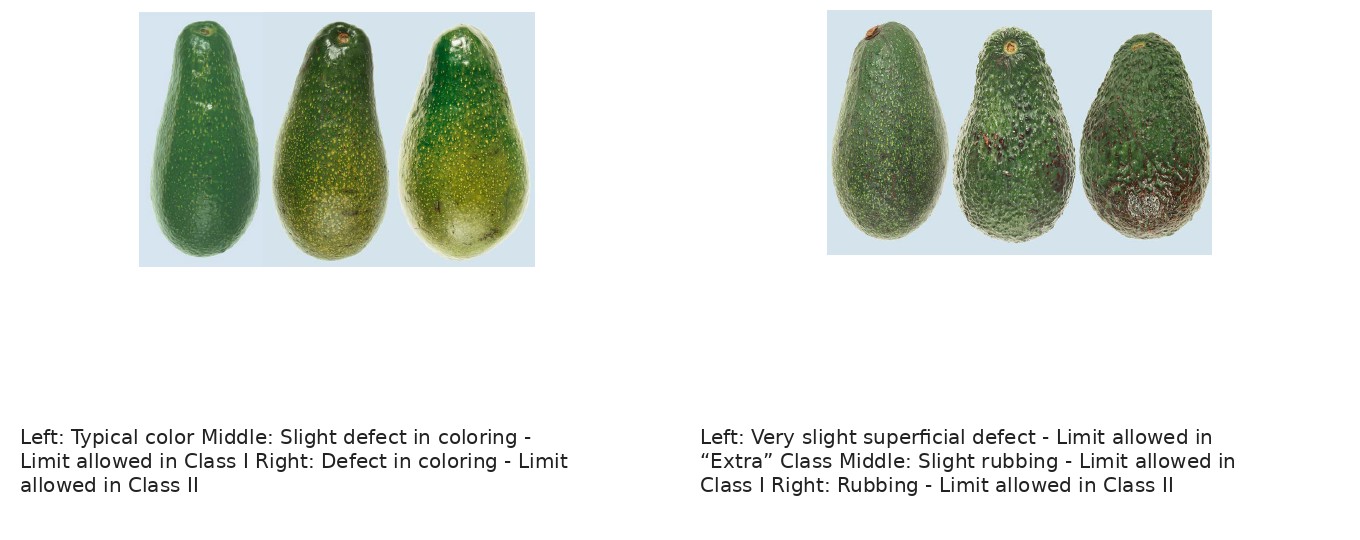
Slight defects in shape and colour may be accepted.
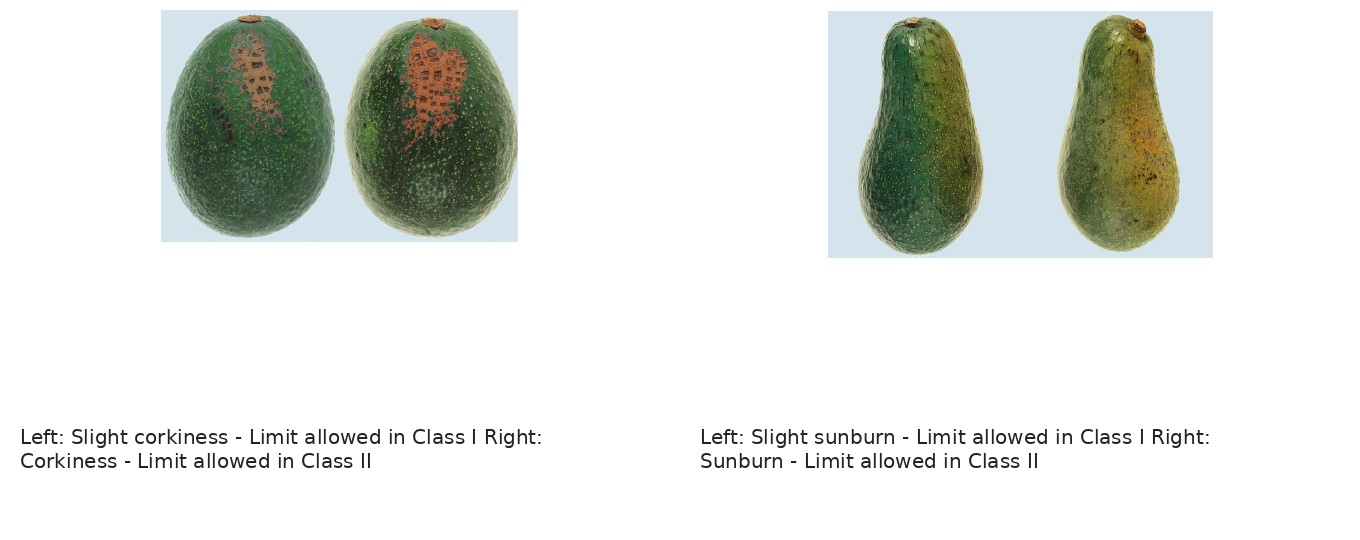
Slight skin defects, such as corkiness, healed lenticels or sunburn, may be accepted if they are not progressive and do not exceed 4 cm² in total.
Up to 10% of the fruit may meet only Class II requirements.
Up to 10% by number or weight may fall outside the agreed sizing requirements.
Table 1. Quality requirements and permissible tolerances for fresh avocados
| Category | Requirement |
|---|---|
| General quality requirements (all classes) | Avocados must be intact and free from damage or injury affecting the integrity of the fruit. |
| Avocados must be sound; fruit affected by rotting or deterioration making it unfit for consumption must be excluded. | |
| Avocados must be clean and practically free of visible foreign matter. | |
| Avocados must be free from pests. | |
| Avocados must be free from damage caused by pests. | |
| Avocados must be free from abnormal external moisture. | |
| If present, the stalk must not exceed 10 mm in length. | |
| Avocados must be able to withstand transport and handling and arrive at destination in satisfactory condition. | |
| Additional requirements for Class I avocados | Slight defects in shape are allowed. |
| Slight defects in colouring are allowed. | |
| Slight skin defects, such as corkiness, healed lenticels or sunburn, are permitted provided they are not progressive; the total affected area must not exceed 4 cm². | |
| The stalk, if present, may be slightly damaged. | |
| Permissible tolerances for Class I avocados | A tolerance of 10% is allowed for fruit meeting only Class II requirements. |
| A tolerance of 10% by number or weight is allowed for avocados that do not meet the sizing requirements. |
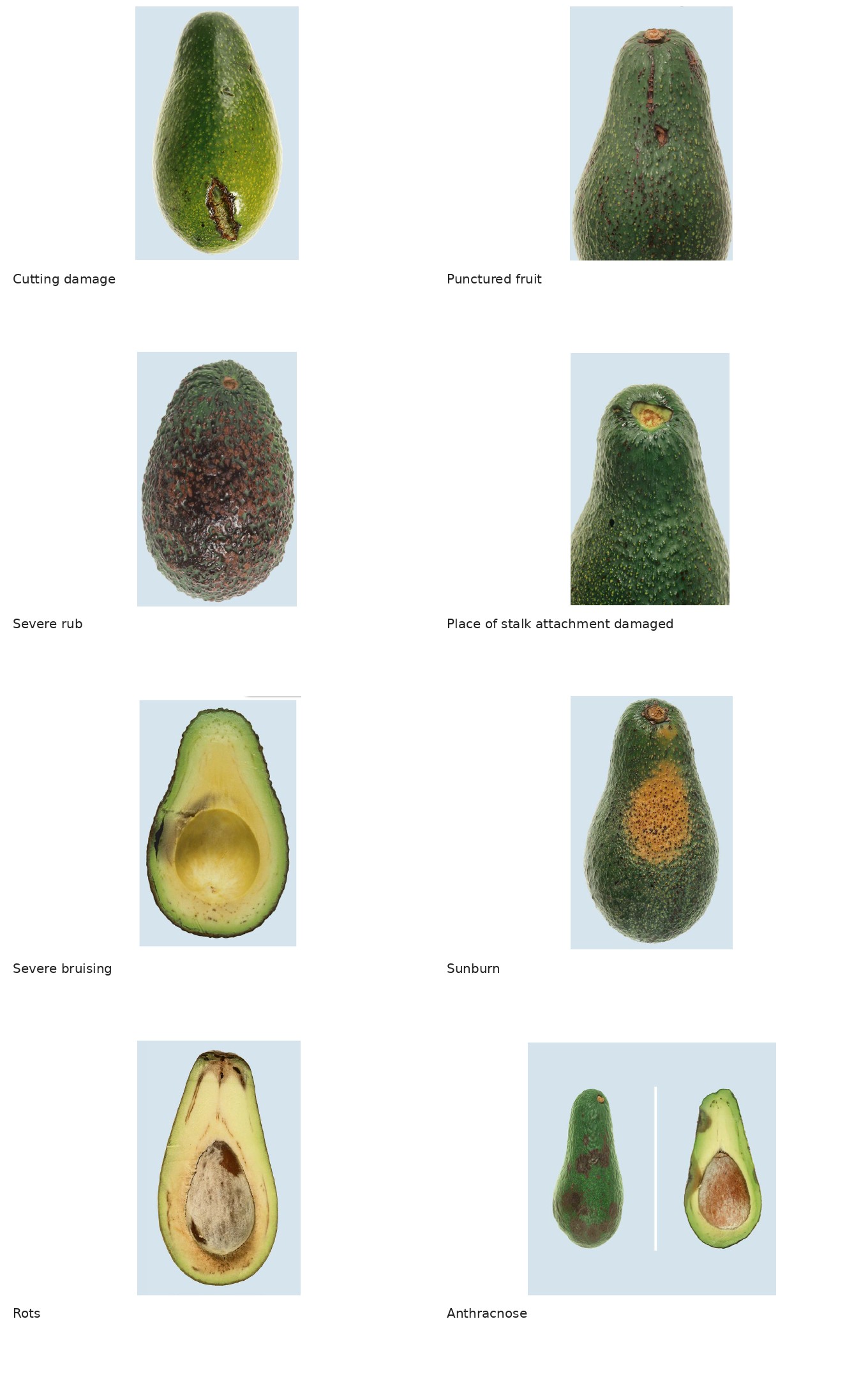
- Produce affected by rotting or deterioration such as to make it unfit for consumption is excluded such as:
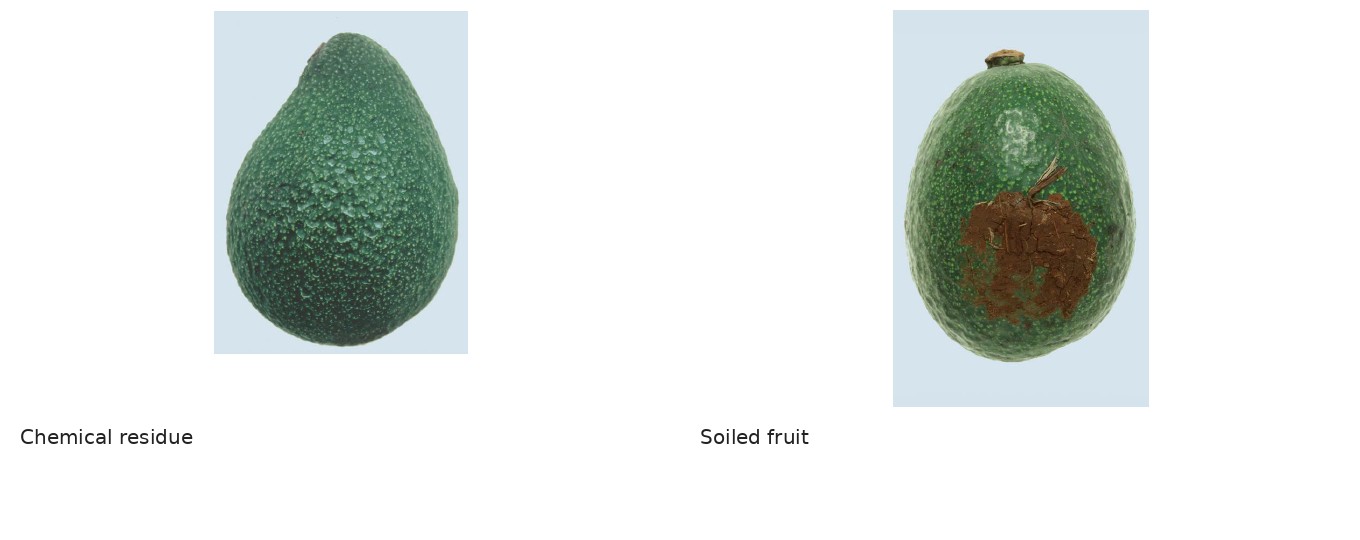
- Clean, practically free of any visible foreign matter: Avocados must be practically free of visible soil, dust, chemical residue or other visible foreign matter
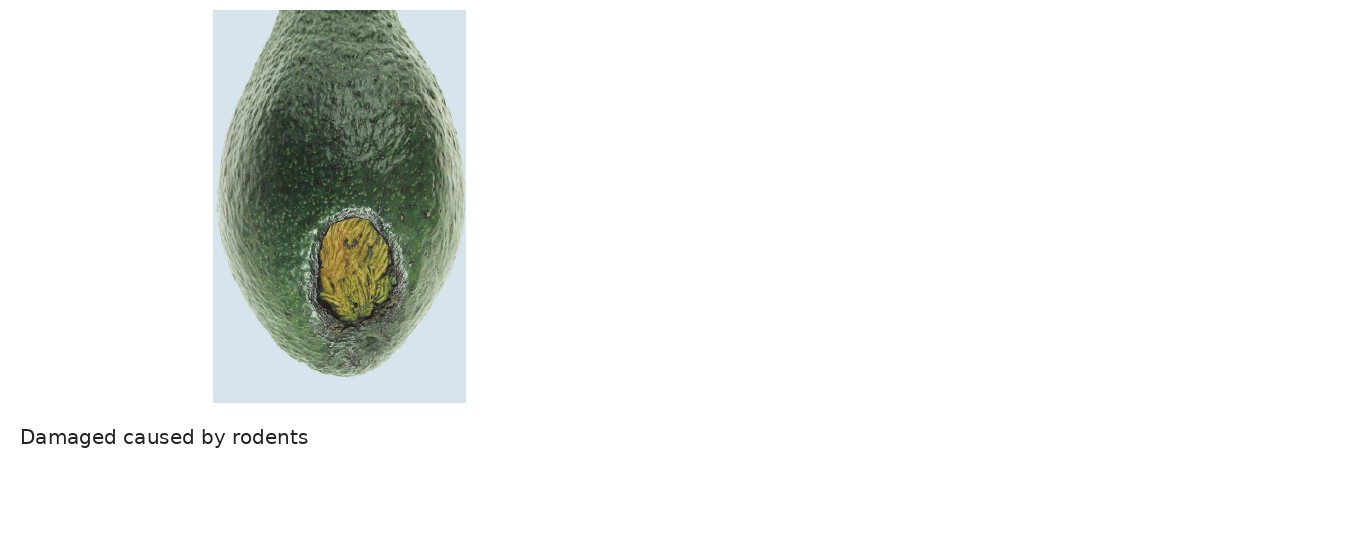
- Free from pests
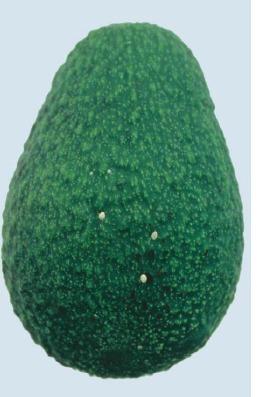
Scale Insects
- Free from damage caused by pests affecting the flesh
- Free from damage caused by low temperature
- Have a stalk no longer than 10 mm in length
- Free of abnormal external moisture
- Free of any foreign smell and/or taste
- The development and condition of the avocados must be such as to enable them to withstand transportation and handling and to arrive in satisfactory condition at the place of destination
General quality requirements (all classes)
General quality requirements (all classes)
General quality requirements (all classes)
General quality requirements (all classes)
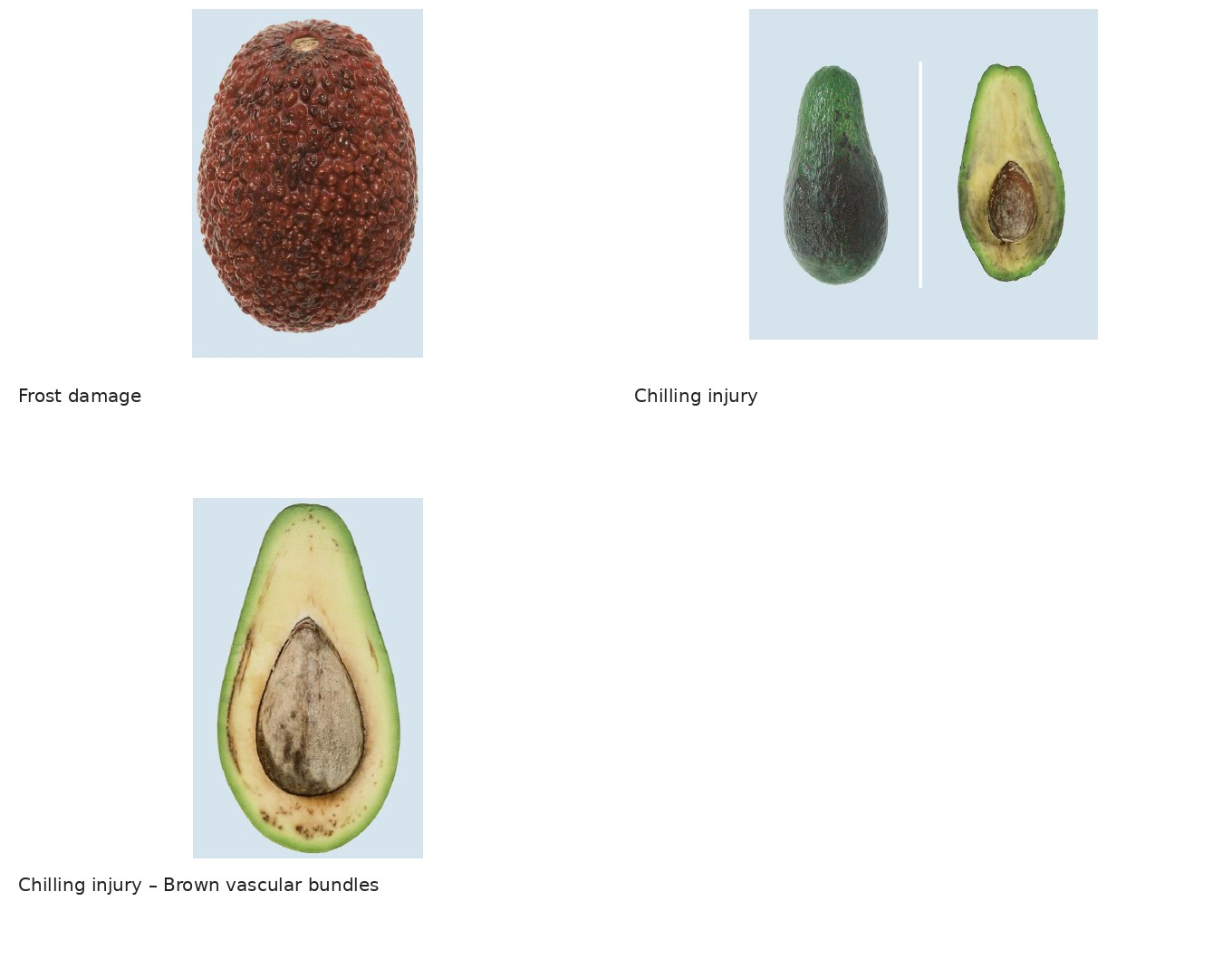
General quality requirements (all classes)
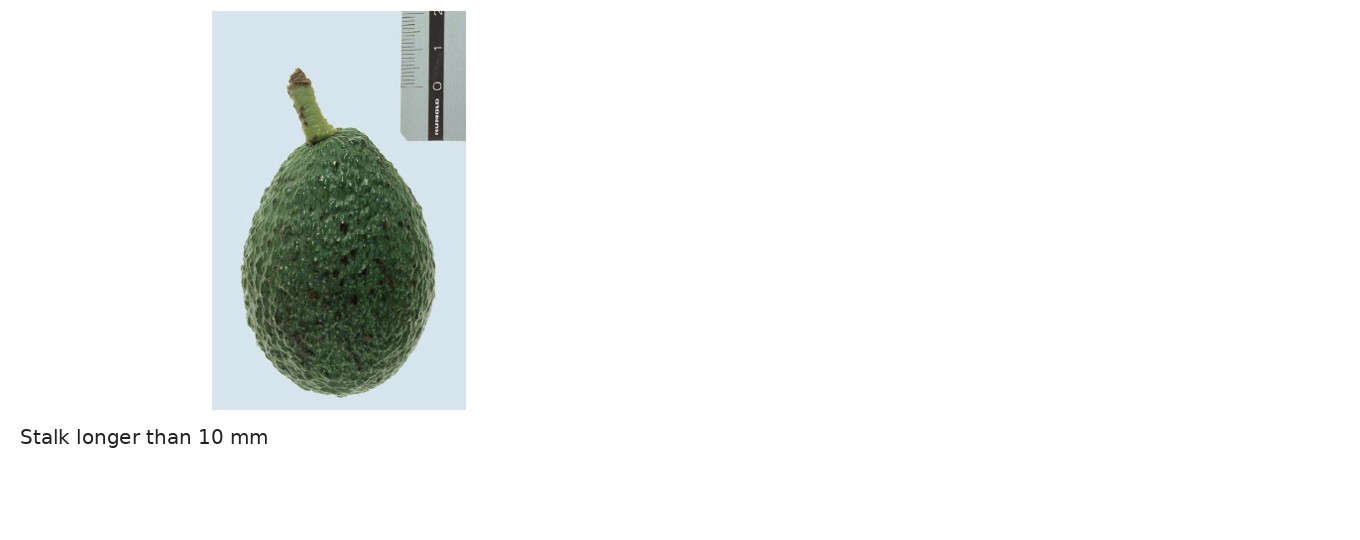
Scale insects
Classification
Avocados are classified in three classes, as defined below:
“Extra” Class
Avocados in this class must be of superior quality. They must be characteristic of the variety. They must be free from defects, with the exception of very slight superficial defects. These defects should not affect the general appearance of the produce, the quality, the keeping quality and presentation in the package. If present, the stalk must be intact.
Class I
Class I avocados must be of good quality and characteristic of the variety. The following slight defects may be accepted, provided they do not affect the flesh, appearance, keeping quality, ripening performance or package presentation:
slight defects in shape;
slight defects in colour;
slight skin defects, such as corkiness, healed lenticels or sunburn, provided they are not progressive and do not exceed 4 cm² in total;
slightly damaged stalk, if present.
In practice, Class I is the main target for Lebanese exporters supplying Dutch importers, ripeners and retail-oriented buyers.
Class II
This class includes avocados that do not qualify for inclusion in the higher classes but satisfy the minimum requirements specified above. Avocados in this class must be of reasonable quality and suitable for human consumption. The following defects may be allowed provided the avocados retain their essential characteristics as regards the quality, the keeping quality and presentation:
- defects in shape;
- defects in coloring;
- skin defects (corkiness, healed lenticels) and sunburn, provided they are not progressive; the maximum total area should not exceed 6 cm2.
In no case may the defects affect the fruit flesh. The stalk, if present, may be damaged.
Classification
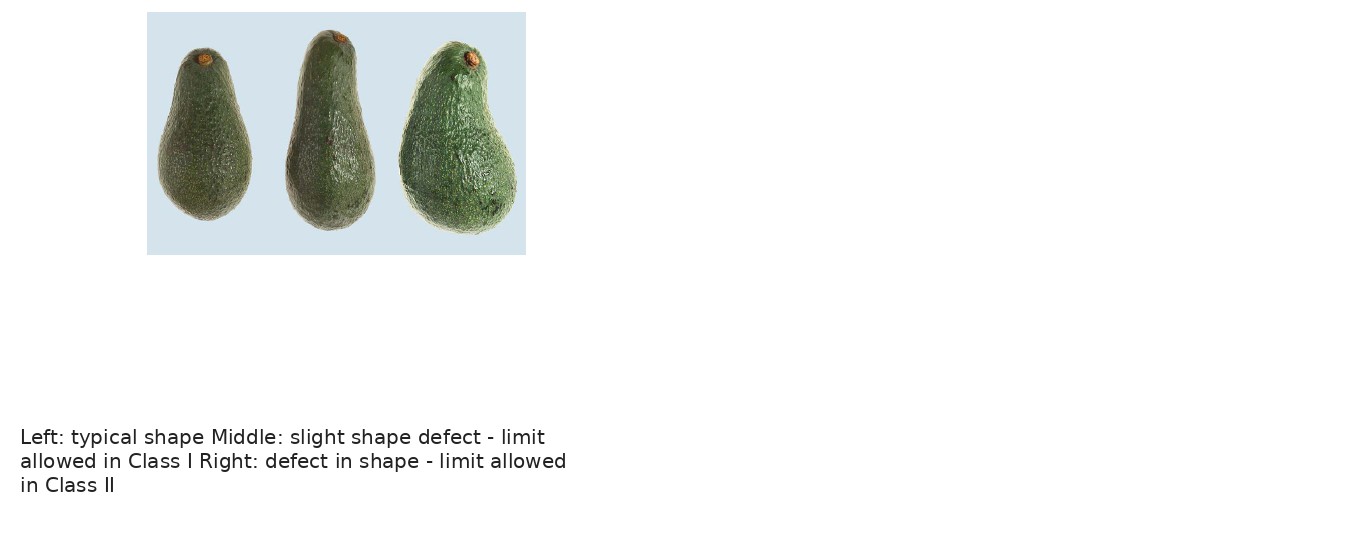
Classification
Classification
Tips
- Agree the required class with the Dutch buyer before harvest and packing.
- Target Class I or better for mainstream Dutch market channels.
- Remove fruit with rot, serious bruising, pest damage, chilling injury or visible contamination.
- Keep fruit uniform in size, maturity, colour and quality within each box.
- Take photos of representative packed fruit and share them with the buyer before shipment.
- Do not mix different quality classes in one package unless this is clearly agreed with the buyer.
- For mixed pallets, make sure each box and pallet is clearly identified by size, class, lot and variety.
- Use the OECD avocado standard and visual guides to train graders and packing staff on acceptable and non-acceptable defects.
- Check the OECD International Standardisation of Fruit and Vegetables – Avocados, which has images of the types of avocados and damages allowed.
Maturity
Maturity is one of the most important quality factors for avocado exports. Fruit must be harvested mature enough to ripen properly during transport and after arrival in the Netherlands. If avocados are harvested too early, they may not ripen well and can lead to buyer claims. If harvested too late, they may have a shorter shelf life and higher risk of quality problems.
For export to Europe, avocados should meet the minimum dry matter levels below, measured by drying to constant weight.
| Variety | Minimum dry matter | Commercial target for Dutch buyers | Exporter action |
|---|---|---|---|
| Hass | 21% | Around 23% is often safer for ripening and ready-to-eat programmes | Test each lot and avoid early harvest |
| Fuerte, Pinkerton, Reed, Edranol | 20% | Confirm target with the buyer | Test by variety, farm block and lot |
| Other varieties | 19%, except Antillean varieties, which may be lower | Confirm target with the buyer | Do not mix fruit with different maturity levels in one lot |
Uniformity is also essential. Avocados in the same lot should have similar maturity levels so they ripen evenly and perform well during transport, ripening and sale. Ripe avocados should also be free from bitterness.
Tips
- Verify with your buyer their preferences on checking maturity. Suppliers use different measuring methods and product standards may differ per country and per variety.
- Check the buyer’s maturity requirements before harvest. Different buyers may use different methods and target levels.
- Do not harvest too early. Low dry matter can lead to poor ripening and buyer claims.
- Aim for uniform maturity within each shipment. This helps ensure even ripening and better market performance.
- For Hass avocados, 23% dry matter is often a safer commercial target when supplying European ripeners.
- Keep clear maturity test records for each lot before shipment.
- For Hass avocados, aim for around 23% dry matter when supplying Dutch ripeners.
- Do not mix fruit with different maturity levels in the same shipment unless agreed with the buyer.
Labeling and Packaging
Size and Packaging
For Lebanese avocados exported to the Netherlands, packaging must protect the fruit during inland transport, sea or air shipment, handling, ripening and distribution. Boxes or crates should be new or clean, strong, well-ventilated and suitable for fresh produce. Packaging must not cause bruising, skin damage, pressure marks or moisture problems.
Dutch buyers pay close attention to uniformity, presentation and ripening performance. Each package should contain avocados of the same origin, variety, class, colour and size. The visible part of the package must represent the full contents. Poor sorting, mixed sizes or unattractive presentation can lead to complaints, claims or rejection.
For the Dutch market, Hass is the main commercial variety. The safest commercial sizes for Lebanese exporters are usually size 16–18, and sometimes size 20, commonly packed in 4 kg cardboard boxes. Fuerte and other green-skin varieties are more niche and should only be shipped after confirming buyer demand.
The difference between the smallest and largest fruit in the same package should not exceed 25 g. The minimum fruit weight is normally 123 g, except for Hass, where fruit from 80 g may be accepted under size code 32.
Common size and packaging preferences in the Netherlands
| Variety / segment | Preferred size codes | Common pack format |
|---|---|---|
| Hass for Dutch mainstream market | 16–18, sometimes 20 | 4 kg cardboard box |
| Fuerte / green-skin niche | 14–16 | 4 kg cardboard box, buyer-specific |
| Smaller sizes / repacking or price-sensitive segment | 26–30 | 10 kg plastic or cardboard crate, buyer-specific |
Size scale for avocados
| Size code | Weight range (g) | Size code | Weight range (g) |
|---|---|---|---|
| 4 | 781–1220 | 18 | 203–243 |
| 6 | 576–780 | 20 | 184–217 |
| 8 | 456–576 | 22 | 165–196 |
| 10 | 364–462 | 24 | 151–175 |
| 12 | 300–371 | 26 | 144–157 |
| 14 | 258–313 | 28 | 134–147 |
| 16 | 227–274 | 30 | 123–137 |
| 32 | 80–123, only Hass | S | Less than 123 |
Size and Packaging
Tips
- Agree the pack format, box weight and preferred size range with the Dutch buyer before shipment.
- For the Netherlands, Hass sizes 16–18 are usually the safest commercial option.
- Use strong, clean cartons or crates to reduce bruising and transport damage.
- Keep fruit uniform in size and presentation within each box.
- Make sure packaging is clean and well presented, as this affects buyer perception and quality claims.
- Confirm whether the buyer wants 4 kg boxes or 10 kg crates for ripening and repacking.
- If the product is packed for retail, check Regulation (EU) No 1169/2011
- Do not mix sizes or varieties in one box unless the buyer has clearly approved it.
- Keep packaging free from soil, leaves, sand, dust and foreign matter.
- Make sure labels, stamps or stickers do not damage the fruit or leave visible marks.
- Confirm whether the buyer requires 4 kg boxes or 10 kg crates for ripening, repacking or wholesale.
- For retail packs, check the buyer’s labelling instructions and EU food labelling requirements before printing packaging.
Marking and labelling
For avocados exported from Lebanon to the Netherlands, each trade package must be marked clearly, legibly and durably on one side. The information on the carton must be visible from the outside and must match the invoice, packing list, phytosanitary certificate and traceability records.
Packaging must protect the fruit during local transport, shipment, handling, ripening and distribution. Cartons or crates should be clean, strong, suitable for fresh produce and free from foreign matter such as soil, leaves, sand or dust. If cartons are reused, all old labels, barcodes and markings must be removed to avoid confusion during inspection, customs clearance or delivery.
The main commercial reference for avocado marking is the UNECE standard for avocados. Traceability is also compulsory under the EU General Food Law, so Lebanese exporters must be able to identify where each lot came from and where it was shipped.
Export carton marking
Each export carton should normally include the following information:
| Item | What to include |
|---|---|
| Packer / exporter | Name and address of the packer and/or dispatcher-exporter |
| Product name | “Avocados”, if the contents are not visible from outside |
| Variety | Hass, Fuerte, Pinkerton, etc. |
| Origin | Produce of Lebanon |
| Class | Class I, Extra Class or other agreed class |
| Size / count | Size code, count, or minimum and maximum weight |
| Lot / batch code | Unique code linked to farm, harvest, packing and test records |
| Net weight | For example, 4 kg net or buyer-specific pack weight |
| Additional information | Organic certification, post-harvest treatment or buyer-specific information, where applicable |
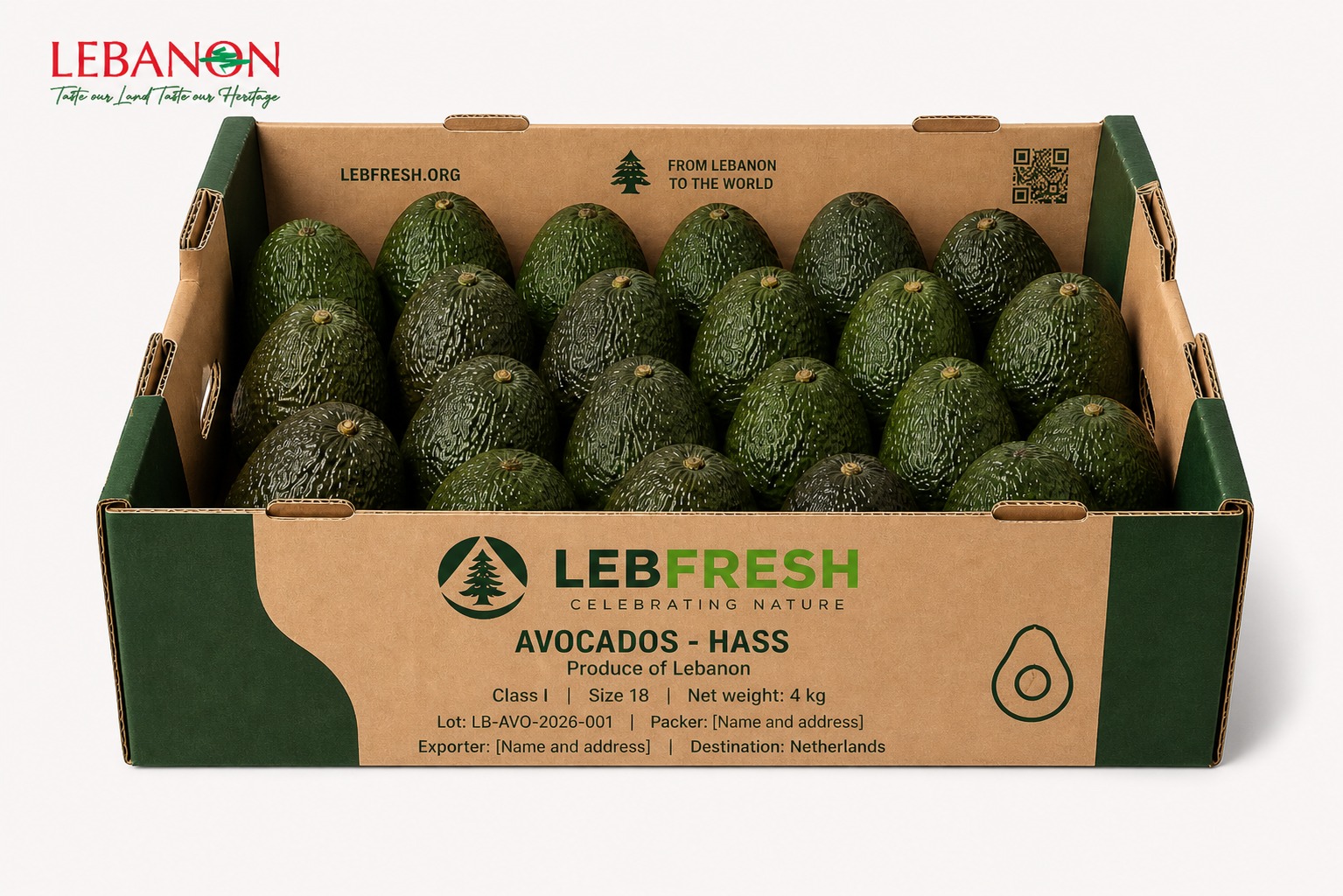
Sample export carton label
| AVOCADOS - HASS Produce of Lebanon Class I | Size 18 | Net weight: 4 kg Lot: LB-AVO-2026-001 | Packer: [Name and address] Exporter: [Name and address] | Destination: Netherlands |
Retail pack labels
If avocados are packed for retail sale in the Netherlands, the consumer-facing label must comply with Regulation (EU) No 1169/2011 on food information to consumers. Mandatory consumer information should be provided in Dutch, unless otherwise agreed with the buyer and permitted under applicable rules.
Lebanese exporters should confirm the final retail label with the Dutch buyer before printing, including the language, responsible food business operator, origin statement, net quantity, lot code, barcode and any certification claims.
Tips
- Agree the carton label and retail label layout with the Dutch buyer before printing.
- Use “Produce of Lebanon” clearly and consistently on all export cartons.
- Add a lot or batch code on every carton to support traceability.
- Make sure carton labels match the invoice, packing list, phytosanitary certificate and test records.
- Remove old labels and barcodes from reused cartons.
- Do not add organic, certification or treatment claims unless they are valid and documented.
- For retail packs, confirm which information must appear in Dutch and which company will be named as the responsible operator.
- Keep labels simple, accurate and buyer-specific to avoid relabelling costs, inspection delays or buyer complaints.
Handling
Good handling is essential for Lebanese avocados exported to Europe. Many quality problems are not visible at shipment, but appear later when the fruit arrives in the Netherlands or is ripened by the buyer. For this reason, exporters should control every step from harvest to loading.
After harvest, avocados should be kept in the shade, handled gently, packed quickly and cooled as soon as possible. In Lebanon, high temperatures, road conditions, loading delays and breaks in temperature control can quickly reduce shelf life. A strong cold chain and careful handling are therefore critical to avoid buyer claims.
Where exporters do not have their own facilities, they should work with reliable post-harvest service providers that can support grading, packing, cooling, cold storage, repacking and export handling.
Key handling control points:
| Control point | Good practice | Exporter evidence |
|---|---|---|
| Harvest | Harvest only at approved maturity. Avoid fruit drops, pulling damage and rough handling. | Harvest lot record and dry matter test |
| Field transport | Use clean field crates and keep fruit shaded while waiting for transport. | Field quality checklist |
| Packhouse | Grade gently, remove damaged fruit and avoid excessive pressure during sorting and packing. | QC report and pack-out data |
| Cooling | Cool fruit as soon as possible after harvest and keep the cold chain stable. | Temperature record |
| Loading | Avoid loading delays and check truck/container condition before loading. | Loading report and photos |
| Shipment | Agree shipment temperature and logistics arrangements with the buyer/importer. | Temperature logger data and Bill of Lading/AWB |
Tips
- Cool the fruit as soon as possible after harvest.
- Keep harvested fruit shaded before transport to the packhouse.
- Avoid rough handling during harvesting, grading, packing and loading.
- Use clean crates and packaging that protect the fruit from bruising and pressure damage.
- Keep the cold chain stable from packhouse to shipment.
- Avoid unnecessary delays between harvest, packing, cooling and loading.
- Use temperature loggers for export shipments where possible.
- Take loading photos and keep temperature records in case of buyer claims.
- Work with reliable post-harvest service providers if your own facilities are limited.
- Remember that quality problems often appear only after arrival, so prevention at origin is essential.
What additional requirements do buyers often have?
Variety
Buyer requirements are not always legal obligations, but they are often essential for market access. Dutch importers, ripeners and supermarket programmes may require stricter pesticide-residue limits, certification, social compliance, sustainability information, specific packaging formats and reliable ripening performance.
Certification
Avocados are commonly sold through European retail programmes. For this reason, Dutch buyers often ask for certifications that prove good agricultural practices, food safety, traceability and responsible production.
These certifications are not always legal requirements, but they are often necessary for commercial access to Dutch importers, ripeners and supermarket supply chains. Lebanese exporters should confirm the exact certification package with each buyer before the season starts.
At farm level, GLOBALG.A.P. is usually the most important certification for exporters targeting mainstream European buyers. At packhouse level, buyers may request BRCGS, IFS or another HACCP-based food safety system recognised by the Global Food Safety Initiative. Buyers may also ask for social or environmental standards, especially for retail programmes.
Common certification and buyer-standard requirements:
| Requirement | Typical status | Where applied | Exporter guidance |
|---|---|---|---|
| GLOBALG.A.P. | Commonly expected | Farm production | Prioritise this certification if targeting Dutch importers and retail programmes. |
| GRASP or social add-on | Often requested | Farm or producer group | Useful where buyers ask about labour practices and worker welfare. |
| BRCGS, IFS or HACCP-based system | Common for retail supply chains | Packhouse | Work with certified packhouses where possible, especially for supermarket-oriented buyers. |
| SMETA / social audit | Buyer-dependent | Farm or packhouse | Prepare for this if supplying demanding buyers or retail-linked programmes. |
| SPRING or water-use add-on | Increasingly relevant | Farm production | Useful for addressing avocado water-use concerns and showing responsible irrigation practices. |
| Organic certification | Niche only | Farm, packhouse and full supply chain | Pursue only with a confirmed organic buyer or clear organic market plan. |
Sustainability and social compliance
European buyers increasingly want proof that avocados are produced responsibly. For Lebanese exporters, this means buyers may ask questions about water use, pesticide management, worker conditions, packaging, traceability and carbon footprint.
This trend is reinforced by the European Green Deal and the Farm to Fork Strategy, which are pushing the food sector towards more sustainable production, lower environmental impact, responsible sourcing, reduced waste and more recyclable packaging. For avocado exporters, this means Dutch buyers are likely to ask more questions over time about environmental and social practices.
Some buyers may request standards or audits such as SMETA, GRASP, SPRING or Rainforest Alliance, especially for supermarket programmes. Not every exporter needs all these standards at the start, but exporters should be ready to show records and explain how they manage environmental and social risks.
Tips
- Keep records of irrigation methods, water sources and water-saving practices.
- Use IPM to reduce pesticide use and keep residue test results.
- Maintain traceability from farm or plot to export lot.
- Keep records on worker training, health and safety, and working conditions.
- Be ready to explain packaging choices, recyclability and efforts to reduce waste.
- Prepare a simple sustainability statement for Dutch buyers showing current practices and planned improvements.
- Ask each buyer early which environmental, social and retail-specific requirements apply to their programme.
- Consider additional tools or standards such as SMETA, GRASP or SPRING if you want to work with more demanding buyers.
- For supermarket channels, prioritise GLOBALG.A.P. at farm level and work with a certified packhouse where possible.
Required documents and records
| Document / record | Purpose | Who prepares it | When to verify |
|---|---|---|---|
| Commercial invoice | Customs and payment documentation | Exporter | Before dispatch |
| Packing list | Package count, weight, lot and pallet details | Exporter / packhouse | Before loading |
| Certificate of origin | Origin declaration / preferential treatment if applicable | Competent authority / chamber depending on procedure | Before dispatch |
| Phytosanitary certificate | EU plant-health entry requirement | Lebanese plant health authority / NPPO | Before shipment |
| Residue lab report | Evidence of compliance with EU and buyer MRLs | Accredited laboratory / exporter | Before loading |
| Dry matter / maturity record | Evidence of harvest maturity and ripening suitability | Grower / packhouse | Before harvest or packing |
| Traceability records | Farm-to-buyer lot identification | Grower / packhouse / exporter | Always |
| GLOBALG.A.P. / packhouse certificates | Buyer certification requirement | Grower / packhouse | Before sales offer |
| Transport documents | Bill of Lading, Air Waybill, CMR or other logistics document | Freight forwarder / carrier | At dispatch |
| Organic e-COI | Only for organic shipments | Exporter / importer / control body through TRACES | Before customs clearance |
Top rejection risks before shipment
| Risk | Why it matters | Prevention | Priority |
|---|---|---|---|
| Pesticide residues exceed EU or buyer limits | Can lead to rejection, RASFF notification, buyer claims or loss of trust. Dutch buyers may apply limits stricter than EU MRLs. | Keep spray records, use IPM, respect pre-harvest intervals, test before shipment and confirm buyer limits. | Very high |
| Use or presence of prohibited active substances | Avocado RASFF summaries have included chlorpyrifos in avocados from other origins, showing that prohibited substances remain a key EU control risk. (Agrolab) | Check every active substance against EU rules before use; include high-risk substances in multi-residue testing. | Very high |
| Cadmium or lead above EU limits | CBI highlights contaminant limits for avocados: lead below 0.10 mg/kg and cadmium below 0.050 mg/kg. Cadmium has also appeared in recent RASFF reporting for avocados from Peru. (CBI) | Test soil/water where risk exists; include heavy-metal testing when requested by buyers or for new farms. | High |
| Missing or incorrect phytosanitary certificate | Avocados must pass EU plant-health requirements and be accompanied by a phytosanitary certificate. Incorrect documents can delay or block entry. (CBI) | Apply early, check product name, origin, quantity, exporter/importer details and coordinate with the Dutch importer. | Very high |
| Pests or pest damage | Plant-health inspections may detect quarantine or regulated pests; buyers may also reject fruit with visible pest damage. | Field monitoring, clean harvest crates, packhouse sorting and readiness for official inspection. | High |
| Immature fruit / low dry matter | Poor ripening, bitterness and buyer claims. CBI states minimum dry matter is 21% for Hass, while 23% is often preferred by European ripeners. (CBI) | Test dry matter by farm, variety and lot; avoid early harvest; keep maturity records. | High |
| Broken cold chain | Can cause short shelf life, internal defects and ripening failures. CBI warns that poor roads, high temperatures and weak cold-chain control can create losses for exporters. (CBI) | Pre-cool quickly, use temperature loggers, reduce loading delays and agree shipment temperature with the buyer. | High |
| Inconsistent sizing, maturity or quality | Dutch buyers expect uniform cartons, especially for ripening programmes and retail supply. | Strict grading, pallet uniformity, pre-shipment photos and lot-based QC records. | Medium-high |
| Wrong or incomplete labels | Label errors create inspection, traceability and buyer problems. | Use buyer-approved label template and match labels with invoice, packing list, lab report and phytosanitary certificate. | Medium-high |
| Missing certification | Retail programmes often require GLOBALG.A.P. at farm level and BRCGS/IFS or similar systems at packhouse level. (CBI) | Confirm certification requirements before contracting and keep certificates valid before shipment. | Medium-high |
| Dirty packaging or foreign matter | Poor presentation and possible rejection during inspection or buyer intake. | Use clean cartons/crates, clean packhouse procedures and final QC before loading. | Medium |
| Unclear traceability | Difficult recalls and buyer non-compliance if a problem occurs. | Use lot codes linking farm, harvest date, dry matter test, residue report, packing date and shipment documents. | High |