
The Export of Avocados to Saudi Arabia Legal Requirements & Standards
- Product description and classification
- The Saudi Bodies
- Food Import Procedure
- Quality Requirements
- Packaging Requirements
- Food Labeling
Product description and classification
| Harmonized System (HS) code | 08044000 Avocados, fresh or dried |
| Top varieties found in Lebanon | Hass (Guatemalan) Fuerte (hybrid) Ettinger (hybrid) Pinkerton (hybrid) |
The Saudi Bodies
The Kingdom of Saudi Arabia (KSA) is a member of the Gulf Cooperation Council (GCC), which also includes Bahrain, Kuwait, Oman, Qatar, and the United Arab Emirates (KSA). Within this framework, food safety and import requirements are largely harmonized under the Gulf Standardization Organization (GSO), which issues unified technical regulations for food imports across GCC member states.GSO standards form the primary reference framework for regulating imported food products, including fresh fruits and vegetables such as avocadoes
International Standards and Regulatory References
KSA and GCC food regulations are developed with reference to internationally recognized food safety frameworks:
- Codex Alimentarius Commission (FAO/WHO)
- International Organization for Standardization (ISO)
- European Food Safety Authority (EFSA)
- U.S. Food and Drug Administration (FDA)
- Official GCC technical regulations found at the Online Standards Store.
Saudi Regulatory Bodies
The primary regulatory bodies overseeing this pipeline are the Saudi Food and Drug Authority (SFDA), the Ministry of Environment, Water and Agriculture (MEWA), and Faseh Food System portal.
The Saudi Food and Drug Authority (SFDA)
The Saudi Food and Drug Authority (SFDA) is the primary independent regulatory and supervisory body in Saudi Arabia, responsible for protecting public health by ensuring the safety, quality, and efficacy of food, drugs, medical devices, and cosmetics. All foreign exporting establishments (farms/packhouses in Lebanon) and their products must be logged into active digital accounts on the SFDA Platform
The Ministry of Environment, Water and Agriculture (MEWA)
The Saudi importers must submit an electronic application through the Ministry of Environment, Water and Agriculture’s portal to receive an import permit. Licensing is divided into Class A (10-year validity) and Class B (3-year validity) depending on cold-storage ownership.
Faseh Food System Portal:
A customs declaration must be submitted via the Faseh Services System at least 48 hours prior to the shipment's arrival at the Saudi port.
Import Control System Overview
Import Control System Overview
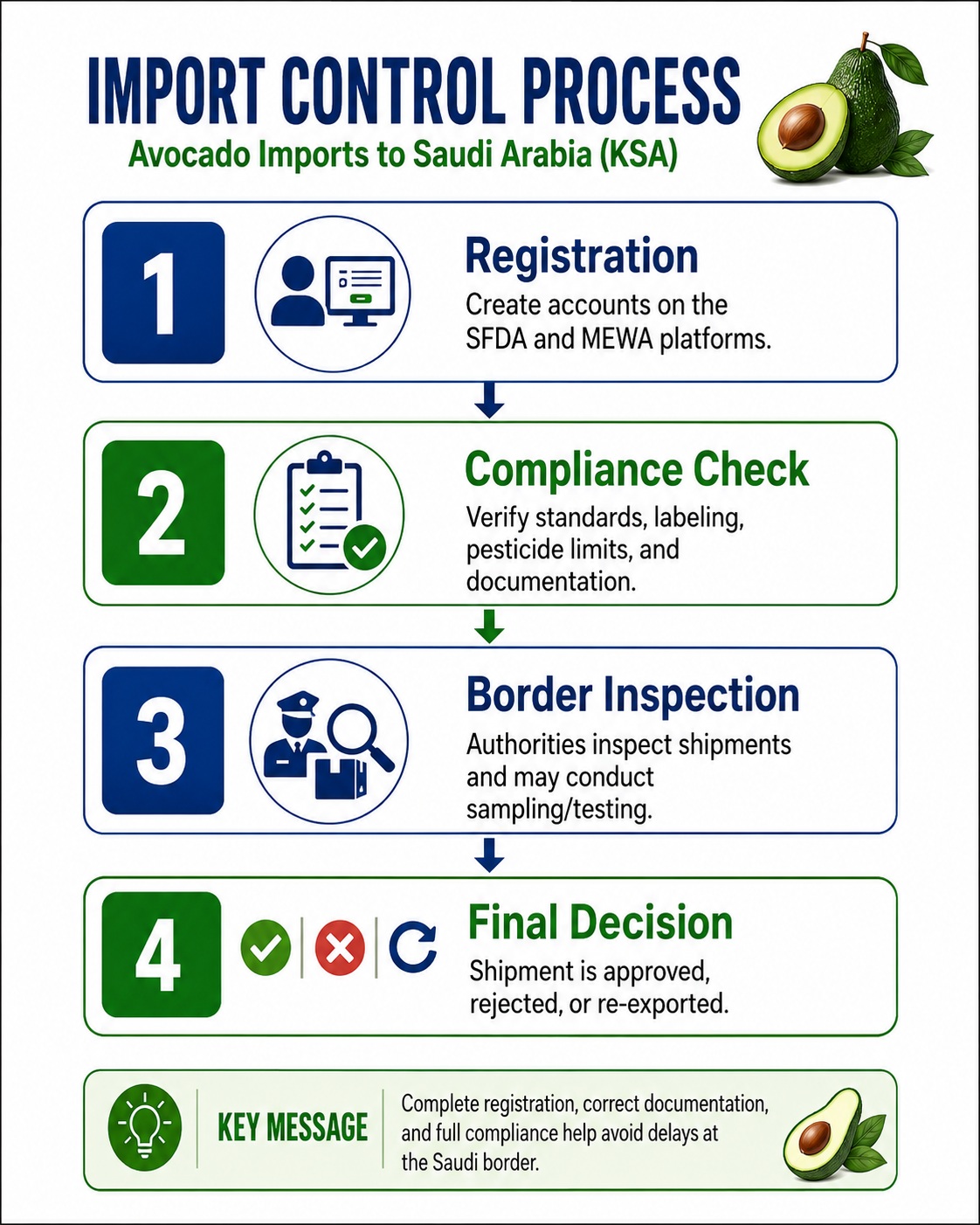
Food Import Procedure
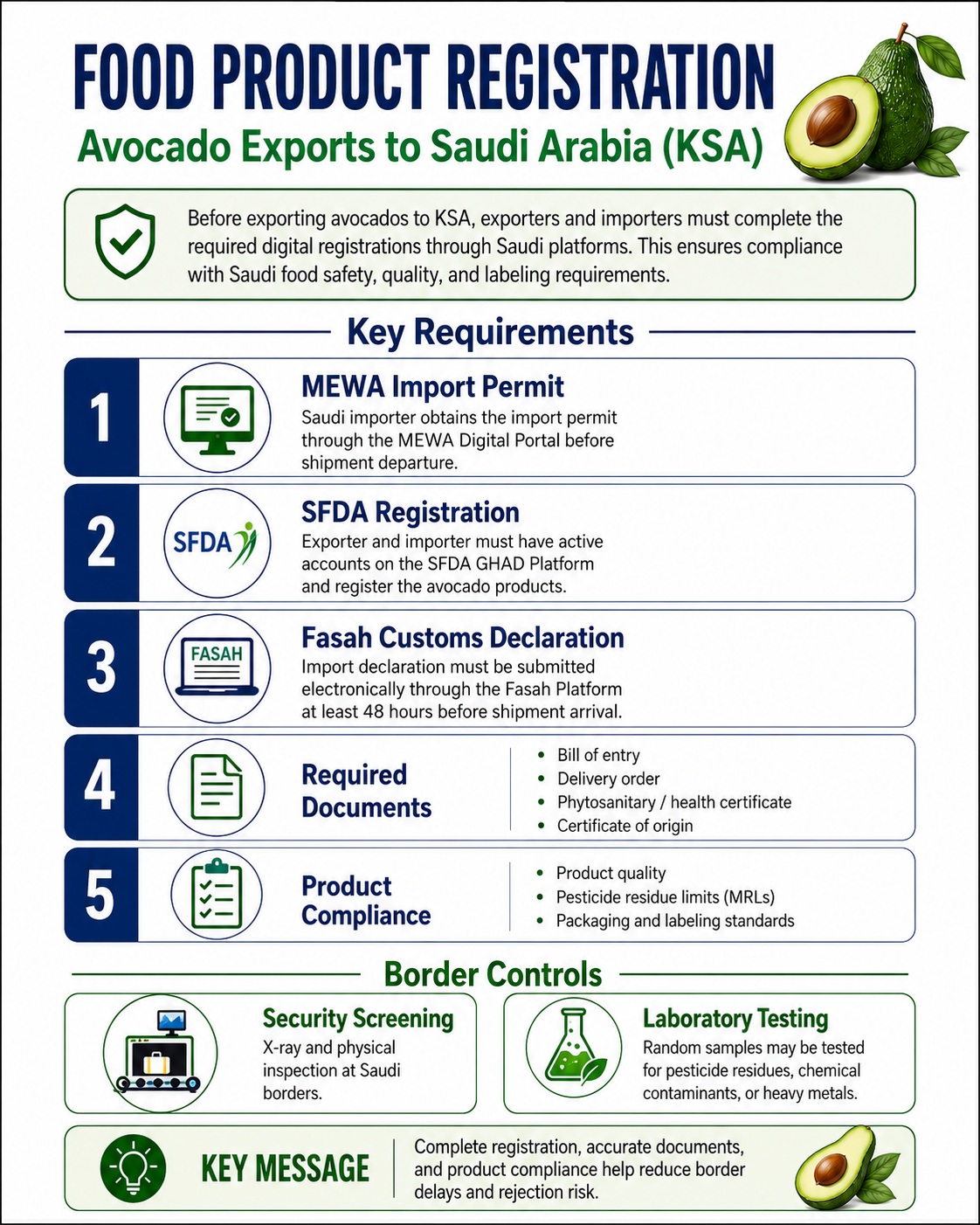
Food Product Registration
Before exporting avocados to Saudi Arabia (KSA), exporters and importers must complete the required digital registrations through Saudi platforms. This ensures that products meet Saudi food safety, quality, and labeling requirements.
Key Requirements for Users
- MEWA Import Permit:
The Saudi importer must obtain an import permit through the MEWA Digital Portal before shipment departure. - SFDA Registration:
Exporters and importers must have active accounts on the SFDA GHAD Platform and register the avocado products. - Fasah Customs Declaration:
The import declaration must be submitted electronically through the Faseh Services System Platform at least 48 hours before shipment arrival. - Required Documents:
Each shipment must include the required documentation:
- Bill of entry
- Delivery order
- Phytosanitary/health certificate
- Certificate of origin
- Product Compliance
Avocados must meet KSA requirements for:- Product quality
- Pesticide residue limits (MRLs)
- Packaging and labeling standards
Border Controls
Avocado shipments may be subject to:
- Security Screening: X-ray and physical inspection at Saudi borders.
- Laboratory Testing: Random samples may be tested for pesticide residues, chemical contaminants, or heavy metals.
Border Controls
Food Import Documentation
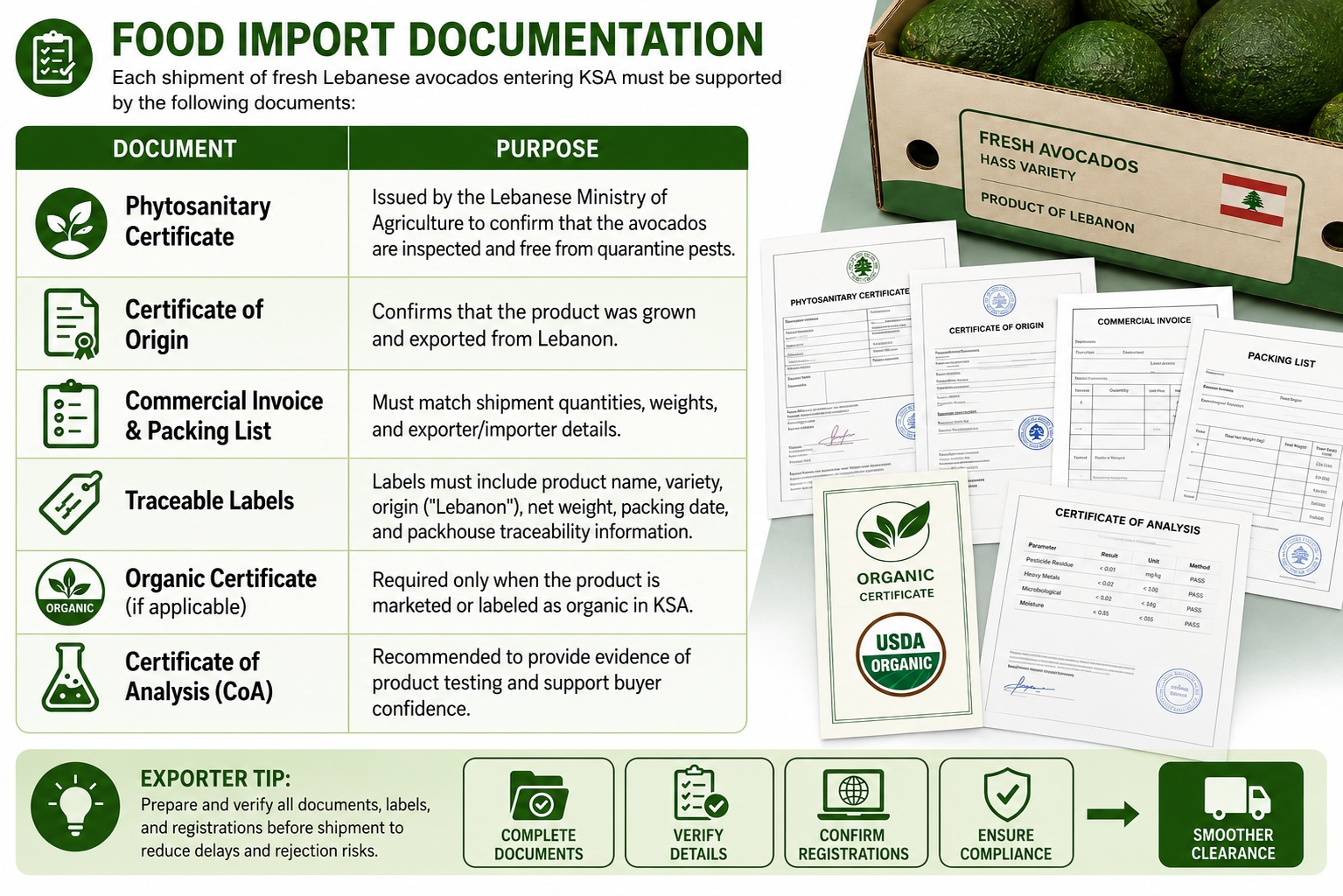
Each shipment of fresh Lebanese avocados entering KSA must be supported by the following documents:
| Document | Purpose |
|---|---|
| Phytosanitary Certificate | Issued by the Lebanese Ministry of Agriculture to confirm that the avocados are inspected and free from quarantine pests |
| Certificate of Origin | Confirms that the product was grown and exported from Lebanon |
| Commercial Invoice & Packing List | Must match shipment quantities, weights, and exporter/importer details |
| Traceable Labels | Labels must include product name, variety, origin ("Lebanon"), net weight, packing date, and packhouse traceability information |
| Organic Certificate (if applicable) | Required only when the product is marketed or labeled as organic in KSA |
| Certificate of Analysis (CoA) | Recommended to provide evidence of product testing and support buyer confidence |
Food Import Documentation

Tips
- Prepare and verify all documents, labels, and registrations before shipment to reduce delays and rejection risks.
Quality Requirements
Lebanese avocado exporters must comply with GCC quality standards. These standards define avocado quality, classification, sizing, pesticide limits, packaging safety, and hygiene requirements;GSO 123:1990 – General Requirements for Fresh Fruits and Vegetables
GSO 2131:2015 – Requirements for Commercial Varieties of Fresh Avocados
General Quality Requirements
Avocados exported to KSA must be:
Healthy and clean
- Whole, fresh, and free from pests, diseases, damage, foreign smell, or taste
- Free from rotting, deterioration, and chilling injury
Properly harvested and matured
- Stalk must be cleanly cut and not exceed 10 mm
- Fruit must be fully developed and mature
- For Hass avocados, minimum 24% dry matter is recommended to ensure proper ripening after transport
Uniformly packed
- Fruits must be sorted by size and packed consistently by weight or count
Avocado Classification
Under GSO 2131:2015, avocados are classified into three quality classes:
| Class | Requirements |
|---|---|
| Extra Class | Highest quality. Uniform fruit with almost no visible defects |
| Class I | Good quality. Minor shape, color, or skin defects are allowed |
| Class II | Acceptable market quality. Some defects are allowed, but flesh must remain sound |
Exporter Rule:
All cartons within the same shipment must have the same quality class and consistent quality.
Size and Weight Requirements
Avocados must be sorted according to standardized sizes.
Key requirements:
Fruit sizes range from:
Size 10: Large fruit (>375 g/fruit)
Size 30: Small fruit (125–145 g/fruit)
Fruit weight variation within the same carton must be limited:
Maximum difference: 25 g for smaller sizes
Maximum difference: 50 g for larger sizes
Cartons must have consistent fruit size to avoid buyer rejection.
Pesticide Residues and Contaminants
Avocados exported to KSA must comply with pesticide residue limits (MRLs) according to:
- GSO 382/2020 – Maximum Levels of Pesticides Residues in Agricultural and Food Products
- GSO 2532/2016 – Maximum limits for pesticide residues in organic food
- Codex Alimentarius MRL standards (when applicable)
Important Rules
Any banned pesticide detection may lead to shipment rejection.
If a pesticide is not listed in approved standards, a default limit of 0.01 mg/kg applies.
Non-compliance may result in:
Shipment rejection
Destruction of products
Re-export at exporter’s cost
Indicative MRL Examples (Avocados)
| Active Ingredient | Use | Maximum Limit |
|---|---|---|
| Thiabendazole | Fungicide | 15 mg/kg |
| Bromide Ion | Fumigation residue | 75 mg/kg |
| Azoxystrobin | Fungicide | 3 mg/kg |
| Bifenthrin | Insecticide | 0.5 mg/kg |
| Imidacloprid | Insecticide | 1 mg/kg |
| Boscalid | Fungicide | 2 mg/kg |
| Acetamiprid | Insecticide | 0.2 mg/kg |
| Glyphosate | Herbicide | 0.2 mg/kg |
| Abamectin | Insecticide | 0.01 mg/kg |
Packaging Chemical Safety
Packaging materials must:
- Be food-grade and safe
- Prevent chemical migration to fruit
- Comply with food-contact material requirements (Codex Standard 193/1995)
Any post-harvest treatment must be:
Approved by authorities
Declared in documentation
Within GCC permitted limits
Organic Avocados (If Applicable)
If avocados are marketed as organic in KSA:
- Product must comply with GSO 2532/2016.
- Organic certification must be valid and recognized.
- Maximum total pesticide residue: 0.01 mg/kg.
- Products exceeding this limit cannot be sold as organic.
Microbiological Requirements
KSA applies Codex-based hygiene requirements to protect food safety. Relevant standards:
- GSO 1694/2005 – General Principles of Food Hygiene
- GSO 1016/2017 – Microbiological Criteria for Food Stuffs
Exporters should apply:
- Good Agricultural Practices (GAP)
- Good Hygienic Practices (GHP)
- Good Manufacturing Practices (GMP) during handling and packing
Tips
- Consistent quality, correct pesticide management, and proper hygiene practices are key to avoiding rejection at the Saudi border.
Packaging Requirements
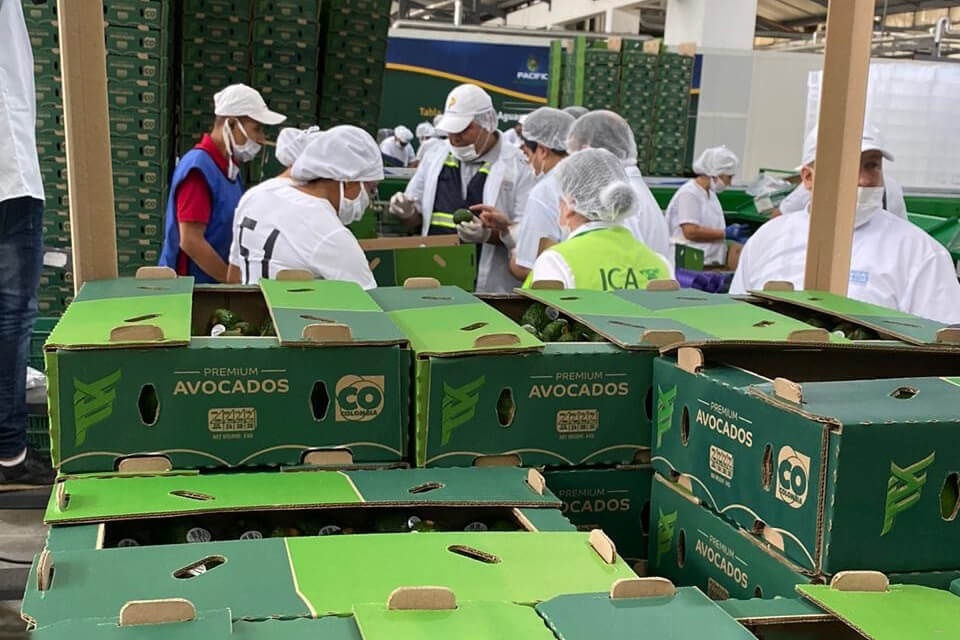
Packaging must keep avocados safe, fresh, and protected during transport to Saudi Arabia (KSA). All packaging materials must comply with:GSO 839:2021 – Food Packages
GSO 1863/2021 – Plastic Packages
GSO 2231/2012 – General Requirements for Food Contact Materials
Key requirements
Must be food-grade, safe, and non-toxic
Must not transfer chemicals, odor, or taste to avocadoes
Must protect fruit from damage, moisture, and contamination
Must allow air circulation to prevent mold and overheating
Approved Packaging Materials
Recommended materials include:
- Corrugated cardboard cartons
- Solid cardboard boxes
- Food-grade plastic crates
Important Rules
Exporters must ensure that packaging:
- Is strong enough to prevent crushing and fruit damage.
- Does not use strong-smelling wood or chemically treated materials.
- Uses only food-safe inks, adhesives, and coatings.
- Uses recycled materials only when they are certified food-grade.
Optional Packaging Solutions
To improve shelf life and transport quality:
- Perforated films: Improve airflow and moisture control.
- Modified Atmosphere Packaging (MAP): Helps slow avocado ripening.
Optional Packaging Solutions
Tips
- Good packaging protects fruit quality, maintains freshness, and prevents rejection during transport and inspection.
Food Labeling
Correct labeling is essential for exporting avocados to Saudi Arabia. Labels must be clear, accurate, easy to read, and approved before shipment to avoid delays or rejection at the Saudi border. All labels and packaging must comply with:GSO 9:2022/Amd1:2025 – Food Labeling
GSO 839:2021 – Food Packaging Requirements
Before shipping, Lebanese exporters should confirm with the Saudi importer that all label information meets KSA requirements.
General Label Requirements
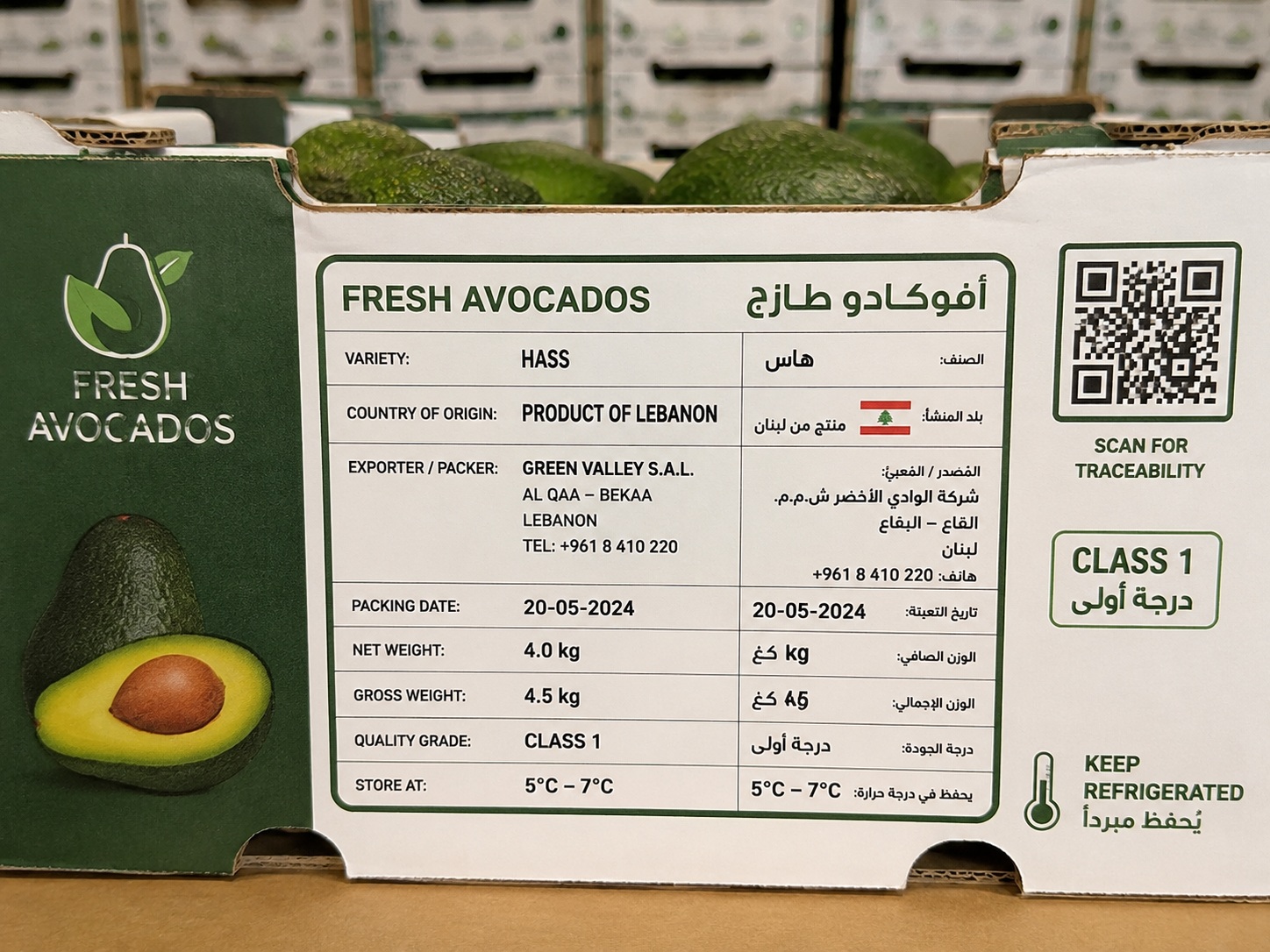
Each outer carton or crate must have a clear label in Arabic or Arabic and English. The label should include:
- Product name: Fresh Avocados
- Variety: Hass, Fuerte, Lamb Hass, etc.
- Country of origin: Product of Lebanon
- Exporter and packer details: Name and full address of the packing facility in Lebanon
- Packing date: DD-MM-YYYY format
- Net and gross weight
- Storage conditions: For example, cold-chain or temperature instructions
- Quality grade: Extra Class, Class I, or Class II
Important Note
Fresh avocados must not include added ingredients. If avocados are mixed with other items or processed, they may no longer be treated as fresh produce and may need to follow additional labeling rules.
QR Code and Traceability
A QR code or barcode is recommended on the label or master pallet label. This can help Saudi authorities and buyers quickly verify:
- Farm or supplier information
- Packing house details
- Batch or lot number
- Export documents
- Traceability records
Quick Checklist for Exporters
| Label Component | What to Check |
|---|---|
| Carton/crate material | Clean, strong, ventilated, and food-grade |
| Label language | Arabic or Arabic/English |
| Origin statement | Clearly states “Product of Lebanon” |
| Weight | Net and gross weight are accurate |
| Packing date | Clearly shown in DD-MM-YYYY format |
| Traceability | Barcode or QR code matches the shipment details |
Dates, Barcodes, and Label Approval
For fresh fruits and vegetables, labels should include:
- Production date or harvest year, where required
- Packing date
- Product barcode, where applicable
An expiry date is usually not required for fresh fruits and vegetables.
Important Rules
- Labels must be approved before shipment.
- Labels cannot usually be corrected after arrival.
- Any change in label, barcode, packaging, or weight may require new approval.
- Each barcode should be linked to one product only.
Sticker Rules
If stickers are used, they must:
- Not cover mandatory label information
- Match the approved label information
- Be applied before export
- Be permanent and not easily removable
- Not be used to add or change production or expiry dates
- Be approved by KSA authorities, where required
Sticker Rules
Marketing and Nutrition Claims
Exporters should be careful when adding marketing or nutrition claims to avocado labels. Claims must comply with:
- GSO CAC GL 1/2008 – General Claims Guidelines
- GSO 2333/2019 – Nutrition and Health Claims
- GSO 2233/2021 – Nutrition Labeling Requirements
- GSO 2576/2021 – Marketing Terms on Labels
Avoid using claims unless they are true and supported by documents. Examples of claims that need proof:
- “Premium”
- “Healthy Fats”
- “High Fiber”
- “Organic”
- “GMO-free”
- “Natural”
Claim Examples
| Label Statement | Status |
|---|---|
| “Fresh Avocado – Product of Lebanon” | Acceptable for fresh, unprocessed avocados |
| “High in Potassium & Fiber” | Allowed only if supported by the required nutrition information |
| “Prevents Heart Attacks” or “Lowers Cholesterol” | Not allowed, because these are medicinal/health claims |
Organic Labeling
Only use the word “organic” if the avocados are officially certified organic. If avocados are labeled or marketed as organic in KSA, they must comply with:
- GSO 2374/2014 – Labeling and Marketing of Organically Produced Foods
Organic avocados must:
- Come from certified organic farms
- Have a valid organic certificate
- Show the approved organic logo, where required
- Be supported by documents recognized by KSA authorities
If the product is organic but the word “organic” is not used on the label or in marketing, an organic certificate may not be required for labeling purposes.
Tips
- Keep the label simple, accurate, and easy to verify.
- Do not add marketing claims unless you have official proof.
- Do not write “organic” unless you have a valid organic certificate.