
The Export of Potatoes to UK Legal Requirements & Standards
- Product description and classification
- Food Import Procedure
- What are the mandatory requirements?
- Quality Requirements
- Labeling and Packaging
- What additional requirements do buyers often have?
Product description and classification
Top varieties found in Lebanon
- Spunta
- Agria
- Maverick
- Everest
- Fabula
Food Import Procedure
Fresh or chilled potatoes from Lebanon can enter the United Kingdom, provided that they meet specific plant-health and import requirements. For Lebanese exporters, the main challenge is ensuring that the potatoes originate from an approved production area and that all phytosanitary, traceability and customs requirements are completed before the shipment arrives in the UK.Potatoes are considered a high-risk plant product because of the risk of introducing quarantine pests and diseases. Imports are therefore subject to stricter controls than many other fresh fruit and vegetables.
For Lebanese potatoes, market access is limited to potatoes produced and harvested in officially recognised Pest-Free Areas in Akkar or Bekaa. Production fields intended for export must be registered, monitored and approved through the Lebanese Ministry of Agriculture (MoA). The competent Lebanese authorities are responsible for confirming that the production areas meet the applicable plant-health conditions and for communicating the relevant information to the UK authorities.

Tips
- Confirm that your potatoes are produced in an approved pest-free area in Akkar or Bekaa.
- Register your field and keep it under official monitoring by the Ministry of Agriculture.
- Plan inspections and certification with the Ministry of Agriculture early in the season.
- Keep clear records for each lot from field to final packaging.
- Do not mix potatoes from approved areas with potatoes from other sources.
- Send all documents to your UK buyer early to allow time for pre-notification and customs clearance.
- Agree on grading, packaging, labelling, and delivery requirements with your UK buyer before packing.
Import Control System Overview
Because potatoes are classified as high-risk plant products, you must complete the following UK Mandatory Border Documentation:
- Phytosanitary Certificate: You must obtain a phytosanitary certificate from the Lebanese Ministry of Agriculture. This document must be issued no more than 13 days before or after the date the shipment leaves Lebanon. It must officially state that the lot has been sampled, tested, and found free of quarantine pests.
- Certificate of Origin: A separate, official commercial declaration validating that the potatoes originated in Lebanon
- IPAFFS Pre-Notification: The UK importer must submit an advance digital pre-notification via the Import of Products, Animals, Food and Feed System (IPAFFS) prior to the shipment's arrival at the UK Border Control Post (BCP).
- Customs Declaration: A full electronic customs entry via the UK Customs Declaration Service (CDS) is required, utilizing an Economic Operators Registration and Identification (EORI) number.
Lebanese Export Clearance
Before the cargo even leaves Lebanon, it must meet specific domestic export controls:
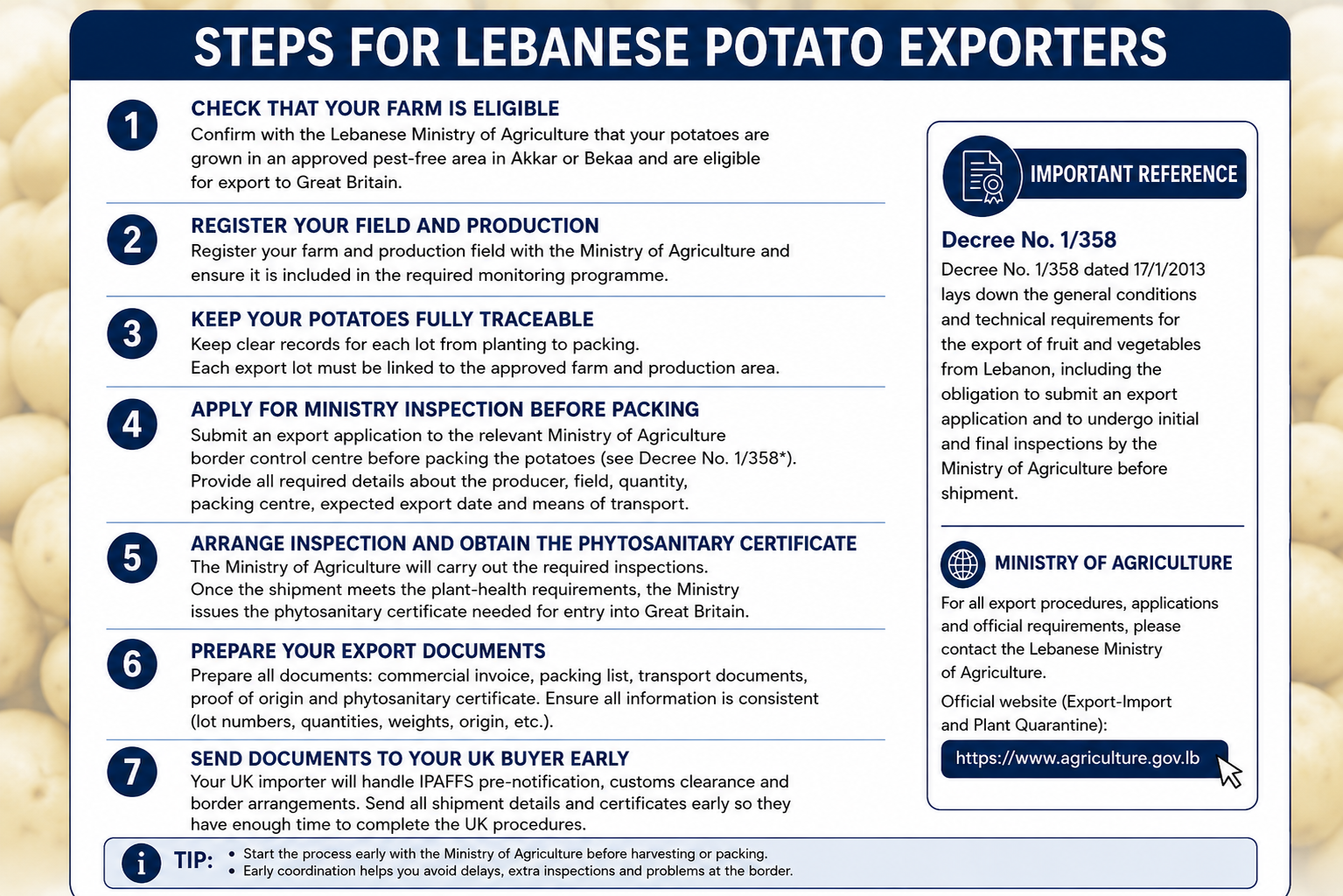
- Ministry of Agriculture (MoA) Inspection: Before packing, Lebanese potato exporters should submit an export application to the relevant Ministry of Agriculture border control centre. The MoA will then carry out the required inspections and plant-health checks before shipment. The figure below provides a practical overview of the main steps exporters should follow, from field eligibility and registration through inspection, certification and preparation of export documents.
- Labeling & Traceability: Every bag of exported potatoes must bear a clear sticker/label detailing the exporter's identity, packing center, potato variety, class, net weight, and explicit geographic origin.
What are the mandatory requirements?
Most of the requirements in the United Kingdom are aligned with those in the European Union. You can also stay up to date on developments in trade and regulation with the information on GOV.UK. The UK versions of the EU legislation can be found on legislation.gov.ukPesticides Residues
An MRL is the highest level of pesticide residue that is legally permitted in or on food products when pesticides are used. Pesticide residues and contaminants are one of the crucial issues for fruit and vegetable suppliers.
Following GB's exit from Europe, Maximum Residue Levels of pesticides permitted in food will now vary as GB determines its own appropriate levels. MRL's are set as trading limits as opposed to safety limits, but exceedance of such MRL's means that product is not legal for trade.
Tips
- GB MRLs for pesticide residues are set by inclusion in the GB MRL Statutory Register under Assimilated Regulation No 396/2005.
- Use the Pesticides database to get all the MRL details. Search for product code 070190 (potatoes). Always check whether your buyers have additional requirements for MRLs and pesticide use.
- Apply integrated pest management (IPM) to reduce the amount of pesticide. IPM is an agricultural pest control strategy and is also part of GLOBALG.A.P certification. It uses natural control practices, such as the application of pests’ natural enemies. The fewer chemicals you use, the better your marketing position will be for export to Europe.
- Stay informed and follow these tips to ensure compliance with GB requirements, protect your markets and build trust with your buyers.
Avoiding Contaminants
Potatoes may contain contaminants. These are substances that are not intentionally added to food, such as heavy metals (cadmium and lead) and perchlorate, which can end up in produce during production, packaging, transport, and holding. The European Union (EU) has set maximum levels for certain contaminants in food laid down in Commission Regulation (EU) 2023/915:
- Cadmium: 0.05 mg/kg
- Lead: 0.10 mg/kg
- Perchlorate: 0.05 mg/kg
Tips
- Find the adjusted EU legislation for the United Kingdom on legislation.gov.uk, such as Regulation (EC) No 178/2002 with the general principles and requirements of food law, Regulation (EC) No 1881/2006 setting maximum levels for certain contaminants in foodstuffs, and Regulation (EU) 2019/1793 on the temporary increase of official controls and emergency measures.
Microbiological criteria
Under assimilated UK food safety regulations based on Commission Regulation (EC) No 2073/2005, fresh, uncut, and unprocessed vegetables are explicitly exempt from routine microbiological testing. Instead, the strict biological focus is placed almost entirely on phytosanitary (plant health) pathogens and general soil contamination.
Even though there are no specific numeric limits for fresh tubers, the shipment must comply with the overarching UK Food Safety Act.
- General Food Fitness: The potatoes must not contain pathogens, toxins, or microbial loads at a level that makes them injurious to human health.
- Cross-Contamination: The potatoes must be harvested, packed, and transported under strict hygiene standards to prevent contamination from pathogen sources (such as animal manure or polluted irrigation water)
Use the Codex Alimentarius - Code Of Hygienic Practice For Fresh Fruits And Vegetables as a guideline.
Phytosanitary regulations
For most fresh fruit and vegetables, you must get a phytosanitary certificate for each consignment from the plant health authority in your country. The certificate is a statement from the plant health authority that the consignment:
- has been officially inspected
- complies with legal requirements for entry into GB
- is free from quarantine pests and diseases
The phytosanitary inspection must take place no more than 14 days before the consignment is dispatched from your country. And it must be signed by someone in the inspecting plant health authority within the same 14-day period
Tips
- Use the GOV.UK guidance on Import plants and plant products from non-EU countries to Great Britain and Northern Ireland to check for further details on your product.
- Contact the National Plant Protection Organisation (NPPO) in your country to arrange a phytosanitary certificate. Only these organisations are authorised to issue phytosanitary certificates. Make sure your plant health authority is able to comply with the phytosanitary requirements before planning your export.
Quality Requirements
All fruit and vegetables imported to or exported from the UK must meet the relevant quality and labelling rules (marketing standards). The United Kingdom follows mostly the EU guidelines on marketing standards.There are 2 sets of marketing standards:
Specific Marketing Standard (SMS) for specific 10 types of fresh produce
General Marketing Standard (GMS) for most other fresh fruit, vegetables, nuts and herbs including potatoes
General Marketing Standard (GMS)
Other fresh fruit and vegetables must be according to the general marketing standards. Products under the general marketing standards do not need to be graded into quality classes, but they must be:
- Intact
- sound (for example, not rotten, severely bruised or severely damaged)
- clean (as is practically possible)
- free from pests (as is practically possible)
- free from damage caused by pests affecting the flesh (as is practically possible)
- free of abnormal external moisture
- free of foreign smell or taste
- sufficiently developed or ripe but not overdeveloped or overripe
The condition of the products must be such as to enable them:
- to withstand transport and handling,
- to arrive in satisfactory condition at the place of destination.
Maturity Requirements
The products must be
- sufficiently developed, but not over-developed,
- must display satisfactory ripeness and must not be overripe
- such as to enable them to continue their ripening process and to reach a satisfactory degree of ripeness
Tolerance
A tolerance of 10 % by number or weight of product not satisfying the minimum quality requirements shall be permitted in each lot. Within this tolerance not more than 2 % in total may consist of produce affected by decay.
Labeling and Packaging
Labeling
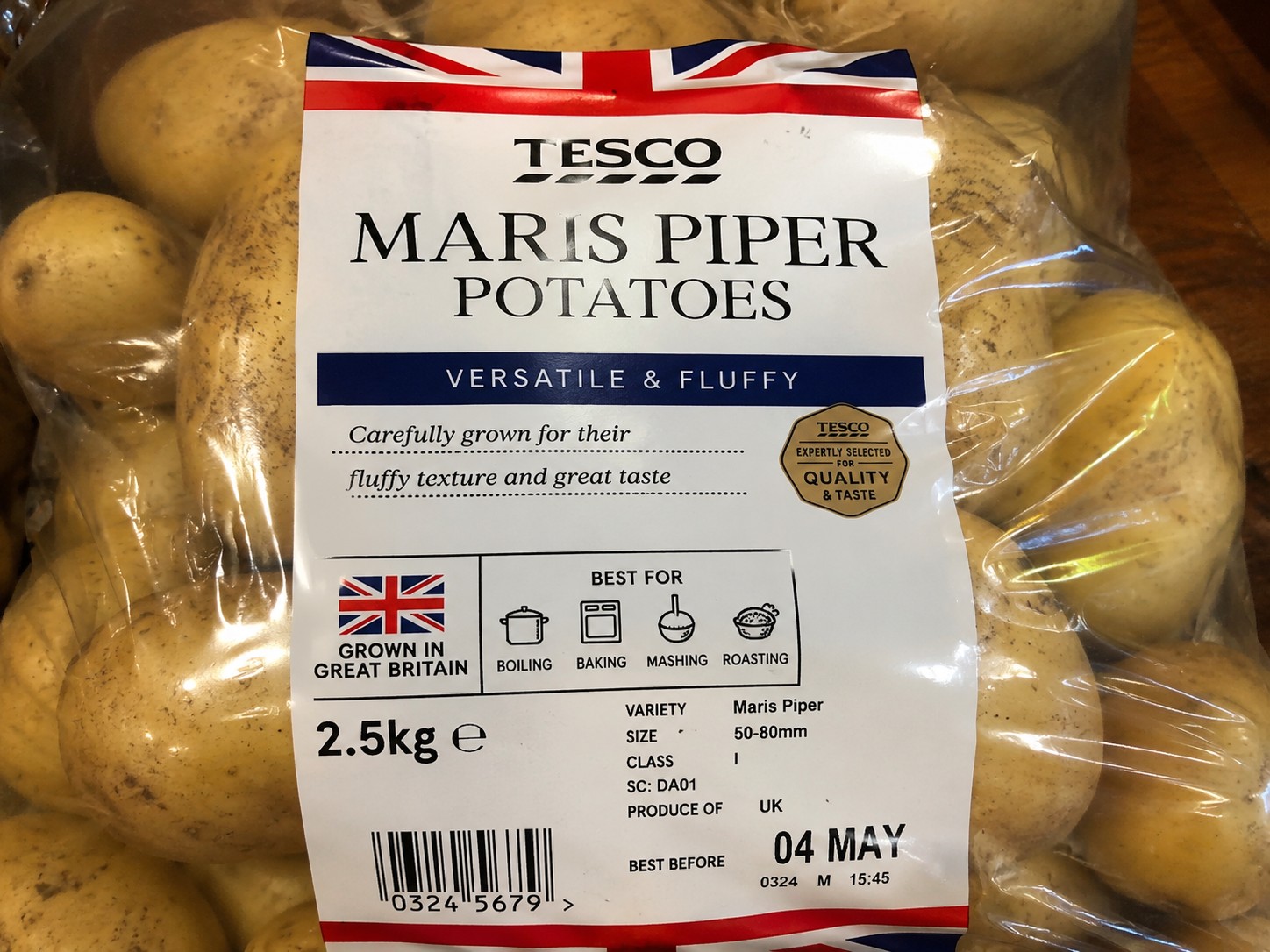
Under the Assimilated Regulation (EU) No 1169/2011 on the Provision of Food Information to Consumers (FIC) and specific UK Fresh Fruit and Vegetable Marketing Standards, any bulk or prepacked potato container must permanently display the following elements in English. GMS produce (including pre-packed produce) must include:
- The Legal Name of the Food: The pack must clearly state "Potatoes" or "Ware Potatoes"
- The Variety: The specific botanical cultivar (e.g., Spunta, Agria) must be explicitly declared on the label
- Country of Origin: The label must explicitly state "Product of Lebanon" or "Origin: Lebanon" to provide clear origin marking
- Net Quantity: The total weight must be expressed in metric units (e.g., "Net Weight: 25 kg")
- The "Field of Vision" Rule: The Name of the Food and the Net Quantity must be printed within the same immediate field of vision so they can be read simultaneously
- Minimum Font Size: Mandatory text lowercase characters must have an absolute minimum x-height of 1.2 mm to satisfy UK legibility laws
- Food Business Operator (FBO) Details: The label must feature the registered corporate name and physical address of either the UK importer, or the distribution entity placing the goods on the Great Britain market
- Traceability IDs (Lot/Batch): A unique trackable sequence (such as a lot number) linking the physical cargo directly to its phytosanitary testing certificates is legally required
Individuals and businesses at all stages of production and marketing must follow rules to meet marketing standards, including:
- Packers
- Growers
- Distributors
- Wholesalers
- Retailers
- Importers
- Exporters
Packaging
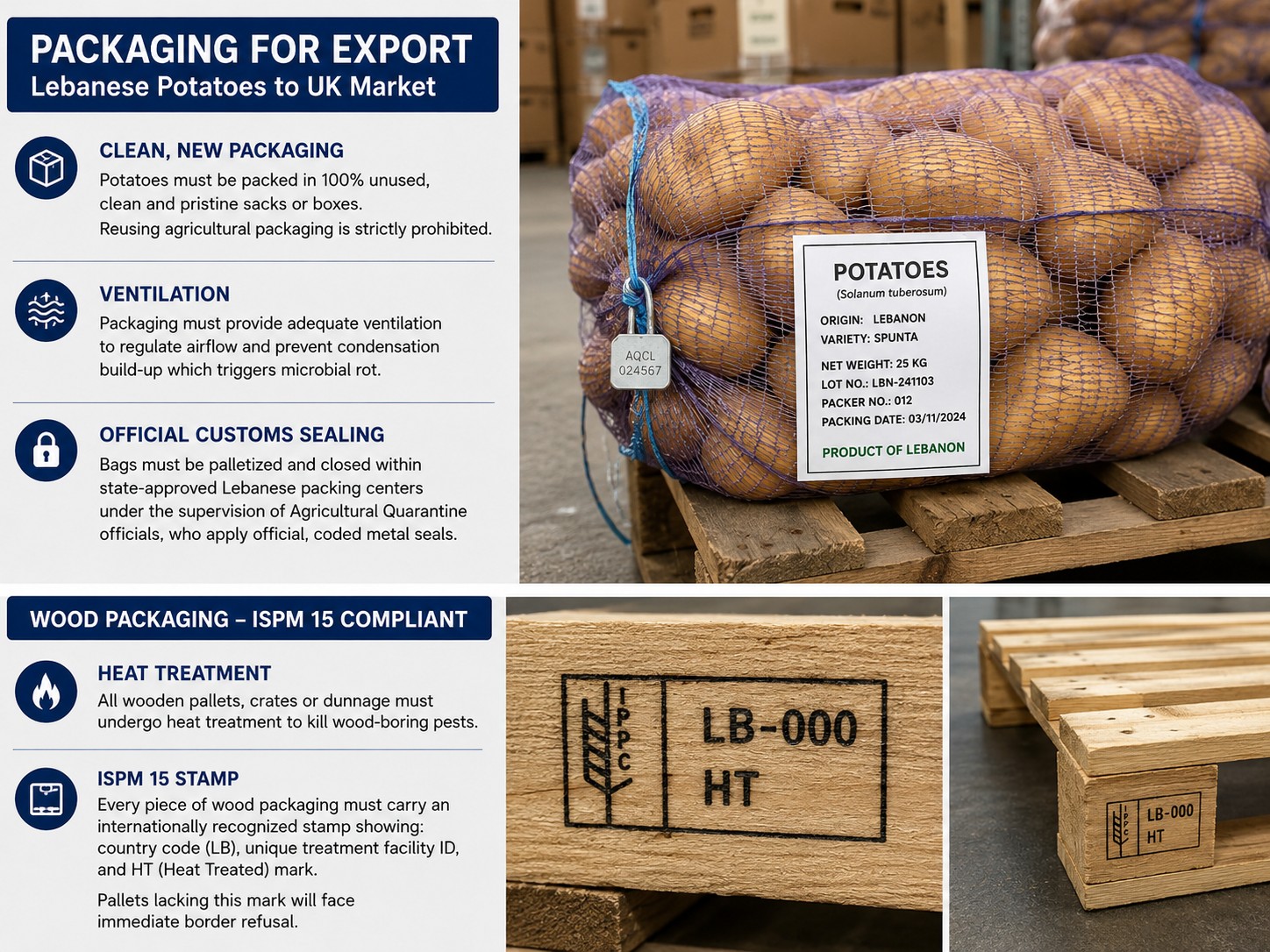
Packaging materials are strictly regulated by the Packaging (Essential Requirements) Regulations 2015 (SI 2015/1640) to protect food integrity, avoid contamination, and eliminate biological pest pathways.
- The 100% Unused Rule: Potatoes must be packed in completely clean, new, and pristine sacks or boxes. Reusing agricultural packaging from prior harvests is strictly prohibited under biosecurity rules.
- Ventilation Profiles: Packaging must provide adequate ventilation to regulate internal airflow, preventing condensation build-up which triggers microbial rot.
- Official Customs Sealing: Bags must be palletized and closed within state-approved Lebanese packing centers under the supervision of Agricultural Quarantine officials, who apply official, coded metal security seals.
Under the international plant health frameworks enforced by the UK's Animal and Plant Health Agency (APHA) International Standard for Phytosanitary Measures No. 15 (ISPM 15), any wood packaging material (WPM) used to transport the potatoes must be compliant with international biosecurity laws:
- Heat Treatment: All wooden pallets, crates, or dunnage must undergo rigorous heat treatment or fumigation to kill wood-boring pests.
- The ISPM 15 Stamp: Every piece of wood packaging must carry an internationally recognized, visible stamp displaying the LB country code (Lebanon), the unique treatment facility ID, and the HT (Heat Treated) mark. Any pallet lacking this permanent mark will face immediate border refusal.
What additional requirements do buyers often have?
Consistency and clear communication
In the fresh produce industry it is important to communicate clearly and directly. Maintain strict compliance with quality requirements and deliver the quality as agreed with your buyer. Being careless with product requirements or stretching the minimum standards will give buyers a reason to claim on quality issues.
Tips
- Maintain strict compliance with quality, delivering it as agreed with your buyer. Being careless with product requirements or pushing quality limits will lead buyers to raise issues with quality.
- Always discuss specific packaging requirements and preferences with your buyer and send images of your product before shipment to avoid miscommunication.
- Prepare yourself for the UK market and doing business in the European fresh produce sector by reading CBI’s tips for doing business with European buyers.
Sustainability and environmental impact
The United Kingdom has left the European Union (EU) and no longer takes part in the European Green Deal. Nevertheless, the country maintains similarly high ambitions concerning environmental policies.
The Climate Change Act commits the UK government by law to reducing greenhouse gas emissions by at least 100% by 2050. This could affect suppliers in terms of plastic reduction, sustainable production and transport methods, and voluntary eco-labels.
Certification
The United Kingdom can be a difficult market in terms of certifications and additional requirements. This is because the fresh fruit and vegetable sector is largely dominated by big retailers. As a supplier you must comply with these strict standards and obtain the most common certifications.
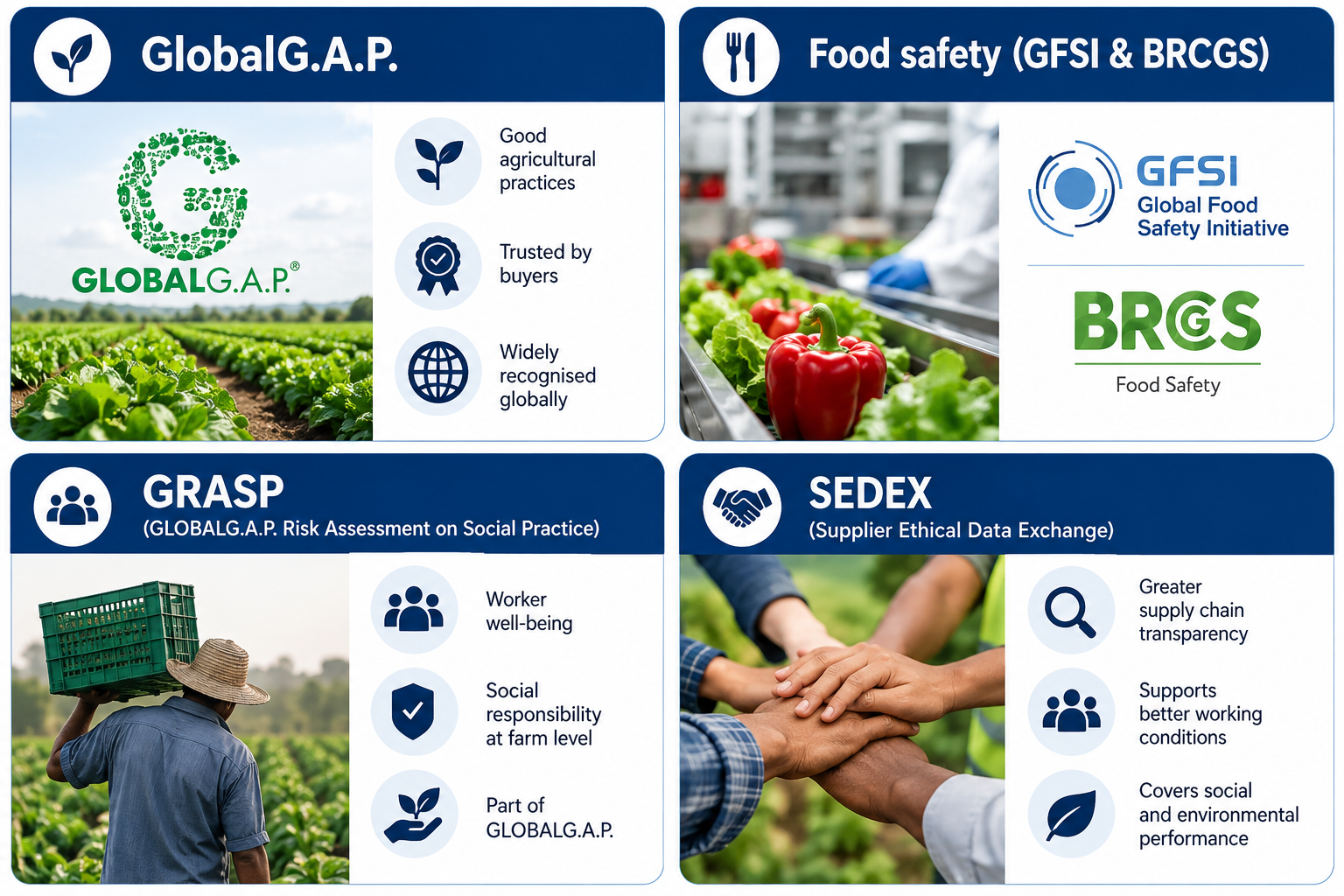
- GlobalG.A.P. will be a minimum requirement for imported fresh fruit and vegetables into the UK. GlobalG.A.P. was initiated by mainly British retailers and is now the most common standard to guarantee ‘Good Agricultural Practices’.
- To ensure good practices in food safety, suppliers need to have a HACCP-based food safety management system, recognised by the Global Food Safety Initiative (GFSI). The most common system and certification for the UK is BRCGS (British Retail Consortium Global Standards).
- GLOBALG.A.P. Risk Assessment on Social Practice (GRASP): a GLOBALG.A.P add-on for the evaluation of worker’s well-being at the farm level.
- Supplier Ethical Data Exchange (SEDEX): a global initiative to make global supply chains more transparent. SEDEX has also developed a social auditing scheme – SMETA – to help companies assess the working conditions in and environmental performance of their business and supply chains.
Tips
- Implement at least one environmental and one social standard. See the Basket of Standards of The Sustainable Trade Initiative for Fruit and Vegetables (SIFAV).
- Implement the social and environmental standards that you need for specific clients. Take these standards seriously: Besides being a requirement, it is also an important aspect to build your relationship with important clients.
- For other additional requirements such as payment and delivery terms, see the CBI’s reports on buyer requirements for fresh fruit and vegetables.