
The Export of Table Grapes to Germany Legal Requirements & Standards
- Product description and classification
- Exporter quick checklist?
- What are the mandatory requirements?
- Quality Requirements
- Labeling and Packaging
- What additional requirements do buyers often have?
- Required documents and records
- Top rejection risks before shipment
Product description and classification
| Harmonized System (HS) code | 08061000 Fresh grapes 08061010 Fresh table grapes |
| Top varieties found in Lebanon | Tfeifihi (also called Halawani) Baytamouni (also Beytamouneh “date of Beirut”) Maghdouchi (brown-skinned) Jbaai (dark-skinned) Thompson Seedless (Sultanina) Superior Seedless (Early Superior) Flame Seedless Crimson Seedless Black Pearl |
Exporter quick checklist?
| Step | Exporter action | Evidence to keep | Responsible party |
|---|---|---|---|
| 1. Buyer specification | Confirm grape variety, class, bunch size, berry size, colour, Brix/sugar level, carton weight, residue limits, certifications, packaging type and Incoterms. | Buyer specification, purchase order, email confirmation | Exporter / buyer |
| 2. Farm compliance | Use only approved pesticides, respect pre-harvest intervals, keep spray records and apply IPM. | Spray records, input log, IPM records, GLOBALG.A.P. records where applicable | Grower / technical adviser |
| 3. Residue control | Test a representative sample before shipment and compare results with EU MRLs and the German buyer’s private limits. | Laboratory report, sampling record, corrective actions | Exporter / lab |
| 4. Maturity and quality check | Check Brix/sugar level, colour, berry firmness, bunch condition and absence of decay before harvest or packing. | Maturity test sheet, quality inspection record, photos | Grower / packhouse |
| 5. Harvest and handling | Harvest carefully, avoid bruising and berry shatter, keep grapes shaded and move quickly to the packhouse. | Harvest record, field QC checklist | Grower / packhouse |
| 6. Packing and grading | Pack only clean, sound, uniform bunches that meet the agreed class, colour, size and presentation. Use buyer-approved cartons, liners or pads where required. | Packing list, grade records, QC report, packed product photos | Packhouse |
| 7. Cold chain | Pre-cool grapes quickly and maintain the agreed temperature during storage, loading and transport. | Temperature records, logger data, loading report | Packhouse / exporter / forwarder |
| 8. Phytosanitary certificate | Apply for inspection and phytosanitary certificate through the Lebanese competent plant health authority before shipment. | Phytosanitary certificate, inspection record | Exporter / authority |
| 9. Shipping documents | Ensure carton labels match the invoice, packing list, certificate of origin, phytosanitary certificate and transport documents. | Complete document set | Exporter / freight forwarder |
| 10. German entry preparation | Coordinate with the German importer or customs agent for pre-notification, TRACES/CHED-PP procedures and plant-health checks where applicable. | Importer confirmation, CHED-PP reference where applicable | Importer / forwarder |
What are the mandatory requirements?
The European fruit and vegetable market is very competitive. You must meet several requirements to export to this market. These can be rules from the European Union or set by buyers. Private requirements are known as 'certifications'. Most certifications in Europe focus on social and environmental issues. Their primary goal is to safeguard European consumers. Some certifications cater to specific niche markets. Mandatory requirements cover food safety and quality. These include: legal rules, quality requirements, and packaging and labelling requirements.Pesticides Residues
Pesticide residues are one of the most crucial issues for grapes suppliers. This is especially true for grapes, which are ingested straight. An MRL is the highest level of pesticide residue that is legally permitted in or on food products when pesticides are used. You can find the MRLs for the pesticide residues relevant to grapes in the EU Pesticides database. It is vital to familiarize yourself with the MRLs, and to not exceed these levels. When grapes contain more pesticide residues than allowed, they will be withdrawn from the European market. More and more buyers ask for upfront information about your pesticide spray records. Shipments are checked before they are sent to the retailer. For future business, you must take into account that your responsibility as an exporter will play an important role as retail chains put more pressure on their suppliers.
Note that buyers in several countries, such as Germany, the Netherlands and Austria, use MRLs which are stricter than the MRLs provided for in European legislation. Lidl, a German discounter, is one of the tightest, limiting single active chemicals to 33% of the EU regulatory limit.

Tips
- Regulation (EC) No 396/2005 sets maximum residue levels (MRLs) of pesticides in or on food and feed of plant origin.
- Use the EU Pesticides database to get all the MRL details, you should search for product code 080610 (fresh grapes). Always check whether your buyers have additional requirements for MRLs and pesticide use.
- Apply integrated pest management (IPM) to reduce the amount of pesticide. IPM is an agricultural pest control strategy, which is also part of GLOBALG.A.P. Certification. It uses natural control practices such as the application of pests’ natural enemies. The fewer chemicals you use, the better your marketing position will be for export to Europe.
Avoiding Contaminants
Grapes may contain contaminants. These are substances that are not intentionally added to food, such as heavy metals (cadmium and lead) and perchlorate, which can end up in produce during production, packaging, transport, and holding. The European Union (EU) has set maximum levels for certain contaminants in food laid down in Commission Regulation (EU) 2023/915:
- Cadmium: 0.05 mg/kg
- Lead: 0.10 mg/kg
- Perchlorate: 0.05 mg/kg
Tips
- Read more about contaminants on the website of the European Commission and find an overview of the in Commission Regulation (EU) 2023/915. Try to check this information on an annual basis.
- Find out more about preventing and reducing lead contamination in the Code of Practice published by the FAO Codex Alimentarius. Also take a look at the European Commission’s fact sheet on food contaminants.
Microbiological criteria
Food safety authorities can withdraw imported products containing pre-cut and packed table grapes from the market or stop them from entering the EU if E. coli is present (Regulation No 2073/2005). The European Food Safety Authority (EFSA) recommends using good agricultural, hygiene and manufacturing practices to reduce contamination in grapes.
Use the Codex Alimentarius - Code Of Hygienic Practice For Fresh Fruits And Vegetables as a guideline.
Phytosanitary regulations
Regulation (EU) 2019/2072 requires table grapes to have a phytosanitary certificate before entering the EU. This guarantees that the grapes are:
- properly inspected;
- free from quarantine pests, within the requirements for regulated non-quarantine pests and practically free from other pests;
- in line with the plant health requirements of the EU, laid down in Regulation (EU) 2019/2072.
The exporting country's national plant protection authority issues these phytosanitary certificates. MOA is the national authority issuing the phytosanitary certificate link
Tips
- Learn more about the European phytosanitary rules in Council Directive 2000/29/EC and the new Implementing Directive 2019/523 on the protective measures against the introduction of harmful organisms in the European Union.
- Contact the National Plant Protection Organisation (NPPO) in your country to arrange a phytosanitary certificate. Only these organisations are authorised to issue phytosanitary certificates.
- For an example of a phytosanitary certificate, look at Annex V of Regulation (EU) 2016/2031.
Organic niche requirements ?
Organic table grapes are a niche opportunity, not a basic export requirement. Lebanese exporters should only market grapes as organic if the vineyard, packing, storage and handling process are certified under EU organic rules — Regulation (EU) 2018/848 by an EU-recognised control body.
For every organic shipment to Germany, an electronic Certificate of Inspection — e-COI must be issued in TRACES before the goods are released in the EU. Without the e-COI, the shipment cannot be released as organic.
German organic buyers may also ask for additional private standards such as Naturland, Bioland, Demeter or Bio Suisse, depending on the buyer and sales channel.
Tips
- Do not use “organic” on labels, invoices, packing lists or marketing material unless the lot is certified.
- Check which EU-recognised control body can certify organic table grape production and handling in Lebanon.
- Make sure the e-COI is prepared in TRACES before the shipment arrives in Germany.
- Ask the German buyer whether EU organic certification is enough or whether private organic standards are also required.
- Keep full traceability from vineyard plot to packed export lot.
- Avoid mixing or contamination with non-organic grapes during harvesting, packing, storage and transport.
- Treat organic as a premium niche: it can open doors, but it adds certification costs, inspections, paperwork and stricter residue controls.
Quality Requirements
You must comply with the marketing standard for table grapes of Regulation (EU) No 1308/2013 to export your products to the EU.General quality requirements
At the very least, bunches and berries of fresh table grapes must be:
- Sound; produce must be free from rotting or deterioration likely to make it unfit for consumption;
- Clean; practically free of any visible foreign matter;
- practically free from pests;
- practically free from damage caused by pests;
- free of abnormal external moisture;
- free of any foreign smell and taste;
- able to withstand transport and handling.
In addition, the grape berries must be intact, well-formed and normally developed.
Table grapes must be free from disease or serious deterioration which appreciably affects their appearance, edibility or market value. In particular, table grapes showing the following defects are therefore excluded:
Table grapes must be free of insects or other pests. The presence of pests can detract from the commercial presentation and affect the keeping quality and edibility of the table grapes.
Pigmentation due to sun is not a defect. Berries of white varieties exposed to sunlight turn yellow and may show pigmentation on the skin only. Spots of sun scorch that deteriorate the skin and may affect the flesh are not allowed.
General quality requirements
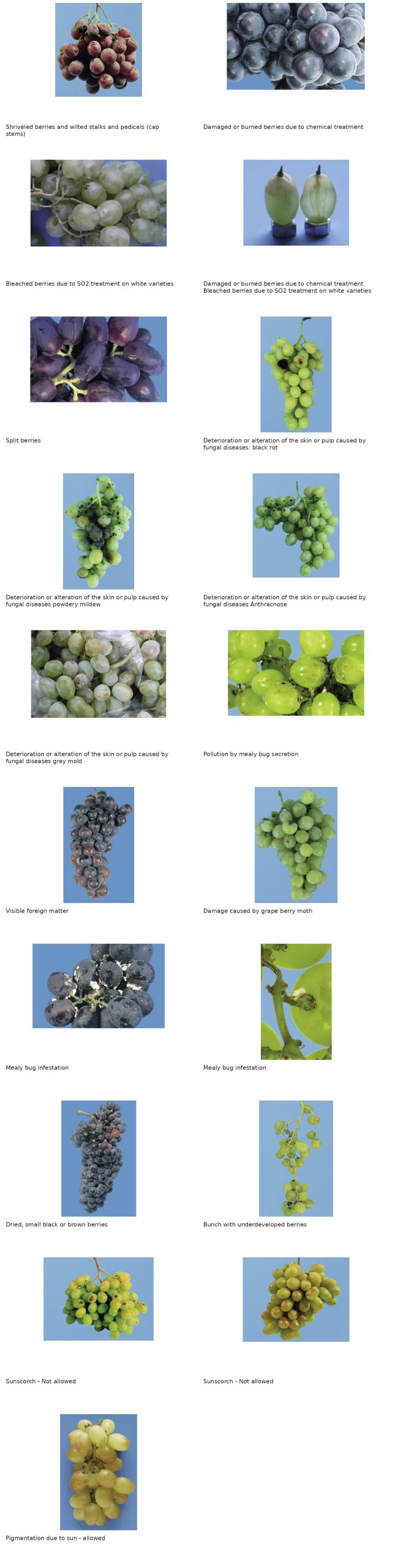
Maturity
Table grapes must be sufficiently developed and display satisfactory maturity and ripeness. In practice, however, the grapes must have reached at least 16° Brix. Fruit with a lower index is accepted if the sugar-acid ratio is at least equal to:
- 20:1 if the Brix level is greater than or equal to 12.5° and smaller than 14° Brix.
- 18:1 if the Brix level is greater than or equal to 14° and smaller than 16° Brix.
Classification
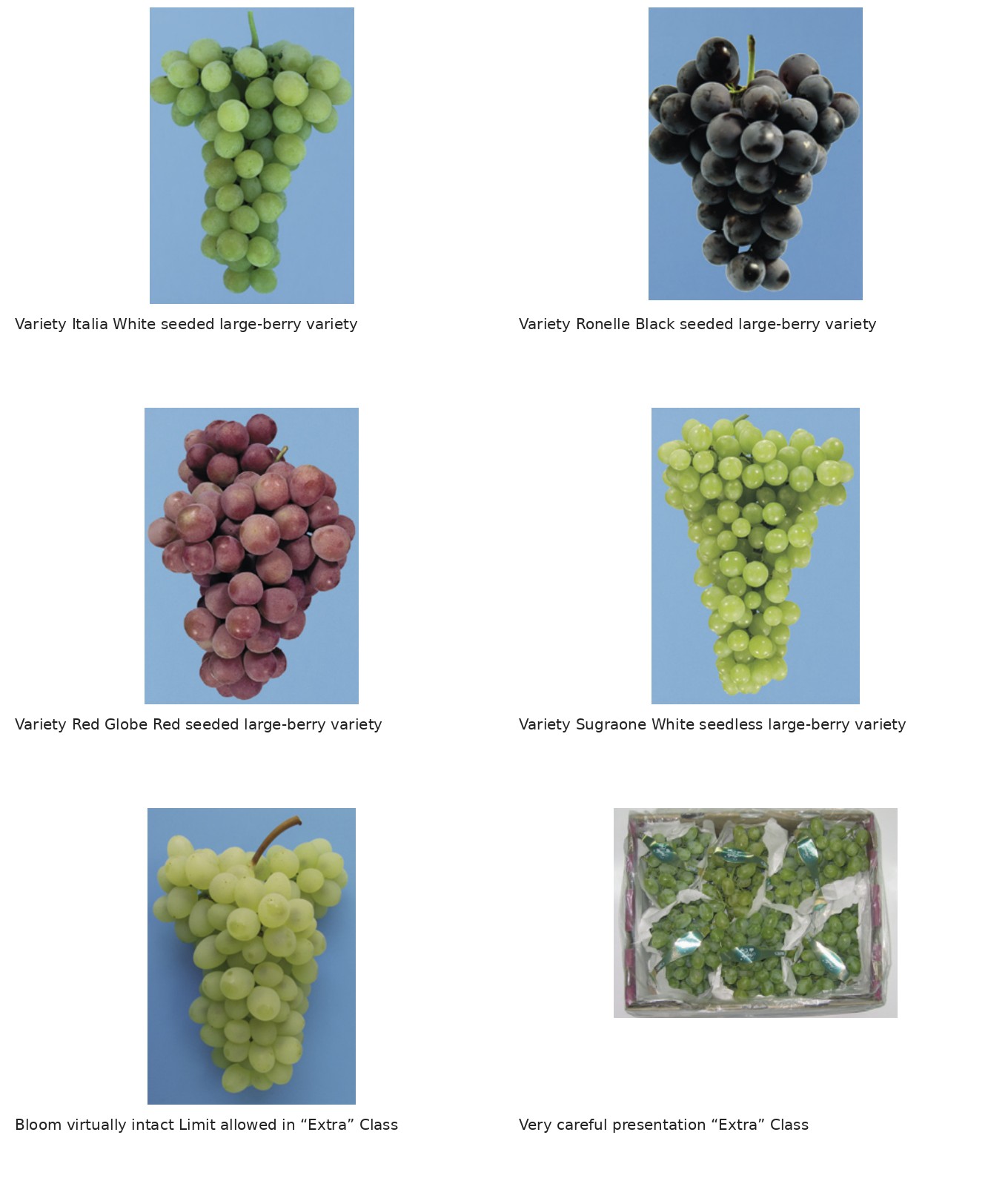
The regulation defines 3 classes of table grapes: Extra Class, Class I, and Class II. European buyers mostly require Class I as a minimum.
“Extra” Class
Table grapes in this class must be of superior quality. In shape, development and coloring, the table grapes must be typical of the variety, and have no defects. Berries must be firmly attached, evenly spaced along the stalk and have their bloom virtually intact. Slight traces of missing bloom due to handling are allowed.
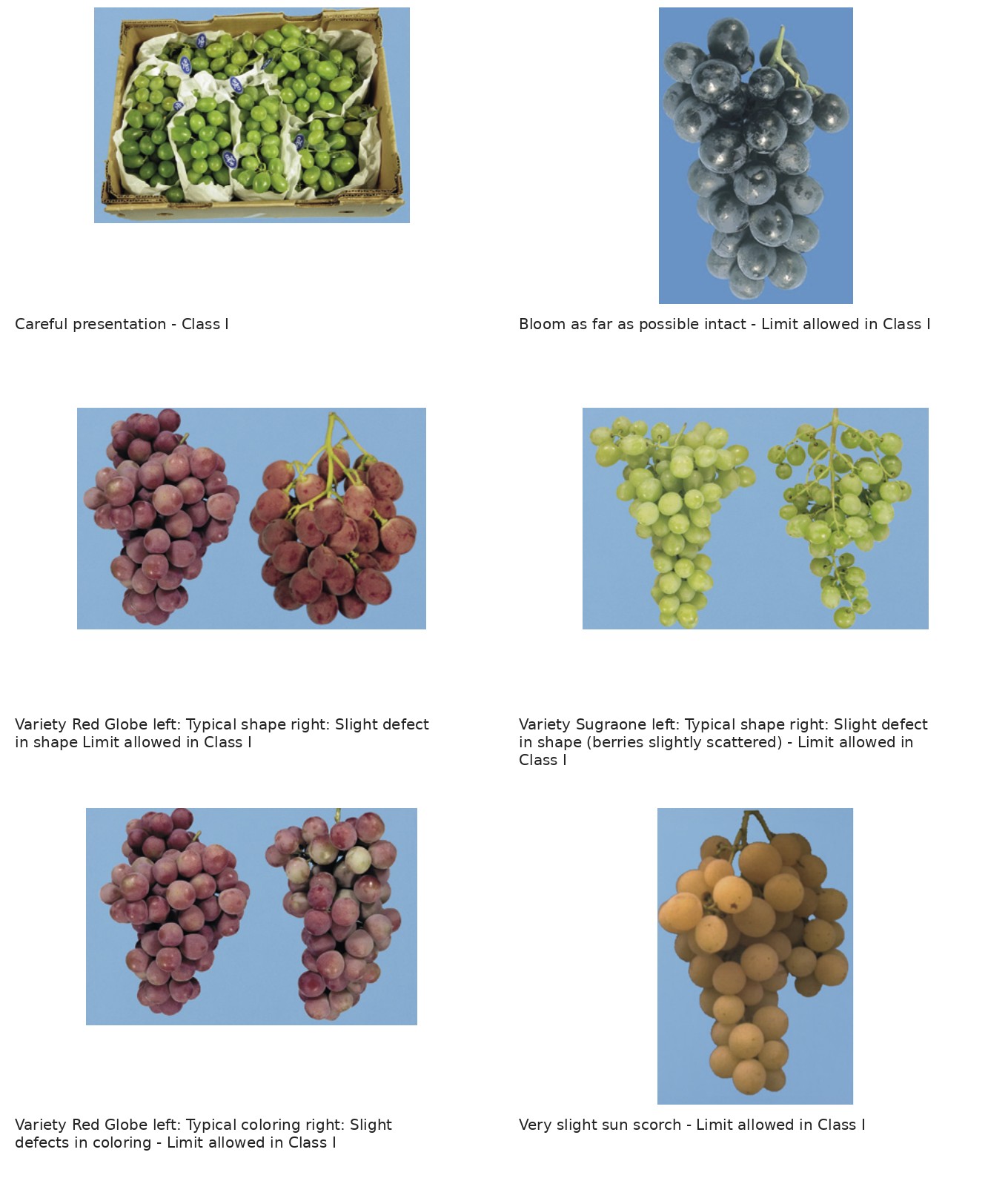
Class I
Table grapes in this class must be of good quality. Although the Class I quality requirements are less strict than for “Extra” Class, Class I table grapes must, nevertheless, be carefully selected and presented. Berries must be firm, firmly attached and, as far as possible, have their bloom intact. They may, however, be less evenly spaced along the stalk than in the “Extra” Class. Traces of missing bloom due to handling are allowed. The following slight defects, however, may be allowed provided these do not affect the general appearance of the produce, the quality, the keeping quality, and presentation in the package.
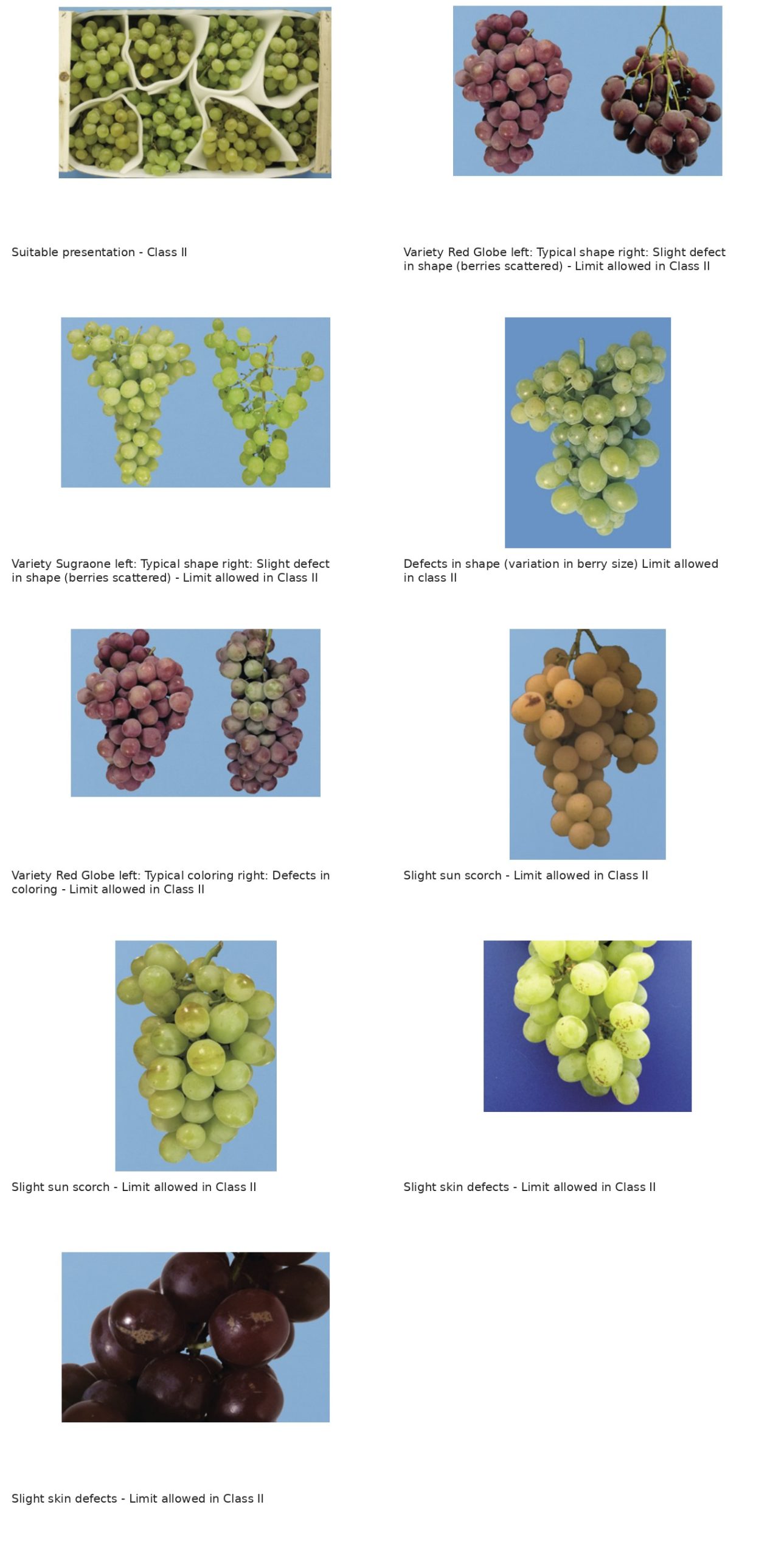
Class II
This class includes table grapes which do not qualify for inclusion in the higher classes but satisfy the minimum requirements specified above. Table grapes in this class must be of marketable quality, suitably presented and suitable for human consumption.
The berries must be sufficiently firm and sufficiently attached, and where possible, still have their bloom. They may be less evenly spaced along the stalk than in Class I. The following defects are allowed provided the table grapes retain their essential characteristics as regards to the quality.
- defects in shape and coloring ➩ evenly spaced along the stalk.
- slight sun scorch affecting the skin only.
- slight bruising is allowed provided it does not affect the pulp.
- slight skin defects.
Classification
Classification
Classification
Labeling and Packaging
Size and Packaging
Size is determined by the weight of the bunch. The minimum bunch weight is 75g, but it does not apply to packages intended for single servings. There is a tolerance of 10% on bunches not meeting size requirements.
The contents of each package must be uniform and contain only bunches of the same origin, variety, quality and degree of ripeness. However, a mixture of table grapes of distinctly different varieties may be packed together in a package, provided they are uniform in quality and, for each variety concerned, in origin. Common packaging options include:
- clamshells or punnets with heat-seal or flow pack in various sizes, such as 10x500 g or 18x250 g in a box;
- bag-in-box between 4.5 kg and 9 kg;
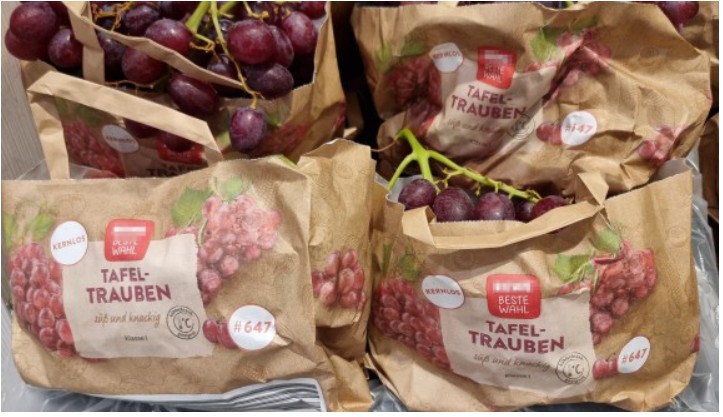
- carry bags with grape bunches between 4.5 kg and 9 kg.
In the case of the “Extra” Class, the table grapes must be packed in a single layer either in sales packages or in bunches arranged in the package.
The contents of each package must be uniform and contain only bunches of the same origin, variety, quality and degree of ripeness. In the case of the «Extra» Class, the bunches must be of more or less identical size and coloring and there should be no major variations.
The table grapes must be packed in such a way as to protect the produce properly. Packages must be of good quality, strength and characteristics to protect the produce during transport and handling.
The materials used inside the package must be new, clean and of a quality such as to avoid causing any external or internal damage to the produce. The use of materials, particularly paper or stamps, bearing trade specifications is allowed provided the printing or labelling has been done with non-toxic ink or glue. Stickers individually affixed on the produce shall be such that, when removed, neither leaves visible traces of glue, nor lead to skin defects.
Grape packers were already using more and more top-sealed punnets to reduce the plastics of lids (clamshells). Now companies have started to implement new sustainable packaging such as biodegradable and compostable carry bags for grapes, cardboard punnets or paper bags. For organic grapes, sustainable packaging such as cardboard is a real selling point.
Size and Packaging
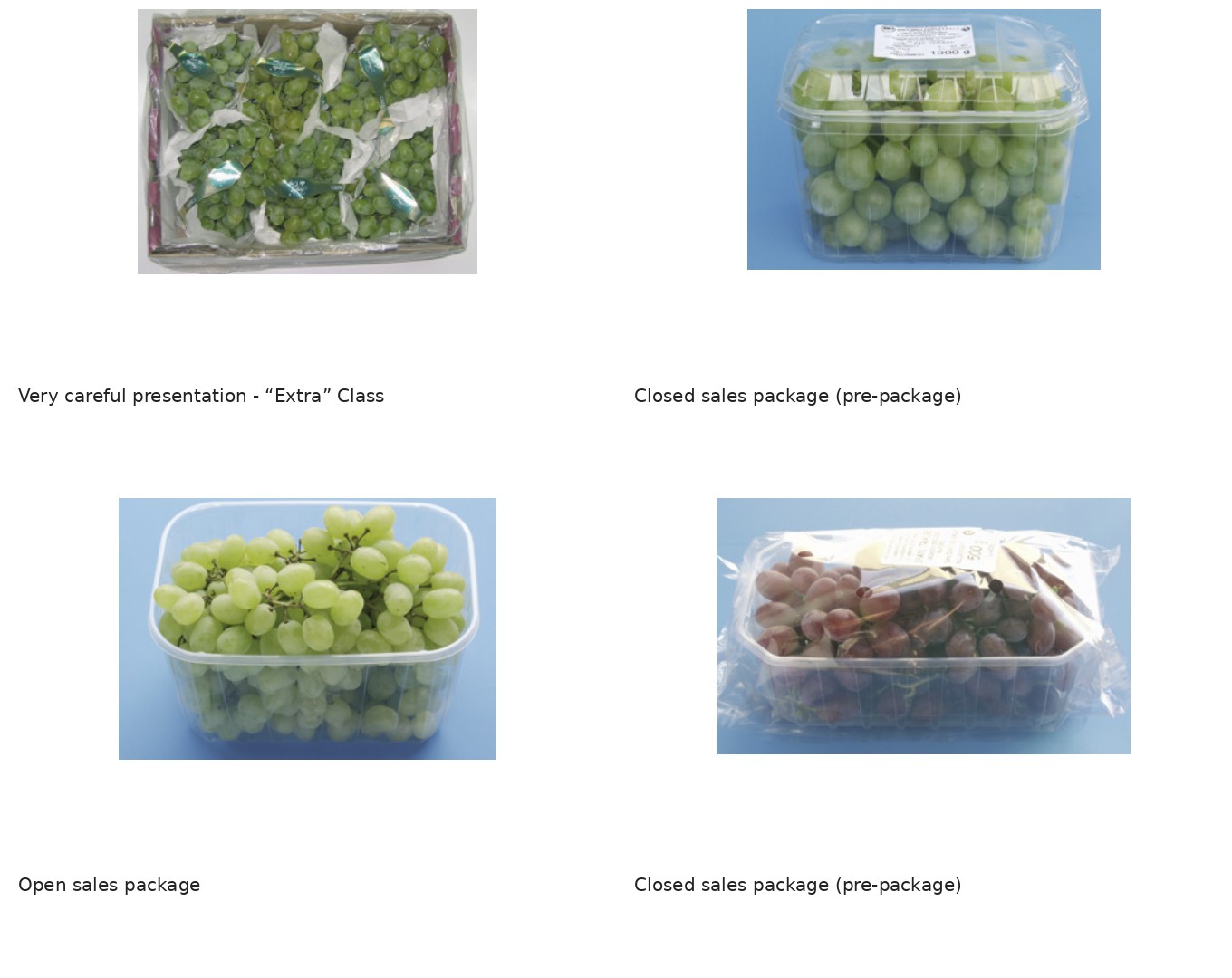
Size and Packaging
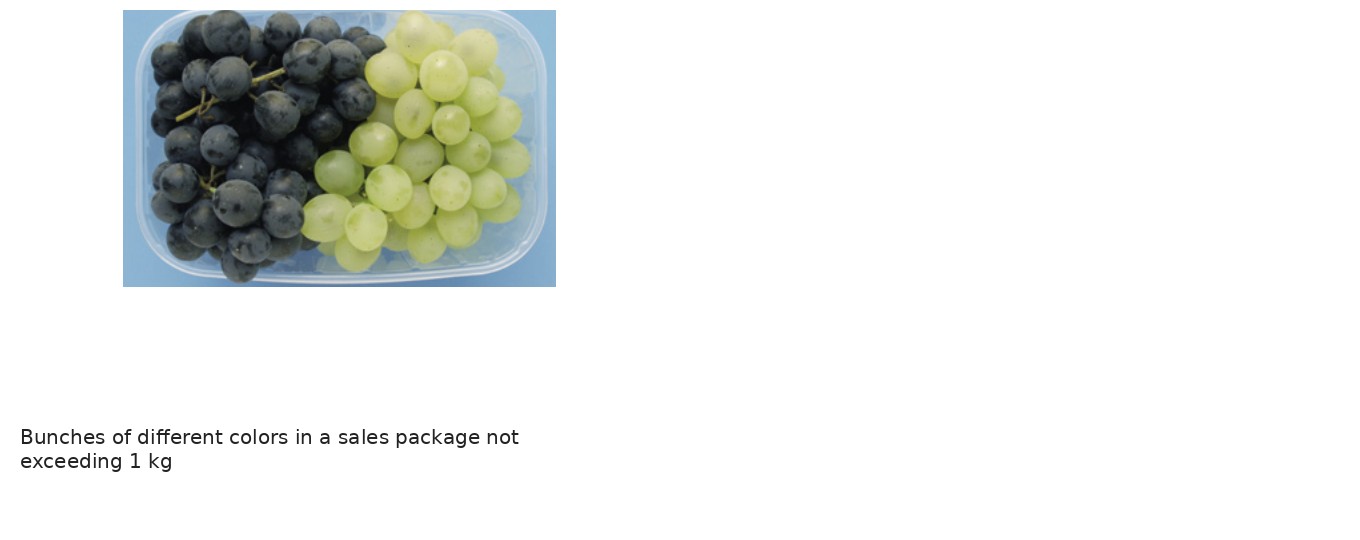
Table grapes in paper-based packaging in a German mainstream supermarket
Tips
- Maintain strict compliance with quality, delivering it as agreed with your buyer. Being careless with product requirements or pushing quality limits will lead buyers to raise issues with quality. Send images of your product before shipment to avoid miscommunication.
- Make sure your table grapes are well-preserved to ensure optimal freshness and taste. Supply chain logistics should not affect product taste in any significant way.
Marking and Labeling
To fulfill these obligations, you must document the sources of your product and be able to provide proof of origin for all fruits and vegetables. Proof of origin is also necessary for importers to get beneficiary tariffs that are common for imports from developing countries with a Generalised Scheme of Preferences (GSP). The traceability of products is compulsory and defined by the General Food Law Regulation. Food placed on the EU market must meet the legislation on food labelling.
Export carton marking
Trade packages and cartons of fresh fruit or vegetables must mention the following particulars:
| Item | What to include |
|---|---|
| Packer / exporter | Name and address of the packer and/or dispatcher-exporter |
| Product name | “Fresh table grapes”, if the contents are not visible from outside |
| Variety | Thompson Seedless, Superior Seedless, Crimson, Red Globe, etc. |
| Origin | Produce of Lebanon |
| Class | Class I, Extra Class or other agreed class |
| Size / bunch size | Size category, bunch size or buyer-specific size description, such as Large |
| Lot / batch code | Unique code linked to vineyard, harvest date, packing date, residue test and shipment records |
| Net weight | For example, 4.5 kg net or buyer-specific carton weight |
| GGN | GLOBALG.A.P. number, if certified and requested by the buyer |
| Post-harvest treatment | For example, SO₂ pad used, where applicable |
| Organic certification | Control body and certificate number, only if the grapes are certified organic |
| Destination / buyer information | Germany or buyer-specific destination details, where requested |
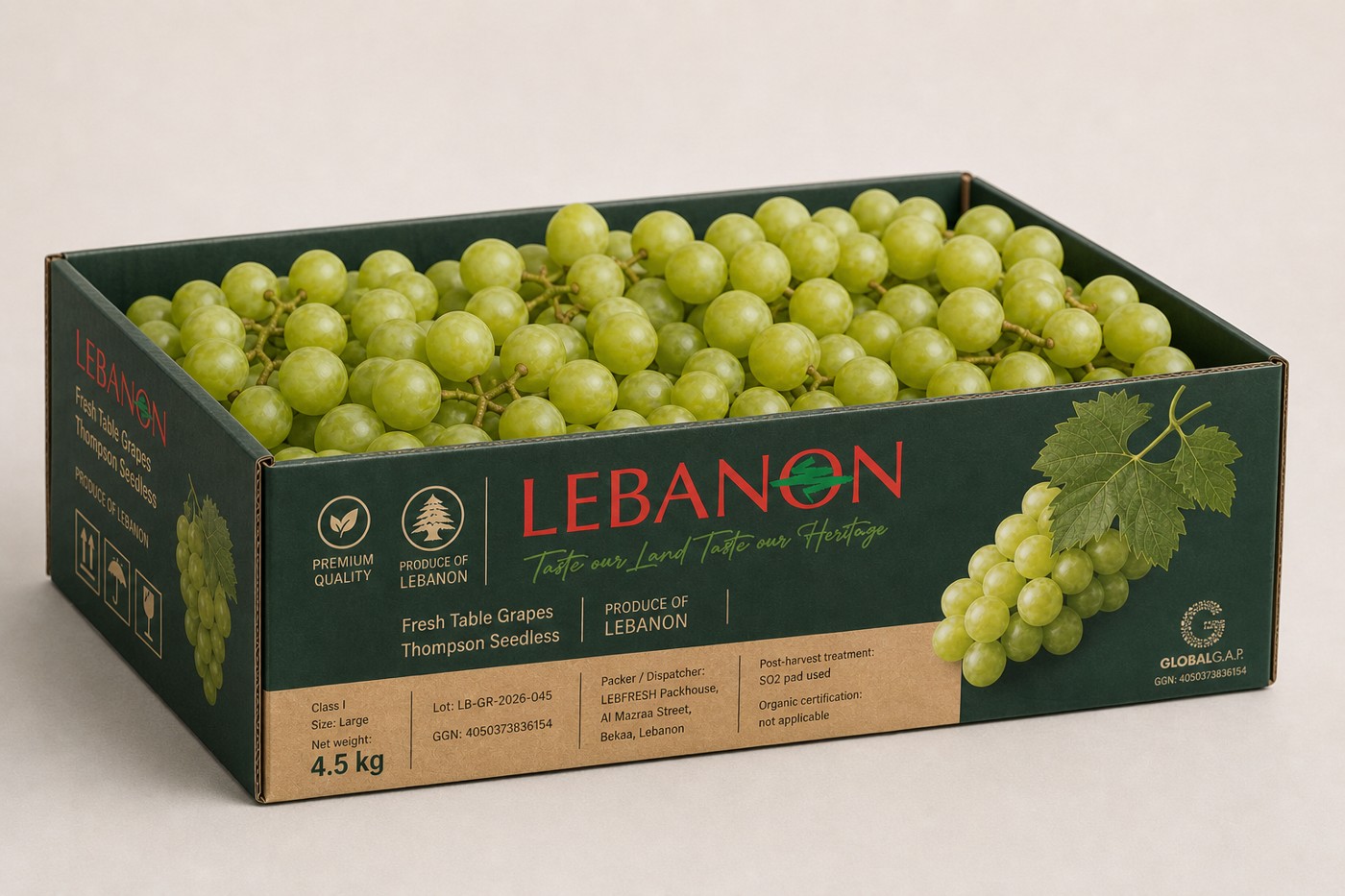
Sample export carton label — Table grapes from Lebanon to Germany
| FRESH TABLE GRAPES – THOMPSON SEEDLESS Produce of Lebanon Class I | Size: Large | Net weight: 4.5 kg Lot: LB-GR-2026-045 | GGN: [GLOBALG.A.P. number, if applicable] Packer: [Name and address] Exporter / Dispatcher: [Name and address] Destination: Germany Post-harvest treatment: [SO₂ pad used / None] Organic certification: [Only if certified — control body and certificate number] |
Retail pack labels
If table grapes are packed for retail sale in Germany, the consumer-facing label must comply with Regulation (EU) No 1169/2011 on food information to consumers and with buyer labelling requirements.
Mandatory consumer information should normally be provided in German, unless otherwise agreed with the buyer and permitted under applicable rules. Lebanese exporters should confirm the final retail label with the German buyer before printing, including product name, variety, origin, net weight, lot code, barcode, responsible food business operator, certification claims and any post-harvest treatment information.
Example export carton for table grapes
Tips
- Always discuss specific packaging requirements and preferences with your buyer.
- Find the legal requirements for packaging and labeling in our study on buyer requirements for fresh fruit and vegetables.
- If your product is pre-packaged for retail, check the additional requirements in the Codex General Standard for the Labelling of Pre-packaged Foods and Regulation (EU) No. 1169/2011 on the provision of food information to consumers in Europe.
- For more information on quality, size, packaging and labeling requirements, see the Table grapes, International Standards for Fruit and Vegetables, OECD Publishing, Paris.
Handling
Good handling is essential for Lebanese table grapes exported to Germany. Grapes are sensitive to bruising, berry shatter, dehydration, mould and temperature abuse. Many quality problems appear only after arrival, so exporters should control every step from harvest to loading.
After harvest, grapes should be kept in the shade, handled gently, moved quickly to the packhouse, pre-cooled as soon as possible and stored under a reliable cold chain. Damaged, mouldy, immature or poorly coloured bunches should be removed during grading.
Where exporters do not have their own facilities, they should work with reliable packhouses or cold-chain service providers that can support grading, packing, pre-cooling, cold storage, temperature monitoring and export handling.
| Control point | Good practice | Exporter evidence |
|---|---|---|
| Harvest | Harvest only when grapes meet the buyer’s maturity, colour and Brix requirements. Avoid bruising, berry shatter and damaged bunches. | Harvest lot record, Brix test, maturity and colour check |
| Field transport | Use clean field crates, avoid overfilling, and keep grapes shaded while waiting for transport to the packhouse. | Field quality checklist, harvest handling record |
| Packhouse | Grade carefully, remove damaged, mouldy, immature or poorly coloured bunches, and pack only uniform grapes. | QC report, pack-out data, rejected fruit record |
| Packaging | Use buyer-approved cartons, punnets, bags, liners or SO₂ pads where required. Protect grapes from crushing and dehydration. | Packaging specification, packed product photos |
| Cooling | Pre-cool grapes quickly after packing and keep the cold chain stable. | Pre-cooling record, cold-room temperature record |
| Loading | Avoid loading delays and check truck/container cleanliness, temperature and condition before loading. | Loading report, photos, container/truck checklist |
| Shipment | Agree temperature settings, ventilation and logistics arrangements with the German buyer/importer. | Temperature logger data, Bill of Lading/AWB/CMR |
| Arrival follow-up | Ask the buyer for arrival quality feedback to improve future shipments. | Arrival inspection report, buyer feedback, claim records |
What additional requirements do buyers often have?
Variety
European buyers often have additional requirements. These include specific grape varieties, food safety certification, and compliance with social and environmental standards. Your choice of grape variety depends on several criteria:
- the presence of seeds
- shape and color
- skin thickness
- maturity period
- resistance against diseases and pests
- transportability
- shelf life
You can cover a large season with early, mid-season and late varieties. The rest is a combination of finding the right, sweet taste and cost-competitive grape cultivar. There can be regional differences in grape preference. For example, northern Europe prefers mature seedless white grapes with thin skin and a sweet taste. Seedless grape consumption was developed later in southern Europe, and berry size is sometimes more important in countries such as Italy.
Tips
- Learn more about different grape varieties, characteristics and their seasonality. Consult sources like the harvest calendar of grape breeder SNFL group.
- Select the grape varieties that best suit your client’s market or find the right buyer for your variety. Visit your export market regularly to update your market knowledge.
Certification
Common certifications for table grapes include GlobalG.A.P. for good agricultural practices and BRCGS, IFS or similar HACCP-based food safety management systems for packing and processing facilities. Management systems recognised by the Global Food Safety Initiative (GFSI) are most recommended.
Complying with sustainable and social standards has become common for all fresh fruit and vegetables. Besides GlobalG.A.P. to ensure good agricultural practices, a social certificate such as Sedex Members Ethical Trade Audit (SMETA) is highly recommended to get your product up to retail standards.
Tips
- Implement at least one environmental and one social standard. See the Basket of Standards of The Sustainable Trade Initiative for Fruit and Vegetables (SIFAV).
- For other additional requirements such as payment and delivery terms, see the CBI’s reports on buyer requirements for fresh fruit and vegetables and the tips for doing business with European buyers.
Sustainability and social compliance
European buyers increasingly demand social and environmental compliance. This often means that you need to adhere to the buyer’s code of conduct or a third-party code of conduct. You can also opt for third-party certification schemes. Examples include:
- GLOBALG.A.P. Risk Assessment on Social Practice (GRASP): a GLOBALG.A.P add-on for the evaluation of worker’s well-being at the farm level.
- Supplier Ethical Data Exchange (SEDEX): a global initiative to make global supply chains more transparent. SEDEX has also developed a social auditing scheme – SMETA – to help companies assess the working conditions in and environmental performance of their business and supply chains.
Required documents and records
| Document / record | Purpose | Who prepares it | When to verify |
|---|---|---|---|
| Commercial invoice | Customs and payment documentation | Exporter | Before dispatch |
| Packing list | Package count, weight, lot and pallet details | Exporter / packhouse | Before loading |
| Certificate of origin | Origin declaration / preferential treatment if applicable | Competent authority / chamber depending on procedure | Before dispatch |
| Phytosanitary certificate | EU plant-health entry requirement | Lebanese plant health authority / NPPO | Before shipment |
| Residue lab report | Evidence of compliance with EU and buyer MRLs | Accredited laboratory / exporter | Before loading |
| Dry matter / maturity record | Evidence of harvest maturity and ripening suitability | Grower / packhouse | Before harvest or packing |
| Traceability records | Farm-to-buyer lot identification | Grower / packhouse / exporter | Always |
| GLOBALG.A.P. / packhouse certificates | Buyer certification requirement | Grower / packhouse | Before sales offer |
| Transport documents | Bill of Lading, Air Waybill, CMR or other logistics document | Freight forwarder / carrier | At dispatch |
| Organic e-COI | Only for organic shipments | Exporter / importer / control body through TRACES | Before customs clearance |
Top rejection risks before shipment
| Risk | Why it matters | Prevention | Priority |
|---|---|---|---|
| Pesticide residues above EU MRLs | This is the main RASFF-linked risk for Lebanese table grapes. MRL exceedances can lead to rejection, RASFF notification, buyer claims and loss of trust. | Use only approved pesticides, respect pre-harvest intervals, keep spray records, apply IPM and test before shipment. | Very high |
| Use or presence of prohibited active substances | RASFF history for Lebanese grapes included chlorpyrifos and monocrotophos, which were marked as prohibited in the RASFF summary. | Check every active substance against EU rules before use; do not rely only on local availability. Train growers and technical advisers. | Very high |
| High-risk grape pesticides: chlorpyrifos, monocrotophos, lambda-cyhalothrin and cypermethrin | These substances appeared in the RASFF-linked case for table grapes from Lebanon. Even one non-compliant residue can trigger rejection. | Include these substances in pre-shipment multi-residue testing and review spray programmes before the season. | Very high |
| Buyer limits stricter than EU MRLs | German retailers often apply private residue standards stricter than EU legal limits. A shipment may be legally compliant but still rejected by the buyer. | Confirm the German buyer’s residue policy before harvest and test against both EU MRLs and buyer limits. | Very high |
| Multiple residues in one lot | Even when individual residues are below limits, multiple residues can raise buyer concerns and affect commercial acceptance. | Reduce pesticide applications through IPM, avoid unnecessary tank mixes and monitor residue trends by farm and variety. | High |
| Missing or unreliable spray records | Without records, the exporter cannot investigate residue problems or defend the shipment in case of a claim. | Keep spray date, product name, active substance, dose, plot, operator and pre-harvest interval records. | High |
| Sampling not representative of the shipment | A clean lab result is weak if the sample does not represent the packed lot. | Sample by farm, variety, lot and packing date; keep sampling records and link lab reports to carton lot codes. | High |
| Missing or incorrect phytosanitary certificate | EU entry may be delayed or refused if plant-health documents are missing or inconsistent. | Apply early, verify product name, quantity, origin, exporter/importer details and match all shipment documents. | Very high |
| Pests, decay or poor bunch condition | Grapes are sensitive to mould, berry shatter and rapid deterioration. Poor condition can lead to rejection or price reduction. | Harvest carefully, sort strictly, remove damaged bunches, maintain hygiene and use buyer-approved SO₂ pads where required. | High |
| Broken cold chain | Temperature abuse increases decay, dehydration and quality claims. | Pre-cool quickly, maintain agreed temperature, use temperature loggers and check truck/container condition before loading. | High |
| Wrong or incomplete labels | Label errors create traceability and inspection problems. | Use buyer-approved labels and ensure lot codes match invoice, packing list, lab report, phytosanitary certificate and transport documents. | Medium-high |
| Missing certification | German retail programmes may require GLOBALG.A.P., GRASP, organic or packhouse food-safety certification. | Confirm certification requirements before contracting and keep certificates valid before shipment. | Medium-high |