
The Export of Table Grapes to UAE Legal Requirements & Standards
- Product description and classification
- The United Arab Emirates Bodies
- Food Import Procedure
- Quality Requirements
- Packaging Requirements
- Food Labeling
Product description and classification
| Harmonized System (HS) code | 08061000 Fresh grapes 08061010 Fresh table grapes |
| Top varieties found in Lebanon | Tfeifihi (also called Halawani) Baytamouni (also Beytamouneh “date of Beirut”) Maghdouchi (brown-skinned) Jbaai (dark-skinned) Thompson Seedless (Sultanina) Superior Seedless (Early Superior) Flame Seedless Crimson Seedless Black Pearl |
The United Arab Emirates Bodies
The United Arab Emirates (UAE) is a member of the Gulf Cooperation Council (GCC), which also includes Bahrain, Kuwait, Oman, Qatar, and Saudi Arabia. Within this framework, food safety and import requirements are largely harmonized under the Gulf Standardization Organization (GSO), which issues unified technical regulations for food imports across GCC member states.GSO standards form the primary reference framework for regulating imported food products, including fresh fruits and vegetables such as table grapes.
International Standards and Regulatory References
UAE and GCC food regulations are developed with reference to internationally recognized food safety frameworks:
- Codex Alimentarius Commission (FAO/WHO)
- International Organization for Standardization (ISO)
- European Food Safety Authority (EFSA)
- U.S. Food and Drug Administration (FDA)
- Official GCC technical regulations found at the Online Standards store.
Institutional Responsibilities for Food Import Control
Food import regulation in the UAE is implemented through federal and local authorities:
- MOCCAE: National food safety policy, GCC alignment, risk management, NFSC coordination
- ESMA: Technical standards development, GCC harmonization, conformity requirements
- UAE Municipalities: Product registration (FIRS/ZADI), inspections, labeling, testing, clearance decisions
Key Municipalities
Importers are encouraged to use the online services provided by the Municipalities as a resource for information on food item registration and product label requirements:
- Dubai Municipality
- Other local municipalities across the UAE
Import Control System Overview
- Step 1: Product Registration (FIRS / ZADI)
- Step 2: Compliance Review (standards, labeling, MRL)
- Step 3: Border Inspection (sampling & testing)
- Step 4: Release Decision (approved / rejected / re-export)
Food Import Procedure
Food Product Registration
Food product registration is a mandatory process for any business looking to legally import, manufacture, or sell food items in Dubai. Administered by the Dubai Municipality through platforms like the Dubai Municipality's Food Import and Re-export Service (FIRS) and the ZADI portal. This process ensures that all consumables strictly conform to local health, safety, and labeling standards.
UAE importers will apply online and provide a copy of the product’s label, packaging and official certificate from a competent authority in the country of origin. Once the request is approved, the importer will receive the product registration certificate and he may apply for an import permit and bring shipments through any port in the UAE.
Key Requirements for Users
- Account Creation: Companies must be registered with the Dubai Municipality portal to access online business services.
- Trade License: Your business must hold an active UAE-based trading license with valid food or general trading activities.
- Access: Food business operators with a Dubai ID can log in and link their companies to manage food safety requirements, including submitting necessary documentation like health certificates and test reports.
- Documentation: Required documents include a bill of entry, delivery order, health certificate, and certificate of origin.
- Compliance: Products must meet UAE standards, with mandatory ingredient and label disclosures
- Assessment: The Dubai Municipality evaluates ingredients and verifies the label. They may also request laboratory testing to assess product quality and check for prohibited substances.
Food Import Documentation
Before the table grapes leave the country of origin, the exporter must perform specific quality testing and secure official certifications. Dubai Municipality cross-references these files at the port of entry. These are the pre-Shipment testing & documentation:
Health Certificate: A certificate issued by the competent authority in the exporting country, verifying that the food items comply with health and safety standards.
Certificate of Origin: This certifies that the food products were manufactured or processed in the country of origin.
Certificate of Analysis (CoA): Issued by an accredited independent laboratory in the source country. This report outlines the initial testing data for the batch.
Labeling and Packaging Details: Grapes packed in consumer bags or boxes require an approved label review. The packaging must clearly state the country of origin, product name, batch/lot number, and production/expiry dates in Arabic (or a dual English/Arabic format)
Pesticide Residue Free / Organic Proof: If you market the grapes as organic, you must provide a valid organic certification matching the destination requirements. If the grapes contain synthetic residue, the CoA must show they fall below the strict UAE hierarchical MRLs (such as 0.01 mg/kg for standard default pesticides).
Quality Requirements
You must comply with the marketing standard for table grapes of General Requirements For Fresh Fruits And Vegetables GSO 123:1990 to export your products to the GCC countries.General Quality Requirements
At the very least, bunches and berries of fresh table grapes must be:
- homogenous with regard to: variety, ripeness, size, color and shape;
- fresh, fully mature, unwithered or wet, without change in color or characteristics or shall not be over riped
- clean; practically free of any visible foreign matter;
- practically free from pests; The fruit shall be free from insect infections, molds or diseases within the allowable limits in relevant Gulf standards for the product
- practically free from damage caused by pests;
- free from traces of chemical materials, and pesticides except within allowable limits in relevant Gulf standards for the product
- free from any foreign odor or taste;
- free from wounds, and bruises except within the allowable limits in relevant Gulf standards for the product
In addition, the grape berries must be intact, well-formed and normally developed. The package shall not contain any damaged fruit.
Classification
Fresh fruit and vegetables are graded according to their quality and specifications into three principal classes as follows:
- Extra class
- Class I
- Class II
Key Rule
All packages within a shipment must be uniform in quality and classification.
Any deviation from declared classification may result in the consignment being considered non-compliant or ungraded, leading to rejection or restricted market access.
Quality Tolerance Principle
Extra Class must meet or exceed Class I requirements
Class I must meet or exceed Class II requirements
No tolerance beyond the limits of the next lower class is permitted
Pesticides Residues and other contaminants
All table grapes exported to the UAE must comply with strict pesticide and contaminant regulations aligned with Codex and GCC standards, including:
UAE.S MRL 1/2024 – Maximum Residue Limits for pesticides in agricultural products
UAE.S GSO 2532/2016 – Maximum limits for pesticide residues in organic food
Core Principle
Pesticide residues must not exceed established Maximum Residue Limits (MRLs) expressed in mg/kg (milligrams per kilogram of food). Non-compliance may result in:
Shipment rejection
Destruction of goods
Re-export at exporter’s cost
Indicative MRL Thresholds (Table Grapes)
| Active Ingredient | Primary Class | Baseline UAE / Codex MRL Standard |
|---|---|---|
| Abamectin | Insecticide | 0.01 mg/kg |
| Azoxystrobin | Fungicide | 2.0 mg/kg |
| Boscalid | Fungicide | 5.0 mg/kg |
| Cypermethrin | Insecticide | 0.2 mg/kg |
| Dimethoate | Insecticide | 1.0 mg/kg |
| Pyraclostrobin | Fungicide | 0.5 mg/kg |
Critical Compliance Notice:
The following substances are subject to zero or near-zero tolerance policies:
Chlorpyrifos → restricted / near-zero detection limit (0.01 mg/kg)
Carbendazim → heavily restricted or prohibited under GCC/EU-aligned standards
Any detectable level of banned substances may result in automatic shipment rejection.
Default Rule for Unlisted Substances
If a pesticide is not explicitly listed in UAE or Codex MRL databases, a default strict limit of 0.01 mg/kg applies.
Packaging Chemical Safety
Packaging materials must also comply with food safety requirements:
No transfer of harmful substances to the product (no chemical migration)
Compliance with Codex Standard 193/1995 for food contact materials
Any post-harvest chemical treatment must be:
Approved by relevant authorities
Properly declared on documentation
Within GCC permissible limits
Organic Certification Requirements
For products marketed as organic, compliance with UAE.S GSO 2532/2016 is mandatory:
Maximum total pesticide residue: 0.01 mg/kg
Exceeding this threshold invalidates organic certification status
Product cannot be marketed or sold as organic in the UAE
Microbiological criteria
UAE food safety regulations adopt Codex-aligned microbiological standards to ensure product safety throughout the supply chain.
Key regulatory frameworks include:
UAE.S GSO 1694/2005 – General Principles of Food Hygiene
UAE.S 1016/2017 – Microbiological Criteria for Food Stuffs
Required Practices:
Exporters must apply:
Good Agricultural Practices (GAP)
Good Hygienic Practices (GHP)
Good Manufacturing Practices (GMP) during handling and packaging
These practices minimize contamination risks and ensure compliance with UAE food safety expectations.
Guiding Standard:
Exporters are strongly advised to follow Codex Alimentarius - Code Of Hygienic Practice For Fresh Fruits And Vegetables as a guideline.
Packaging Requirements
Packaging for table grapes must ensure the product stays safe, fresh, and undamaged during transport to the UAE. All packaging must comply with UAE.S/GSO 839:2021, UAE.S/GSO 1863/2021, and UAE.S GSO 2231/2012, which define GCC food-contact material safety rules.
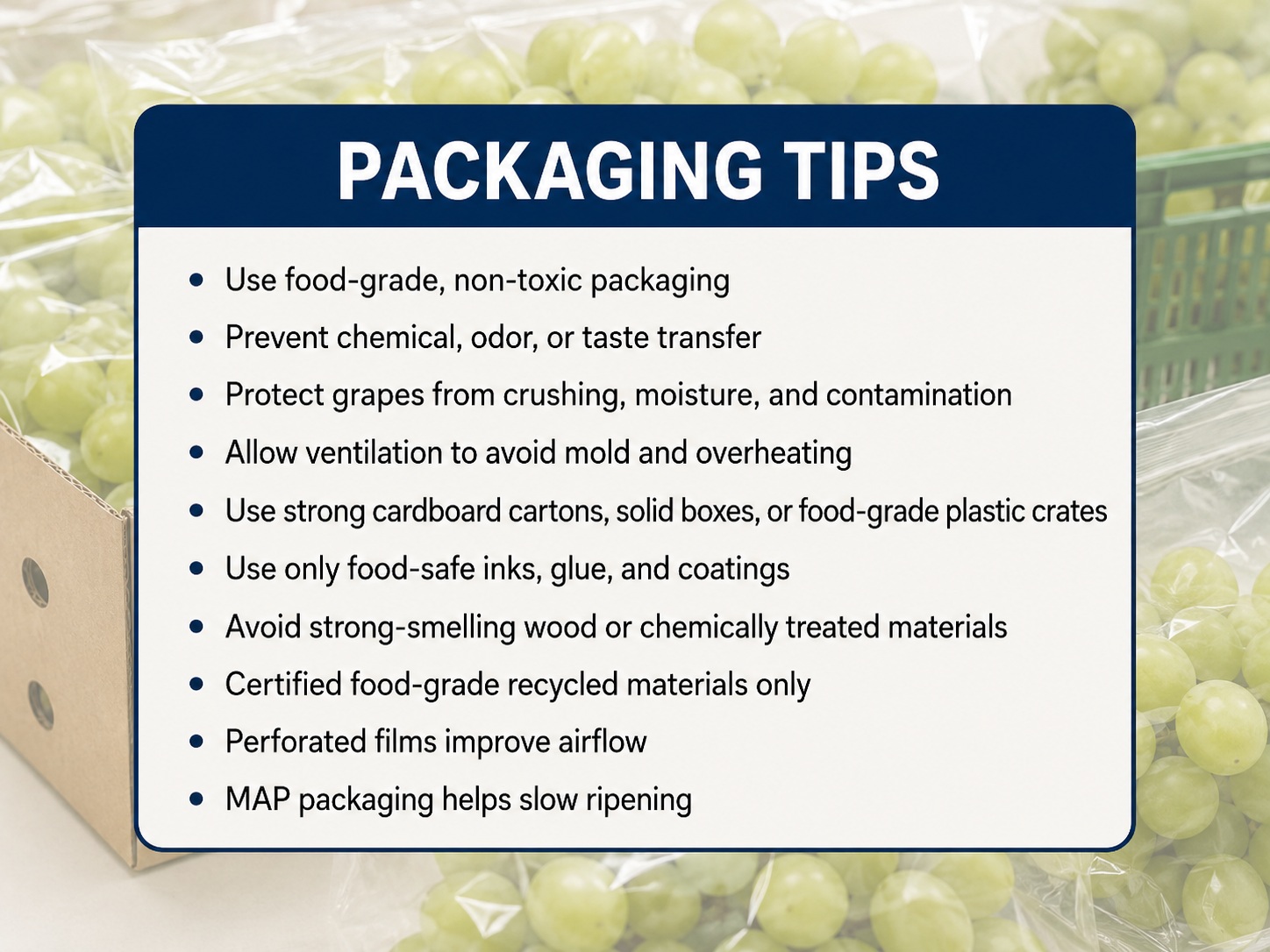
Key requirements
Must be food-grade, safe, and non-toxic
Must not transfer chemicals, odor, or taste to grapes
Must protect fruit from damage, moisture, and contamination
Must allow air circulation to prevent mold and overheating
Approved materials
Cardboard cartons (corrugated fiberboard)
Solid cardboard boxes
Food-grade plastic crates
Important rules
Packaging must be strong enough to prevent crushing or damage
No strong-smelling wood or chemical-treated materials
Only food-safe inks, glue, and coatings allowed
Recycled materials are only allowed if certified food-grade
Special packaging options
Perforated films → allow airflow and moisture control
MAP (Modified Atmosphere Packaging) → slows down fruit ripening
Simple rule
Packaging must protect grapes, keep them fresh, and never affect quality or safety
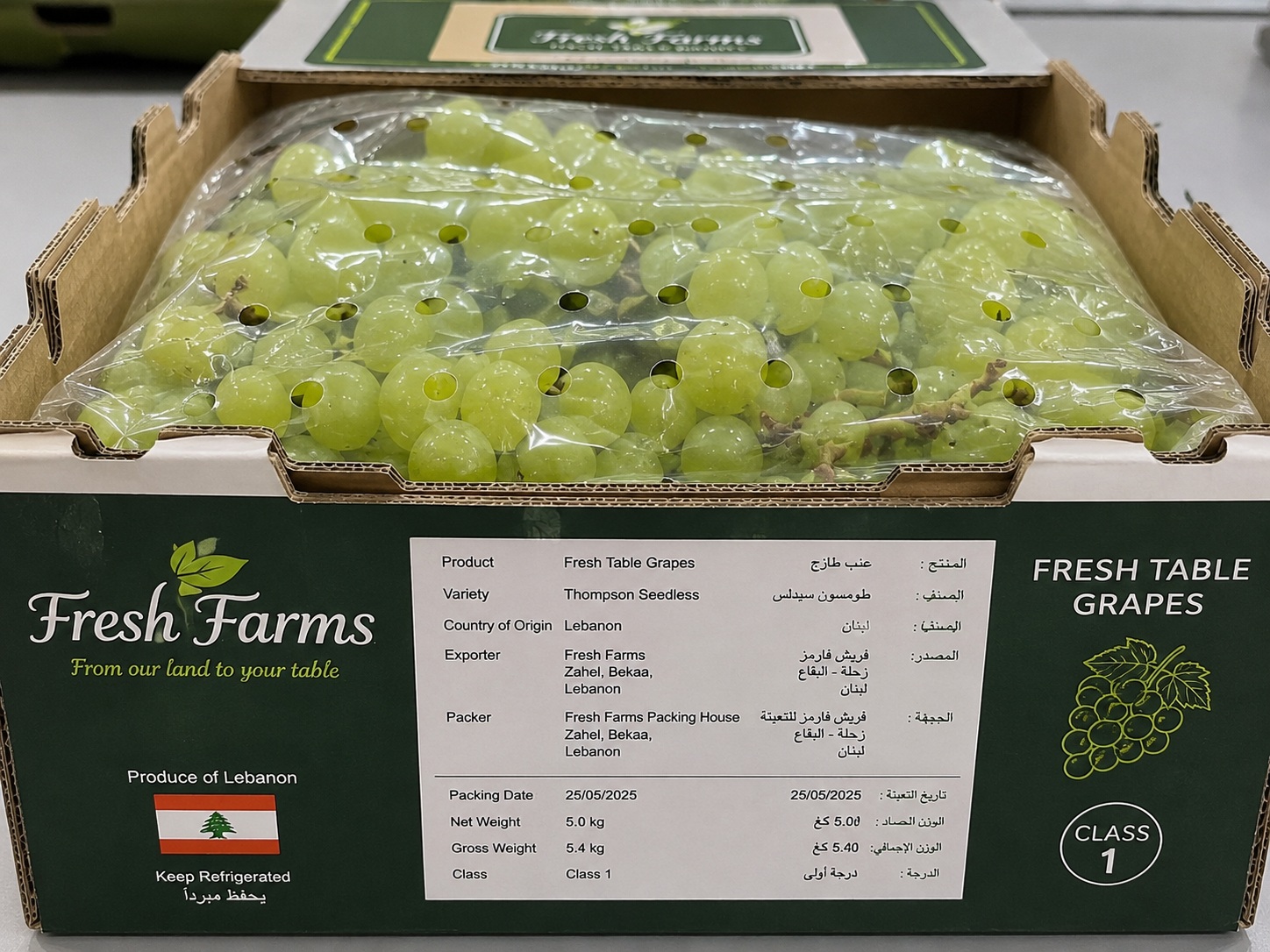
Example packaging for fresh table grapes
Packaging tips
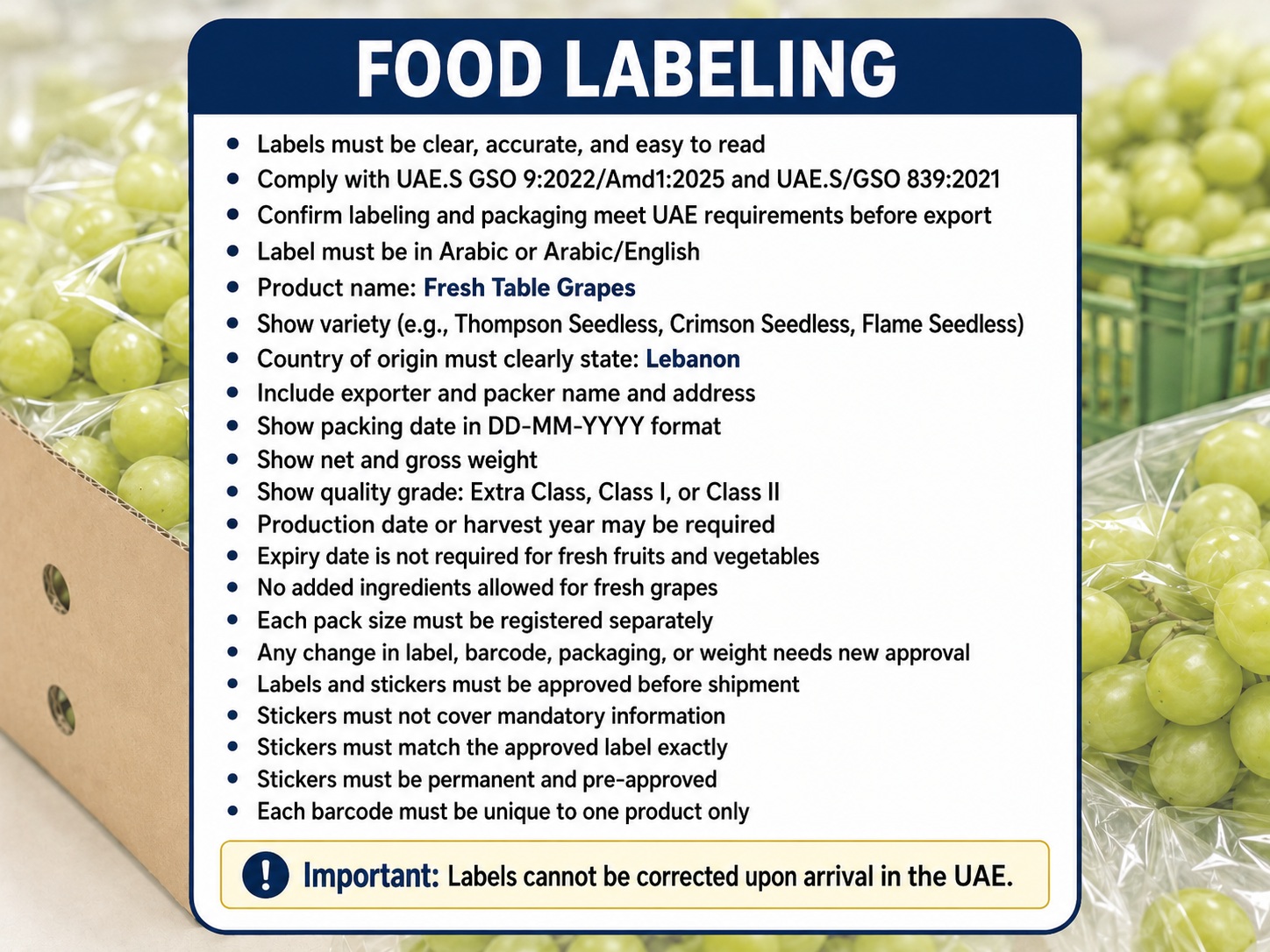
Food Labeling
Labeling rules apply to all food products packed in bulk or retail packaging. Exporters must ensure all label information is clear, accurate, and easy to read to avoid shipment rejection in the UAE.All products must comply with UAE.S GSO 9:2022/Amd1:2025 (food labeling) and UAE.S/GSO 839:2021 (food packaging requirements), which set the rules for packaging materials and label content.
Before export, Lebanese exporters should always confirm that their labeling and packaging meet UAE requirements.
General Requirements:
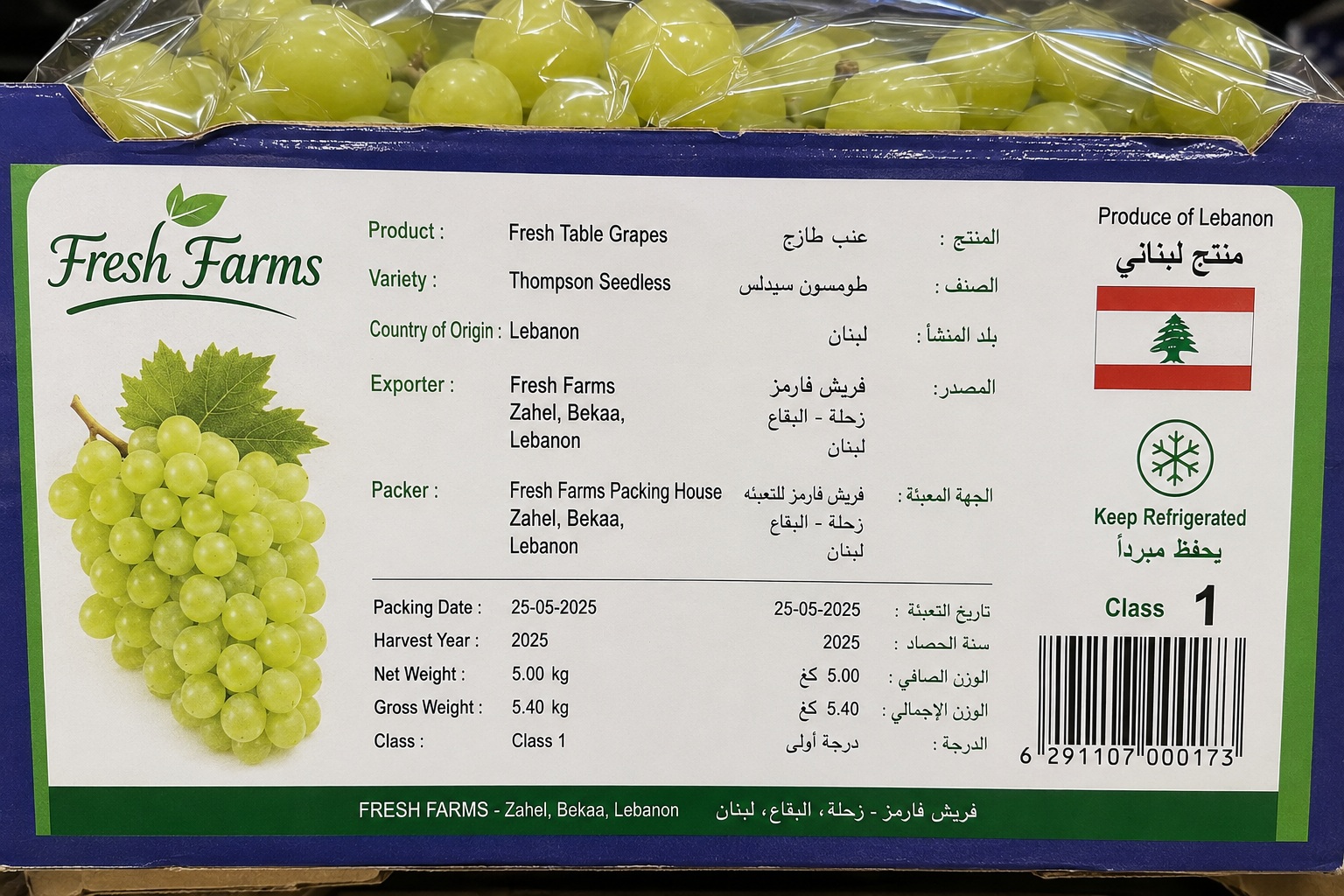
For table grapes exported to the UAE, the outer carton or crate must have a clear and readable label in Arabic or in Arabic/English. Each package must include the following key information:
Product name: Fresh Table Grapes
Variety (e.g., Thompson Seedless, Crimson Seedless, Flame Seedless)
Country of origin (must clearly state “Lebanon”)
Exporter and packer details (name and address)
Packing date (DD-MM-YYYY format)
Net and gross weight
Quality grade (Extra Class, Class I, or Class II)
Important: No added ingredients are allowed. If grapes are mixed with any other items, they will no longer be treated as fresh produce and must follow full prepackaged food rules.
Table Grapes Labeling Specifications:
This section covers label content, registration controls, sticker rules, and enforcement requirements applied by UAE authorities.
Labeling Requirements (Dates & Basic Rules)
For fresh fruits and vegetables, UAE regulations require:
Production date or harvest year
Packing date (depending on product type)
An expiry date is not required for fresh fruits and vegetables, dried legumes, or dried vegetables.
Key Labeling Control Requirements (Dubai Rules)
To ensure compliance, exporters and importers must follow strict control rules:
Newly registered products may undergo laboratory testing in Dubai
If an ingredient or additive is found but not declared on the label, the product may be rejected
Each different pack size (e.g., 100g vs 200g) must be registered separately
Any change in label, barcode, packaging, or weight requires new label approval (re-assessment)
Labels must be approved before shipment and cannot be corrected upon arrival
Stickers must be pre-approved and applied before export
Each barcode must be unique to one product only
Sticker Rules (Strict Enforcement)
All stickers used on packaging must:
Not cover any mandatory label information
Match the original approved label exactly
Not include production or expiry dates
Be permanent and not easily removable
Be approved by UAE authorities before use
Example table grape label
Food labeling guidance
Specific Labeling Claims
Exporters must be careful when adding any claim to the label of table grapes exported to the UAE. Claims must be clear, truthful, and supported by official proof when required. Any statement that cannot be verified may lead to label rejection or shipment delays.
Nutritional and Marketing Claims
All nutrition, health, and marketing claims must follow UAE/GCC rules, including:
UAE.S GSO CAC GL 1/2008 – General Claims Guidelines
UAE.S GSO 2333/2019 – Nutrition and Health Claims
UAE.S 2233/2021 – Nutrition Labeling Requirements
UAE.S GSO 2576:2021 – Marketing Terms on Labels
For fresh grapes, exporters should avoid using claims unless they are accurate and can be proven.
Examples of claims that need support:
“Premium”
“Sweet”
“High quality”
“Organic”
“GMO-free”
“Natural”
Simple rule:
Any claim on the label must be true, verifiable, and not misleading.
Irradiated Food Labeling
If grapes are treated with irradiation, this must be clearly mentioned on the label.
The package must also show the international irradiation logo, as required by UAE.S GSO 9/2019.
For fresh fruits and vegetables, irradiation is only allowed when it follows the technical and safety limits under GSO 1814:2007.
Organic Food Labeling
If grapes are labeled or marketed as “organic” in the UAE, they must:
Come from certified organic farms
Show the approved organic logo on the package
Be supported by an accredited certificate recognized by the UAE authorities
This requirement is based on UAE.S GSO 2374/2014.
If the grapes are organic but the word “organic” is not used on the label or in marketing, then no organic certificate or attestation is required.
Genetically Modified Products — GMO
Under UAE.S/GSO 2142:2011, GMO labeling is required if an agricultural product contains more than 1% genetically modified material.
Any GMO product must also be approved in the country of origin for human or animal consumption.
GMO-Free Labeling
If the label says “GMO Free,” the supplier must provide an official GMO-free certificate issued by a competent government authority in the country of origin.
Weight and Label Accuracy
UAE rules also check whether the weight shown on the label matches the real product weight.
Under UAE.S/GSO OIML R 87:2007, grapes may be sold as fixed-weight packs or variable-weight packs.
Fixed Pre-Packs
Examples: 500 g clamshells, 1 kg bags
For fixed pre-packs:
All packs must show the same declared weight
The average batch weight must match the label
Small weight differences may be accepted within allowed limits
If packs are underweight, the shipment may be rejected
Variable Weight Packs
Examples: catchweight punnets or packs sold by actual weight
For variable-weight packs:
Each pack may have a different weight
Each label must show the exact real weight of that specific pack
The average-weight rule does not apply
Simple Rule to Remember
The label must always match the product exactly.
All claims, weights, origin details, and quality information must be truthful, clear, and supported by documents when required.
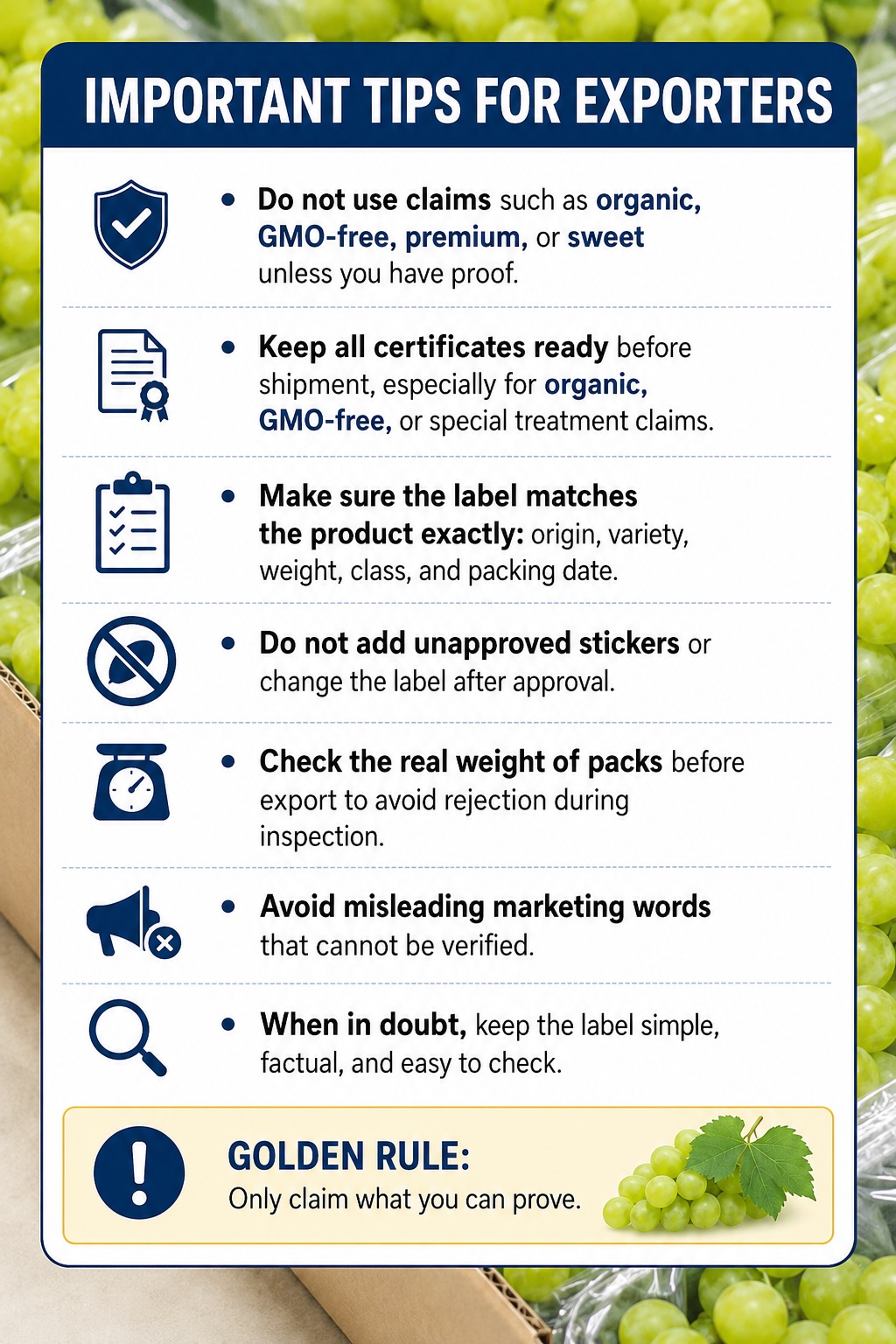
Important tips for exporters

Tips
- Only write claims on the label if you have documents, certificates, or clear evidence to support them.
- Do not use irradiation unless it is approved, documented, and correctly declared on the label.
- Do not write “organic” unless you have the official certificate.
- For fresh table grapes, avoid GMO-related claims unless you have official proof.
- Do not use “GMO Free” as a marketing claim unless the official certificate is available before export.
- Check weight accuracy before shipment. One underweight pack can create problems for the full batch during inspection.