
Promising Markets For Potatoes UK
Product description and classification
Fresh potatoes fall under HS heading 0701: potatoes, fresh or chilled. This roadmap focuses on non-seed ware/table potatoes rather than planting material. For Lebanese exporters, the priority is not a generic potato offer but a specific seasonal product that can fit a UK buyer programme.
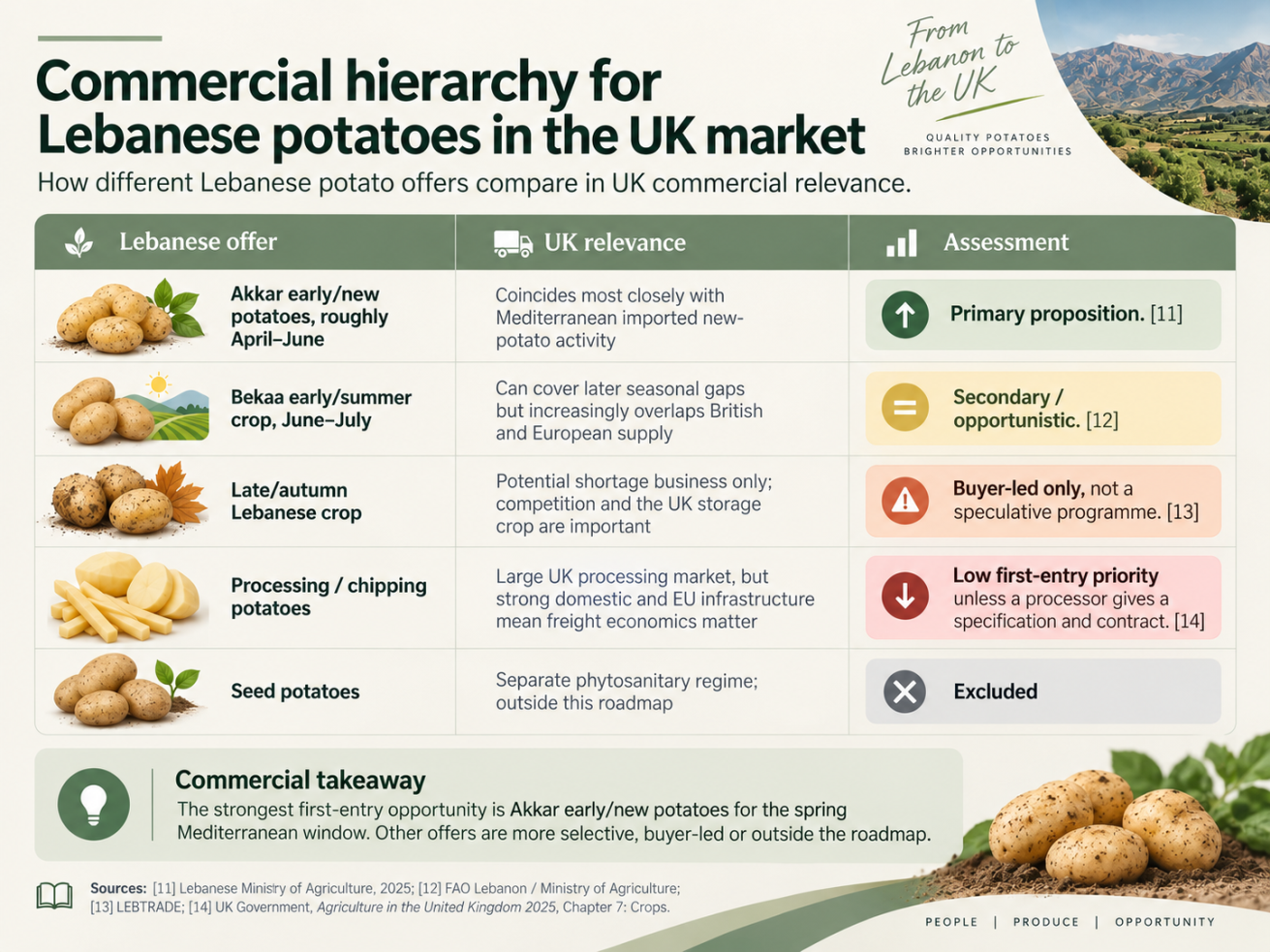
The strongest first proposition is early/new table potatoes with attractive skin finish, consistent sizing and clear traceability. Spunta is commercially useful because it is known to UK potato buyers through Cypriot supply, but UK acceptance still depends on buyer specification, residue compliance and arrival quality.
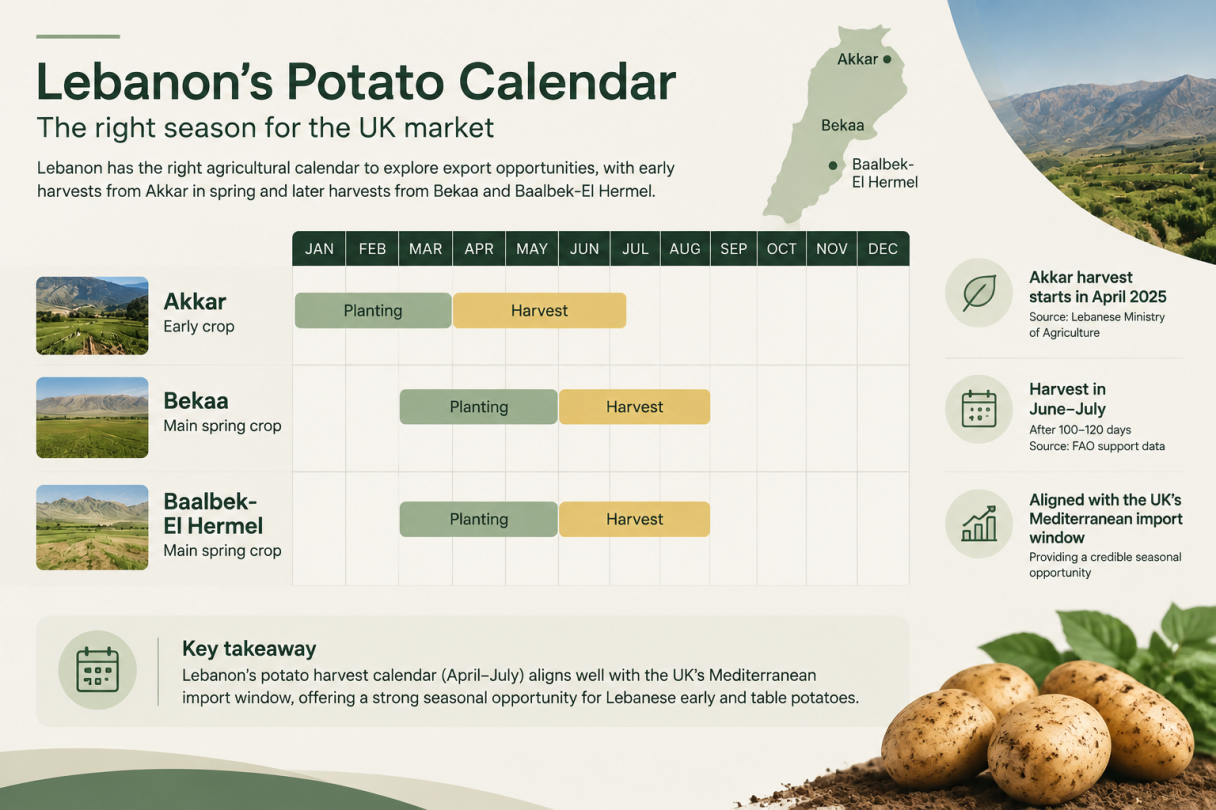
The calendar indicates why Akkar early potatoes are the best starting point. Bekaa and Baalbek-El Hermel can support later opportunities, but they should be treated as secondary or buyer-led programmes rather than a broad speculative season.
What you should prepare before approaching buyers
Why this matters: UK buyers do not buy a generic potato offer. They buy a product that fits an existing programme. |
Market opportunity
The UK is a large end-consumption and processing market with substantial domestic potato production. It should not be treated as a structurally short fresh-potato market. The practical opportunity for Lebanon is to supply seasonal and specification gaps, not to compete as a bulk commodity origin.
The user-supplied Trade Map analysis shows that UK HS 0701 imports moved from about US$61.8 million in 2023 to US$117.6 million in 2024, then back to about US$70.3 million in 2025. This volatility confirms that imports can matter when supply conditions change, but they are not a guaranteed annual opening. Source: user-supplied analysis.
In 2025, the relevant competitor set included nearby European suppliers such as the Netherlands, France, Ireland and Belgium, plus Mediterranean suppliers such as Israel, Cyprus and Egypt. Lebanon belongs in the Mediterranean seasonal group, not the rapid European shortage-response group. Source: user-supplied analysis.
What this means for exporters
|
Competitive position
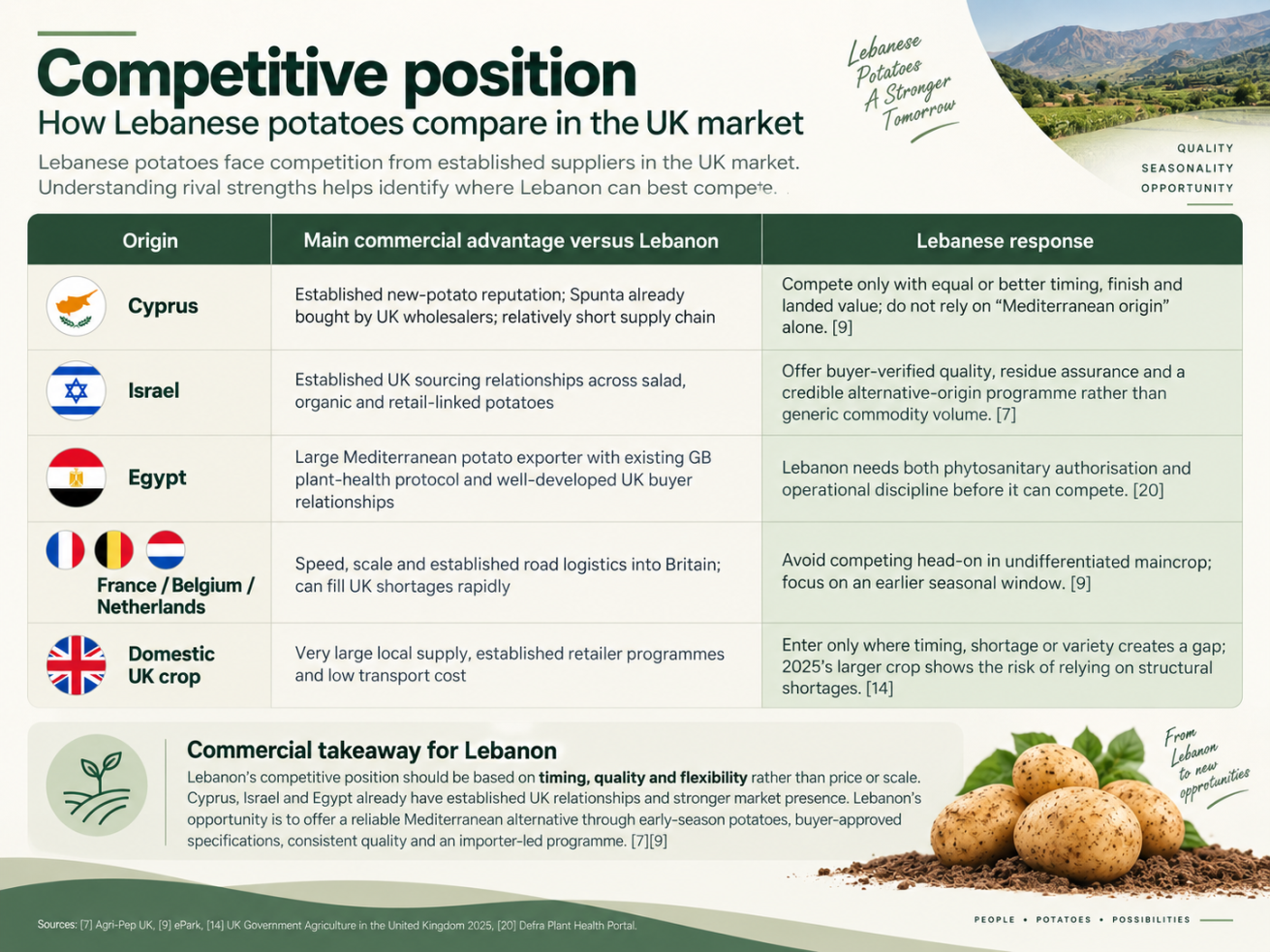
Lebanon should compete on timing, quality and flexibility rather than price or scale. Cyprus, Israel and Egypt already have stronger UK relationships, while nearby European suppliers can react quickly when the UK needs short supply. Lebanon’s opportunity is to be a reliable additional Mediterranean origin with buyer-approved specifications. [7][9]
What you should learn from competitors
|
Pricing and landed-cost logic
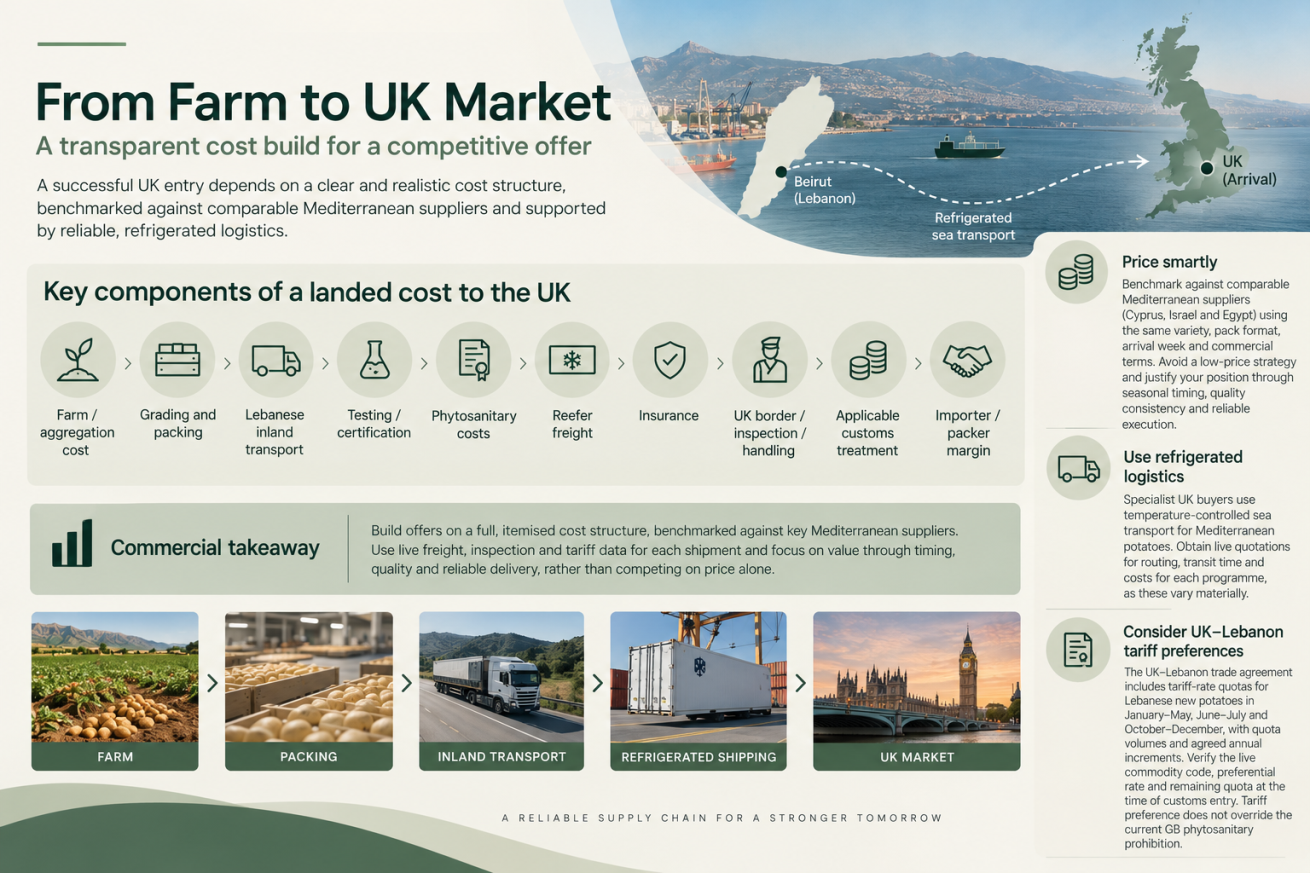
Pricing should be built from a full landed-cost stack, not from farm price alone. Each offer should be benchmarked against comparable Mediterranean suppliers using the same variety, pack format, arrival week and commercial terms. Source: user-supplied analysis.
The landed-cost model should include: farm/aggregation cost + grading and packing + Lebanese inland transport + testing/certification + phytosanitary costs + reefer freight + insurance + UK border/inspection/handling + applicable customs treatment + importer/packer margin.
What you should do before quoting a buyer
Why this matters: Potato prices change by week, origin, variety, pack and buyer channel. |
Market entry route
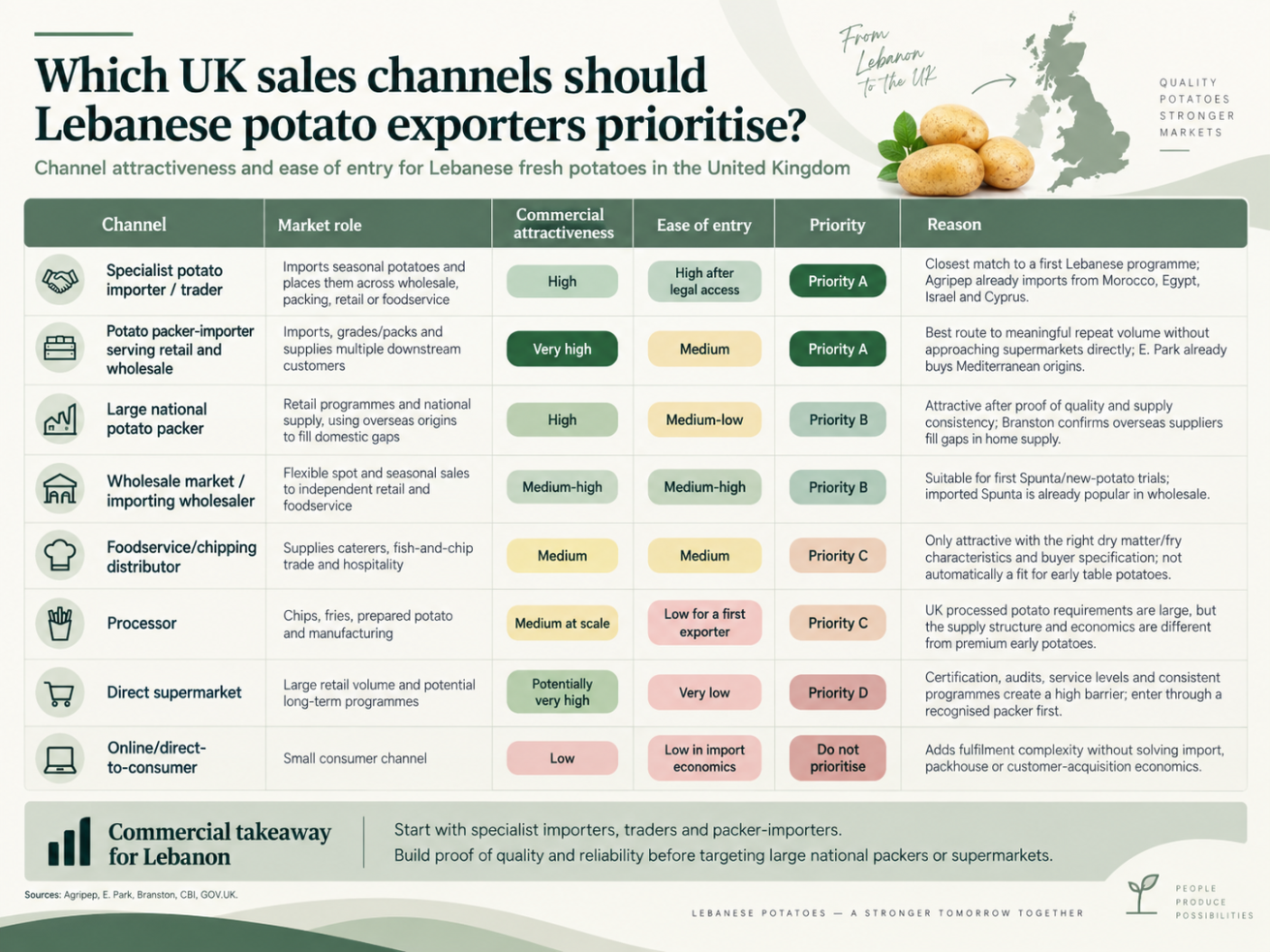
The first entry route should be importer-led. Direct supermarket access should come later, after one controlled pilot has proven specifications, quality, claims handling and delivery reliability. [23]
What you should do first
Why this matters: Specialist importers can manage UK requirements and place product into the right downstream channel. |
For logistics, the first programme should be built around one confirmed route selected with the UK buyer. Obtain at least three current door-to-port or door-to-buyer quotations and compare total landed cost and schedule reliability, not only ocean freight. Source: user-supplied analysis.
Finding and qualifying buyers
The best lead list is not a random directory. Start with companies that publicly import potatoes from Mediterranean origins, then validate the right procurement or technical contact. Agripep and E. Park are stronger first-wave leads than a generic supermarket list because their own websites show Mediterranean potato sourcing. [7][9]
Buyer type | Example | Exporter approach |
Specialist importer/trader | Agripep UK | First-wave contact; send crop calendar, varieties, certification status, volume and proposed UK window. |
Importer/packer | E. Park & Sons | Lead with early potatoes/Spunta and ask which arrival weeks are hardest to cover. |
Large national packer | Branston | Second-stage prospect after proof of access, quality and repeatability. |
Wholesale bridge | Fruits of Lebanon, London | Use for market intelligence; confirm whether it currently handles fresh potatoes. |
How you should build your buyer list
Why this matters: The right contact and basic due diligence are more valuable than a long unqualified list. |
Buyer outreach and promotion
The promotional message should solve a buyer problem. Avoid generic claims such as “high-quality potatoes” unless you can prove them. A credible value proposition is:
“Traceable Lebanese early potatoes from controlled Akkar/Bekaa production, available in a defined Mediterranean supply window, packed to UK buyer specification, with documented plant-health and residue controls and flexible importer-led programmes.”
What your buyer presentation should show
|
Trade fairs should be used for targeted meetings, not general exposure. Fruit Attraction 2026 is useful for buyer development ahead of the 2027 crop, while FRUIT LOGISTICA 2027 is better timed for confirming spring programmes if market access has advanced. [36][37]
The exporter website should make the offer clear in under one minute: origin, harvest weeks, varieties, exportable tonnes by week, pack options, certifications, residue testing, traceability, packhouse images and a named export contact.
Doing business with UK buyers
UK potato buyers are likely to respond better to a specific offer than a long introductory story. State what is available, when, from which region, what volume can be supplied, which certifications are held and how the offer complements the buyer’s current Mediterranean programme. [7]
Practical working rules
|
Reliability should be treated as part of the product. A one-week delay can move the shipment into a different competitive situation as domestic or European potatoes become available. UK buyers therefore need prompt replies, realistic crop forecasts and early warning of yield, quality or shipping problems.
Risks and commercial gates
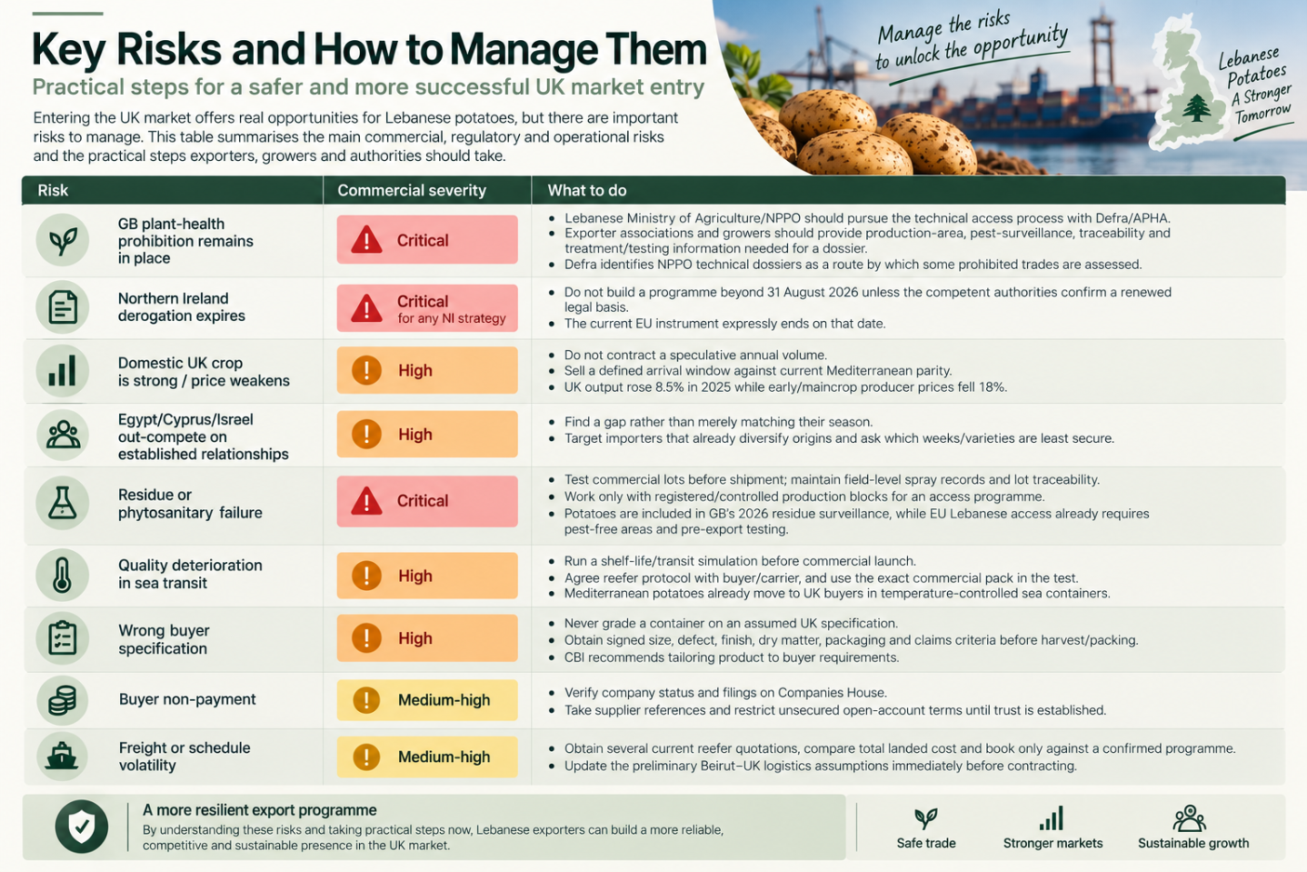
The UK opportunity remains conditional. Exporters should manage risk before shipment rather than trying to solve issues after arrival. The most important risks are plant-health access, buyer specification, residue/phytosanitary compliance, transit quality, payment security and freight volatility.
Practical risk-control priorities
|
Gate | Minimum condition | Decision if failed |
Market access | Written confirmation that the specific Lebanese potatoes/origin/area may enter the UK territory | Stop shipment |
Buyer | Named importer/packer, written specification, pack, arrival week, Incoterm and claims procedure | Do not ship speculatively |
Production | Approved farm/field, variety, traceability and realistic weekly volume | Reduce or stop programme |
Compliance | Required certification, residue test and phytosanitary documentation are cleared | Stop affected lot |
Economics/credit | Landed cost, buyer status and payment terms are acceptable | Renegotiate or decline |
Pilot | First load passes agreed arrival-quality review | Correct before scaling |
3–6 month exporter action roadmap
Timing | Priority action | Output |
Month 1 | Build access file and buyer shortlist | Farm registration, traceability file, production-area data and priority UK importer/packer list. |
Month 2 | Validate specifications and sample requirements | Buyer-ready technical pack and shortlist of realistic pilot partners. |
Months 3–6 | Prepare controlled pilot programme | Importer/packer, volume, logistics, Incoterm, inspection criteria, claims procedure and landed-cost model. |
Practical checklist before exporting
|
Final message for exporters: Do not start with volume. Start with proof. A successful UK potato programme will be built by showing buyers that Lebanon can deliver the right product, at the right time, with the right controls.