Promising Markets For
Product description and classification
Your product falls under HS code 080440, fresh or dried avocados. For the Saudi market, the practical export focus should be fresh Hass avocado. Lamb Hass can be used as a narrower later-season follow-on line. Green-skin varieties should be offered only when a Saudi buyer specifically asks for them.
For Lebanon, the product baseline should be simple: Class I appearance, consistent size count, clean cartons, reliable pre-cooling, controlled maturity and clear origin documentation. Avocados are sensitive because buyers judge not only the fruit at loading, but also ripening behaviour, firmness, shelf life and claims after arrival.
This roadmap assumes a Lebanese producer/exporter selling conventional fresh avocados through a Saudi importer-distributor. If the exporter already has strong certification, residue controls and a proven packhouse system, the Saudi entry path becomes stronger. If not, the first priority is to prepare the export system before sending volume.
Market opportunity
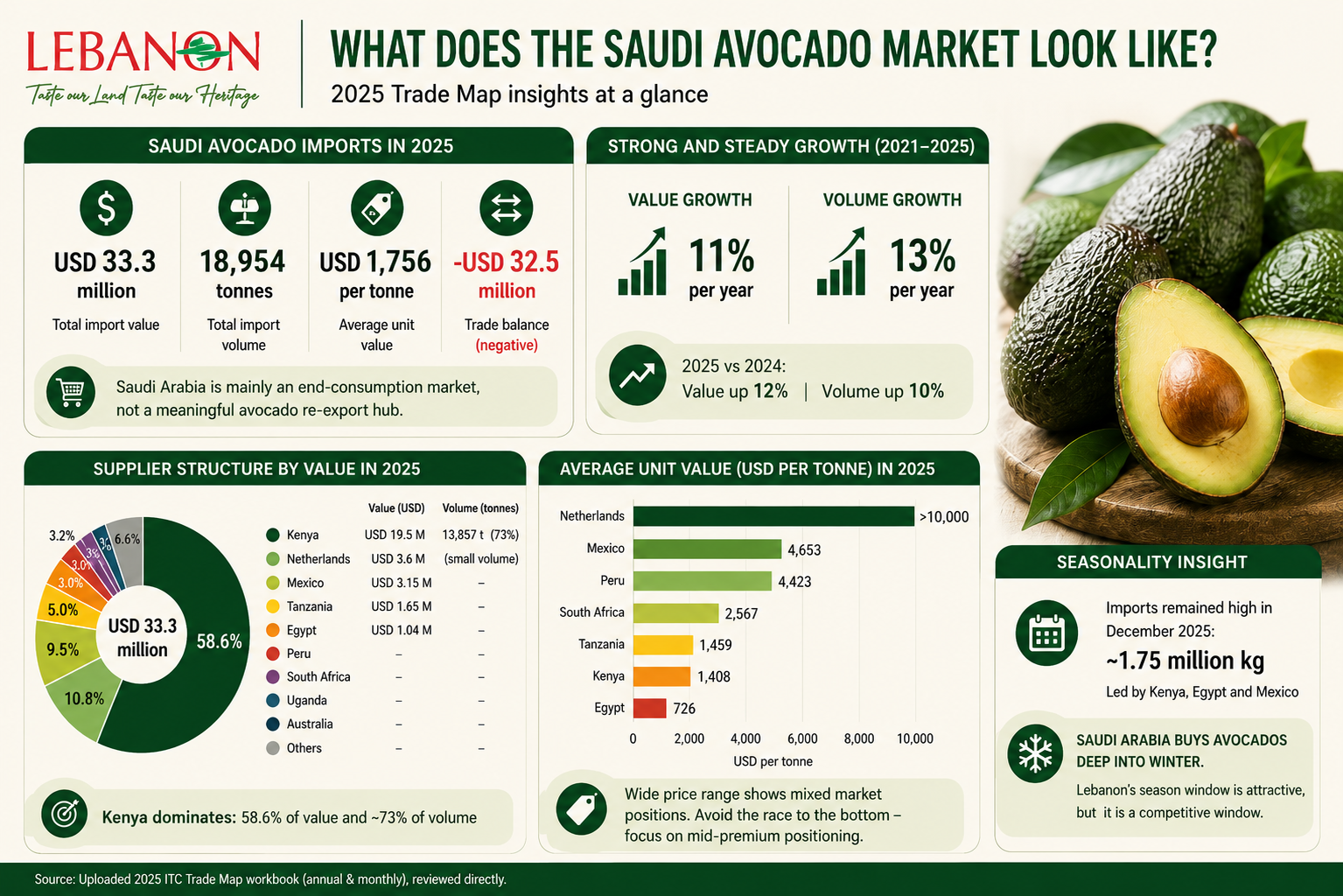
Saudi Arabia is attractive because it is a sizeable and growing avocado import market. According to the 2025 Trade Map workbook reviewed in the original roadmap, Saudi Arabia imported about USD 33.3 million of avocados in 2025, equal to 18,954 tonnes, at an average unit value of about USD 1,756 per tonne.
The market is also competitive. Kenya is the main volume supplier, Egypt is the low-price benchmark, and Mexico and Peru sit closer to the premium end. This means Lebanon should not enter as the cheapest supplier or as a large-volume origin. The more realistic position is short-transit, mid-premium and importer-led.
The figure below summarises the Saudi avocado market and why Lebanon should enter carefully: demand is real, but supplier roles are already clear.
Market snapshot: Saudi avocado import size, growth, supplier structure and price benchmarks.
What this means for you as a Lebanese avocado exporter
Your first goal is not to replace Kenya or compete with Egypt on price. Your first goal is to prove that Lebanese Hass can arrive in good condition, with clean documents, controlled temperature and a buyer who can handle the fruit properly.
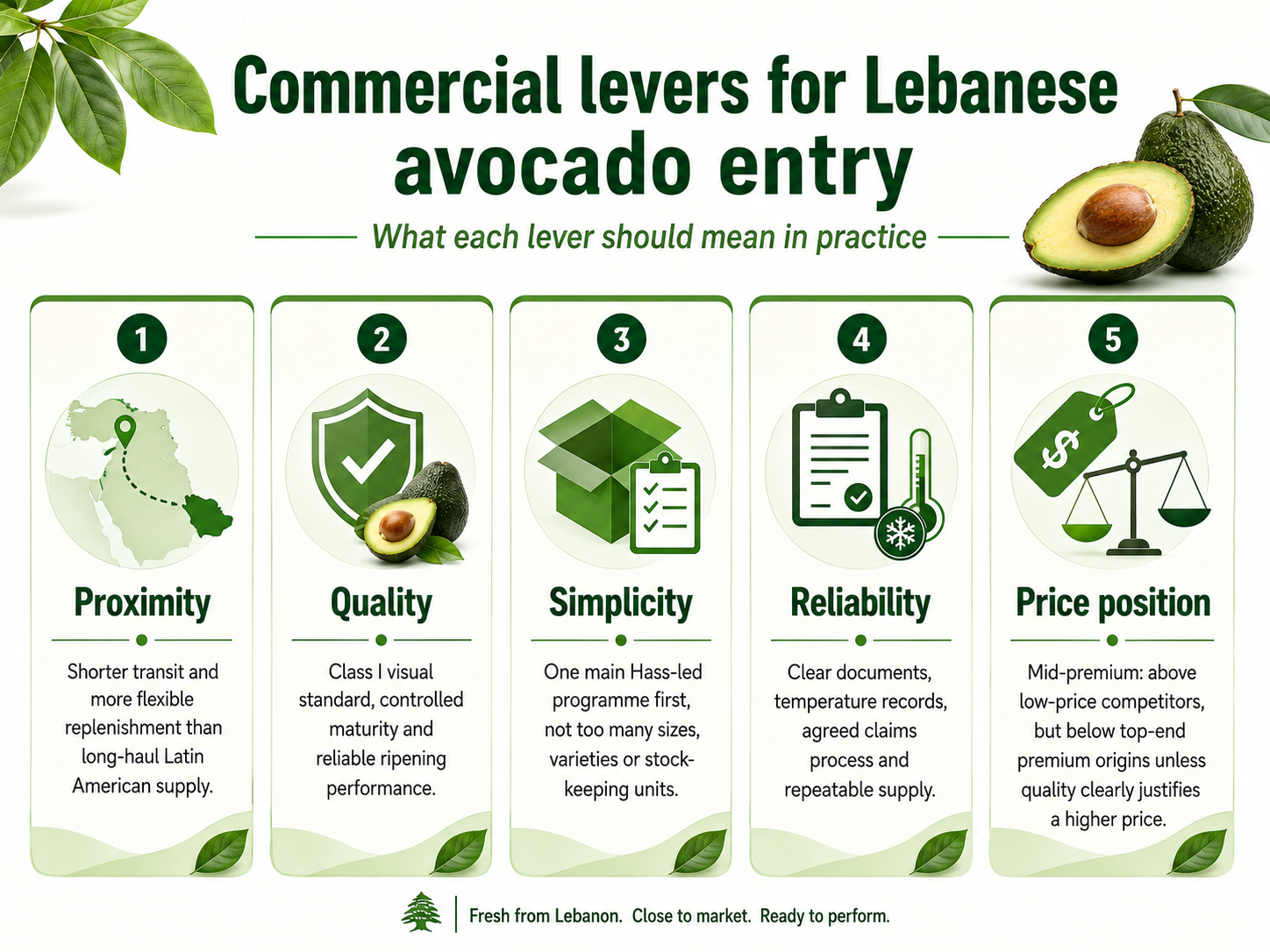
The strongest commercial message is practical: fresh Lebanese Hass avocados with short transit, flexible supply, controlled maturity and reliable importer-led delivery.
Lebanon’s practical export levers: proximity, quality, simplicity, reliability and price position.
Seasonality and entry timing
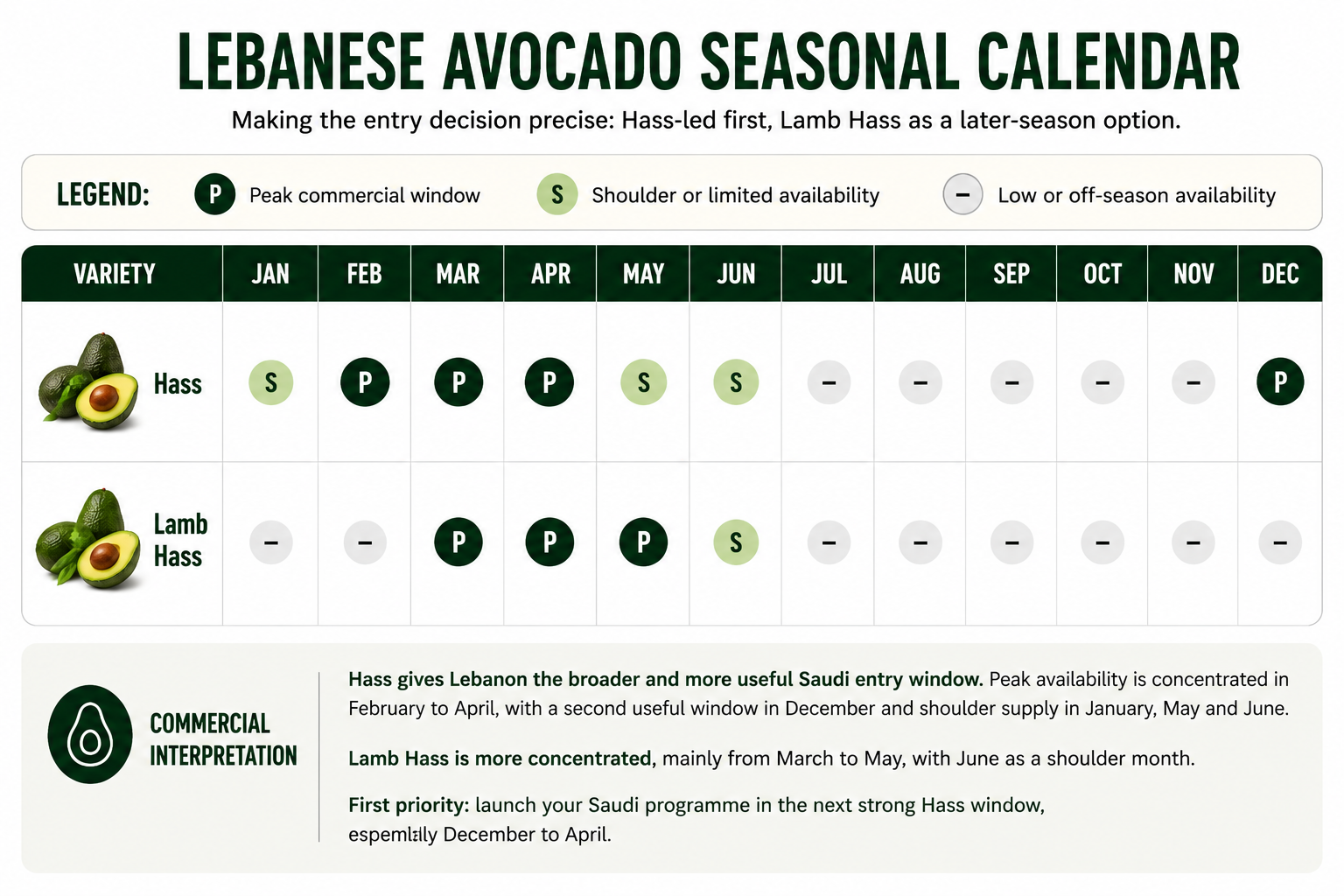
Lebanon’s avocado calendar supports a Hass-led entry. Hass gives the broadest commercial window, with peak availability mainly from February to April and a useful December window. Lamb Hass can support a later spring offer, but should not be the main launch product.
If the exporter is starting market work in June, the short-term task is buyer validation, carton approval, maturity planning and price discussion rather than a rushed large shipment. The best first commercial window is the next strong Hass window, especially December to April, depending on fruit quality and buyer demand.
Indicative Lebanese Hass and Lamb Hass calendar for Saudi entry planning.
| Key takeaway: Use the coming months to prepare the buyer, specification, carton, maturity plan and logistics route. Do not wait until harvest to start commercial validation. |
Market entry
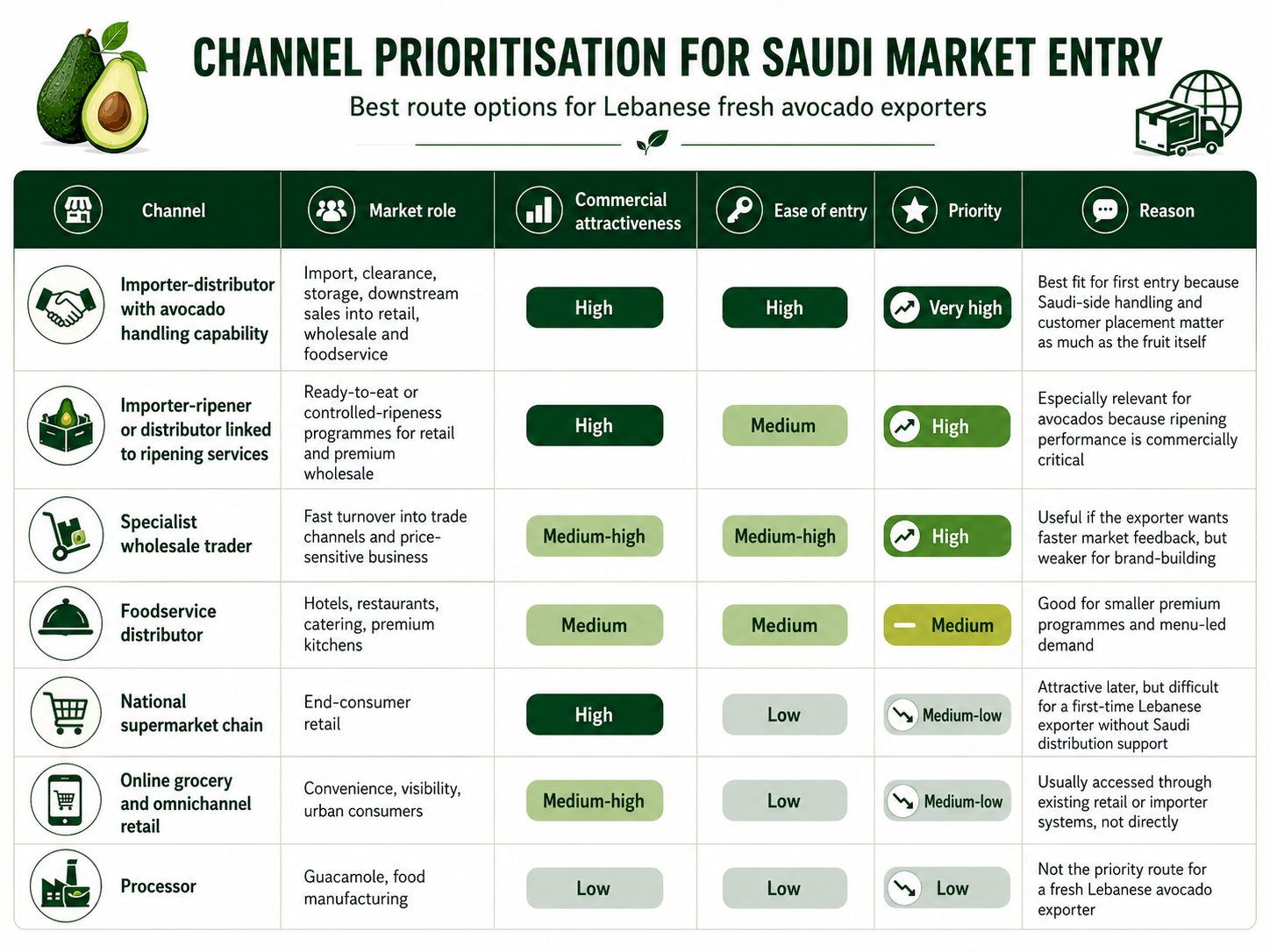
For a first Saudi entry, you should focus on importer-distributors and avocado-capable fresh produce partners. These channels can import, clear, store, handle and sell the fruit into retail, wholesale or foodservice channels. Direct supermarket access should come later, after one or two successful controlled shipments.
This channel choice is important because avocados require cold-chain discipline, maturity control, arrival inspection and claims management. The ideal first partner is not only a trader. It is a Saudi partner that understands avocado handling and can place the fruit into the right customers.
Recommended Saudi entry channels for Lebanese fresh avocado exporters.
What should the first entry look like?
| Step | Exporter action | Commercial purpose |
| 1 | Build a short buyer list of importer-distributors, avocado handlers and fresh-produce importers. | Avoid wasting time on buyers that cannot clear, store or handle avocados. |
| 2 | Share a simple technical pack: variety, size count, carton, season, maturity approach and certifications. | Make the buyer decision easier and reduce misunderstandings. |
| 3 | Agree one controlled trial shipment before offering a large season programme. | Use the first shipment to prove arrival quality, not to maximise volume. |
| 4 | Collect written arrival feedback and temperature evidence. | Build credibility and decide whether to scale. |
Finding potential buyers
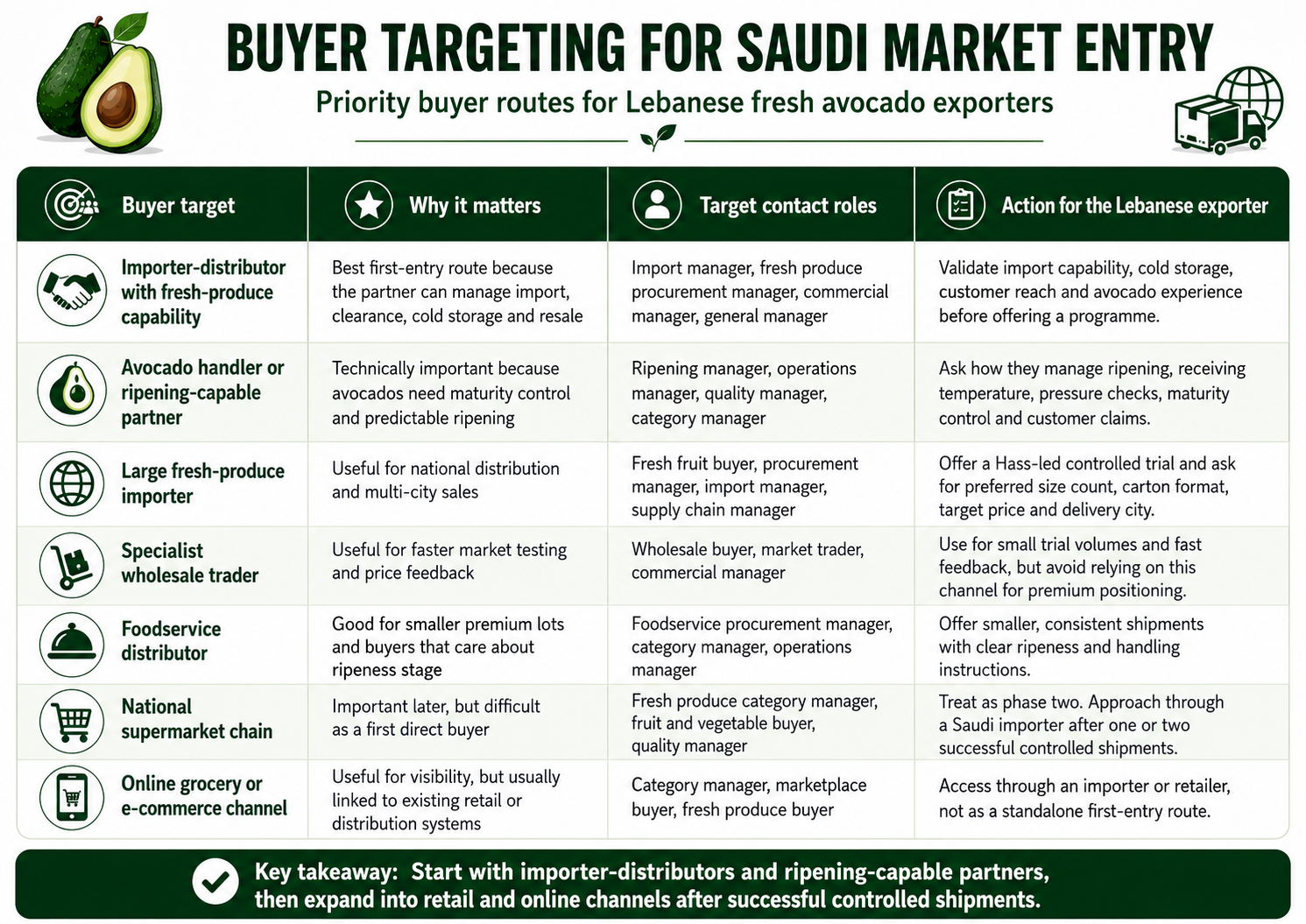
Start with buyers that can manage the import process, not only buyers that sell to consumers. The first target should be Saudi importer-distributors, ripening-capable partners and large fresh-produce importers. Retailers and online grocery channels are important, but they are better approached through a Saudi import partner after a successful arrival.
The figure below gives a practical buyer-targeting matrix. Use it to decide which buyer types deserve the first outreach and which contact roles to look for.
Buyer targeting matrix for a first Saudi market entry.
Validation questions before offering fruit
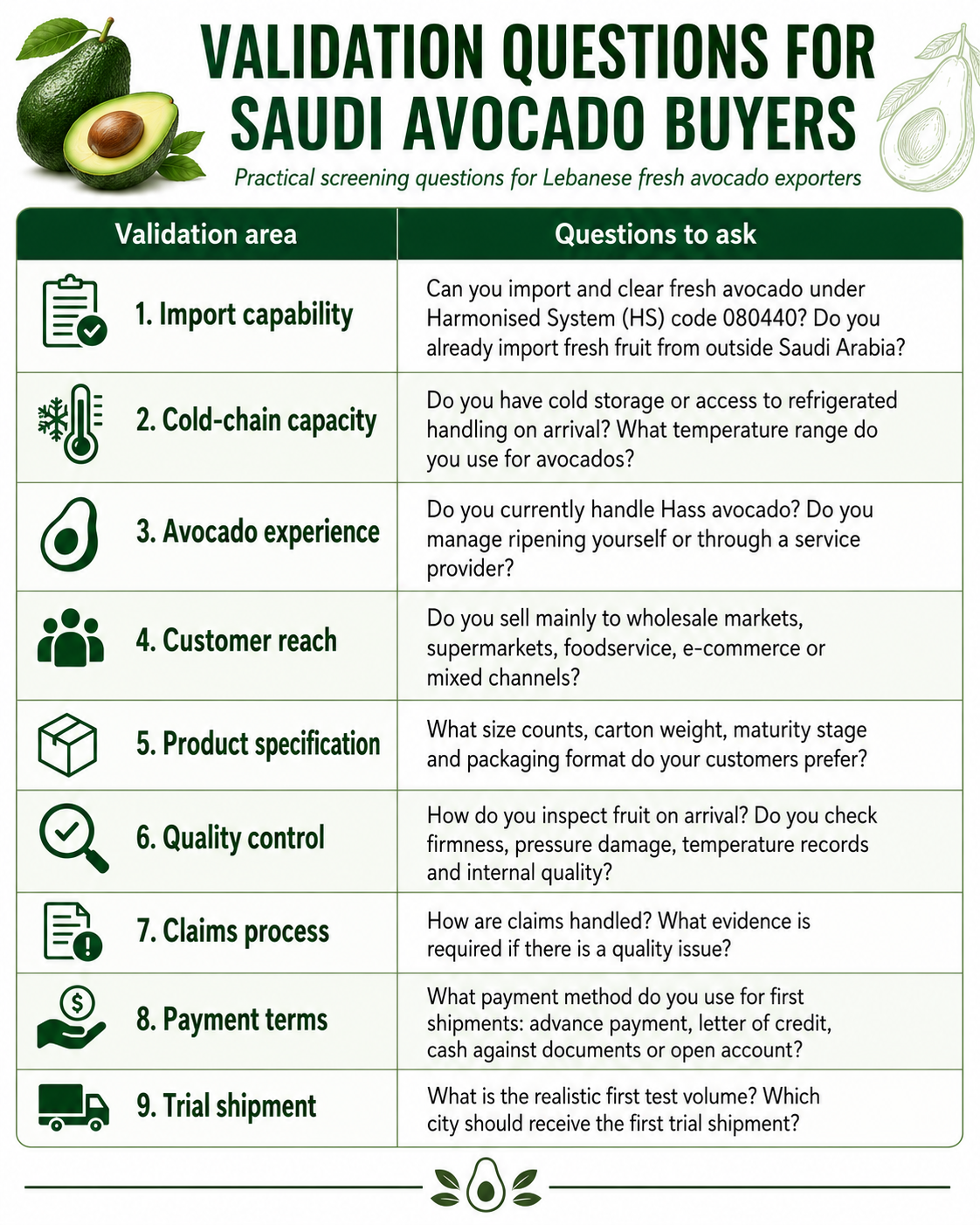
Before you quote price or offer volume, ask the buyer practical questions. Can they import under HS 080440? Do they already handle Hass avocado? What size count and carton format do they prefer? Do they have cold storage or ripening access? How do they inspect arrivals and handle claims?
These questions should be treated as a gate. If the buyer cannot answer them clearly, do not start with a large shipment.
Practical validation questions for Saudi avocado buyers.
Export promotional activities
Your promotion should solve a buyer problem. Do not sell only the story of Lebanese origin. Sell a practical offer that helps the Saudi importer manage risk: short transit, controlled maturity, clean documentation, flexible volumes and fast communication.
A useful Saudi-facing value proposition is: Fresh Lebanese Hass avocados with short transit, flexible supply, controlled maturity and reliable importer-led delivery at a realistic mid-premium price.
Your website and sales tools should be simple and operational. Show variety, size profile, harvest window, carton and pallet options, photos of internal and external fruit quality, certification summary, residue control approach, cold-chain basics, and a WhatsApp/email export contact.
| Sales tool | Why it matters for Saudi buyers |
| One-page English/Arabic product sheet | Buyers want fast information, not a long brochure. |
| Harvest and availability window | Helps match Lebanese supply to the buyer’s programme. |
| Carton, pallet and loading options | Reduces operational friction before the first order. |
| Maturity and pre-cooling approach | Builds confidence in ripening performance. |
| Temperature and claim protocol | Shows that the exporter is ready for disciplined trade. |
Logistics and route execution
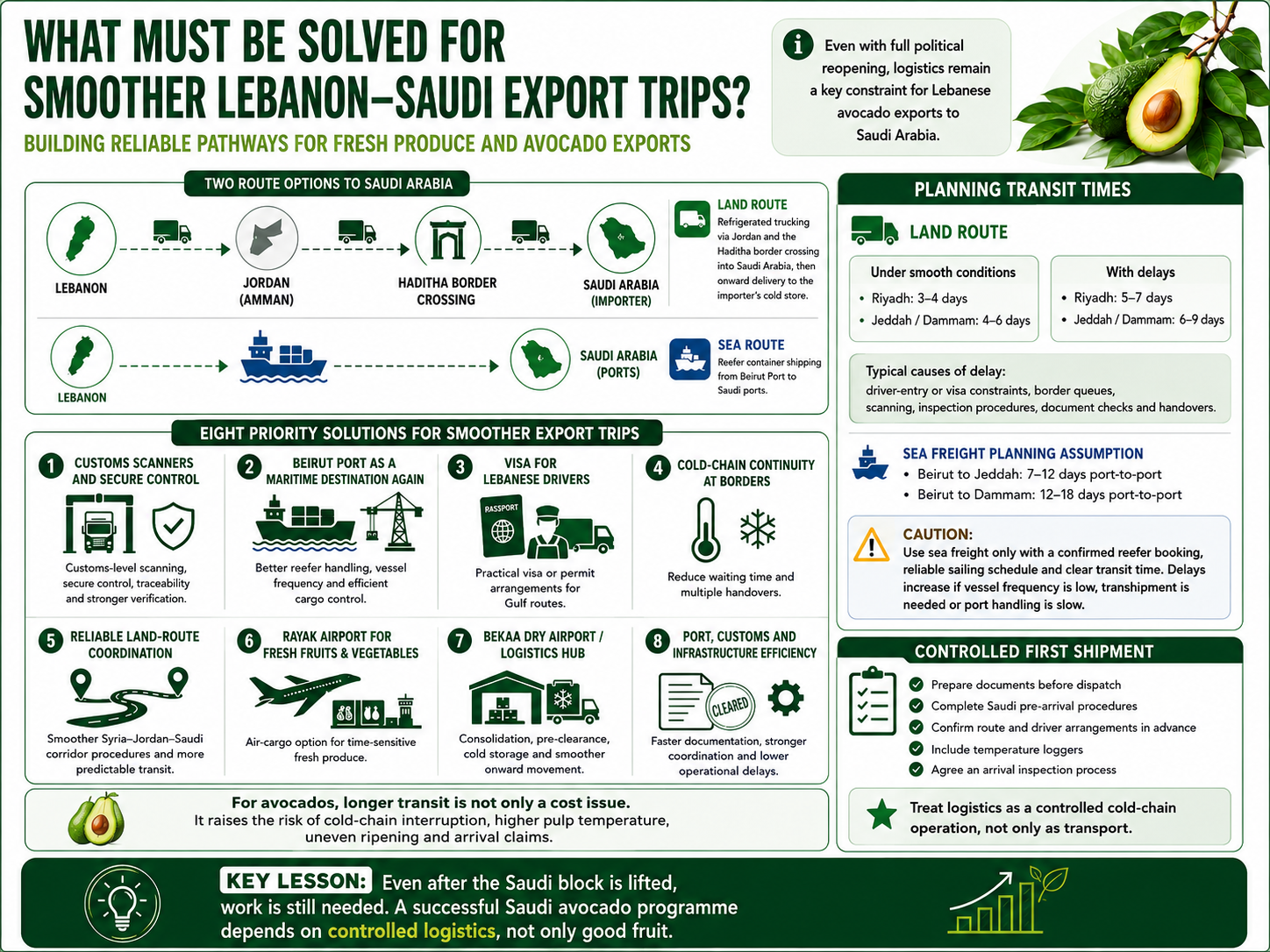
Even if political access is secured, logistics remain a key constraint. The most practical route for fresh avocados is likely to be refrigerated trucking through Jordan and the Haditha border crossing into Saudi Arabia, followed by delivery to the importer’s cold store.
Under smooth conditions, a refrigerated truck shipment from Lebanon to Riyadh can be planned at around three to four days from dispatch to delivery. Shipments to Jeddah or Dammam usually require around four to six days. With delays, this can extend to around five to seven days to Riyadh and six to nine days to Jeddah or Dammam.
Sea freight from Beirut can work only when the exporter has a confirmed reefer booking, reliable sailing schedule and clear port-to-port transit time. As a planning assumption, Beirut to Jeddah may require around seven to twelve days port-to-port, while Beirut to Dammam may require around twelve to eighteen days.
Planning routes, transit times, delays and infrastructure priorities for smoother Saudi shipments.
Shipment release gate
A shipment should leave the packhouse only after a short release review confirms that the route can be executed end to end. This protects shelf life and reduces the risk of border delay, missing documents, unavailable receiving slots or temperature claims.
| Release condition | Required confirmation before loading |
| Saudi readiness | The importer and broker confirm that the pre-arrival file can be processed and that no approval is missing. |
| Receiving capacity | The buyer confirms cold-store or ripening capacity, delivery appointment and arrival-inspection contact. |
| Equipment readiness | The refrigerated truck or container passes pre-trip inspection; setpoint, ventilation and backup arrangements are recorded. |
| Corridor readiness | The carrier confirms driver, vehicle, transit permissions, border status and contingency plan. |
| Control and claims readiness | Customs seal, GPS and temperature loggers are activated, and the parties agree the inspection and evidence protocol. |
Competition and price logic
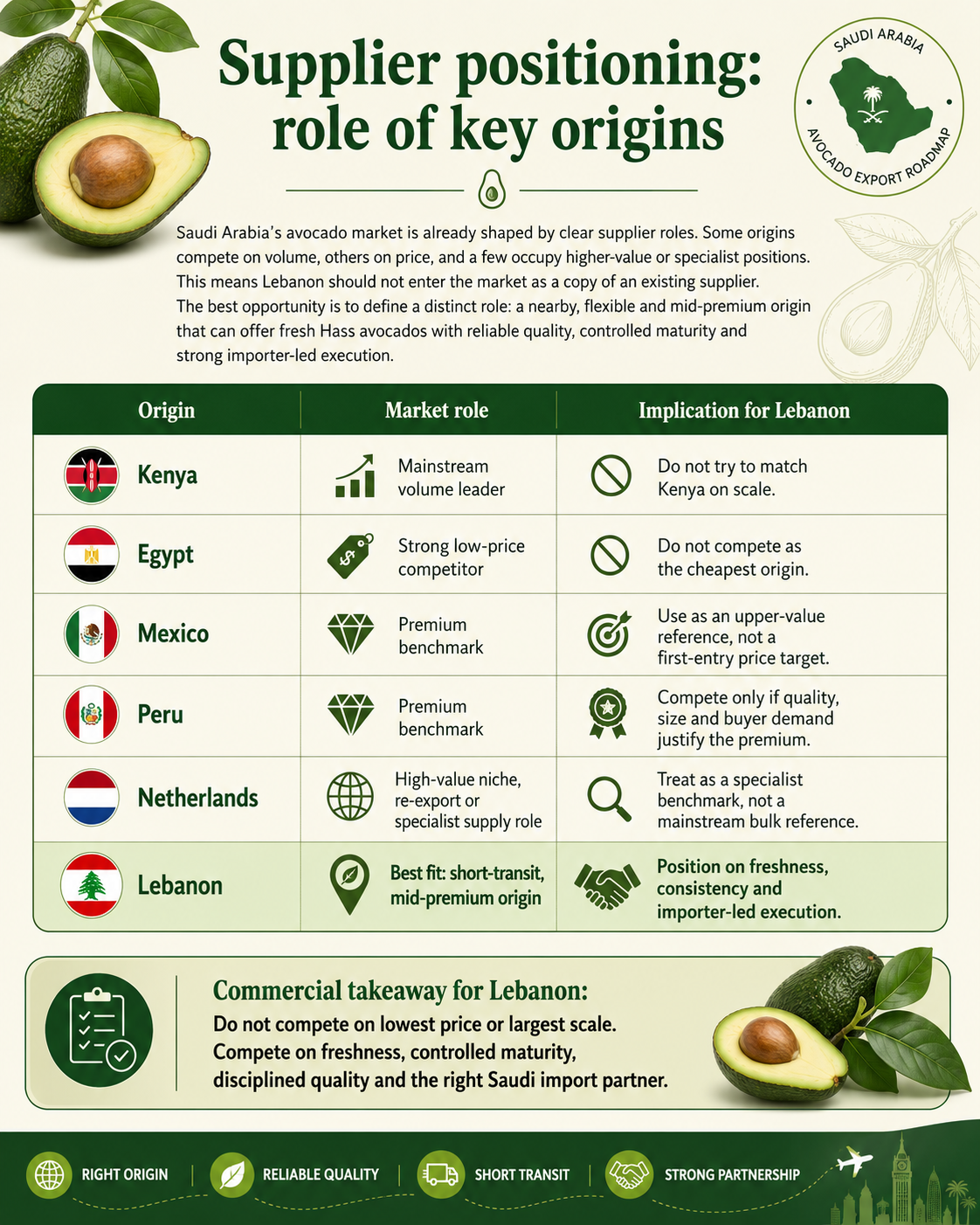
Saudi buyers already have supply options. Kenya sets the mainstream volume benchmark. Egypt is the low-price benchmark. South Africa gives a useful mid-to-higher value reference, while Peru and Mexico show the premium end. Lebanon should not copy any of these positions directly.
The Saudi offer should be priced as a disciplined mid-premium origin: above the lowest-price reference, close enough to Kenya to remain realistic, and below premium Peru and Mexico levels unless the fruit and buyer demand justify a higher price.
Supplier positioning and the role of key origins in the Saudi avocado market.
Pricing logic and landed-price model for a first Saudi avocado entry.
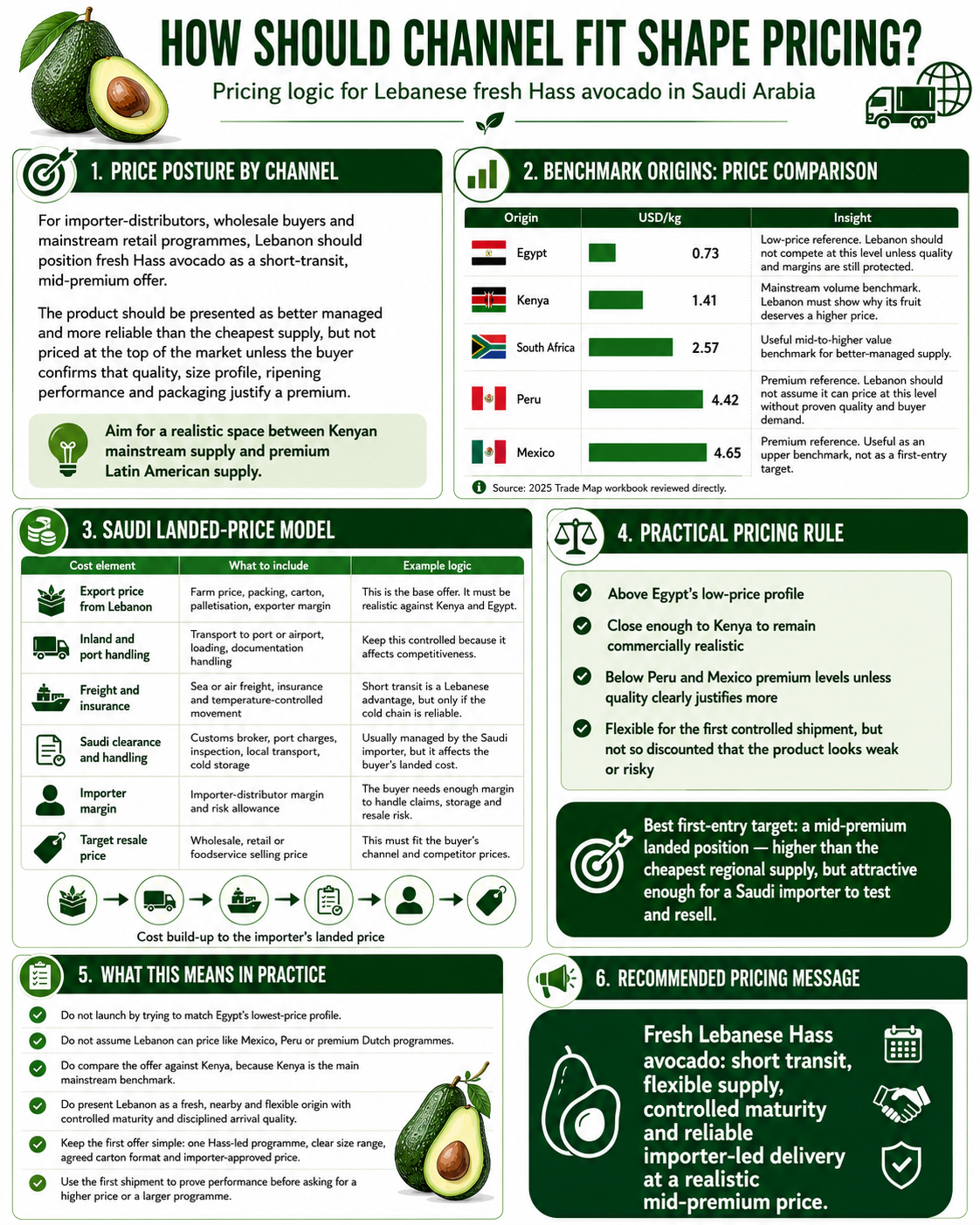
Price guidance for the first offer
| Benchmark origin | What it means for Lebanon |
| Egypt | Low-price reference. Lebanon should not compete at this level unless margins and quality are protected. |
| Kenya | Mainstream volume benchmark. Lebanon must show why its fruit deserves a higher price. |
| South Africa | Useful mid-to-higher value benchmark for better-managed supply. |
| Peru and Mexico | Premium references. Useful as upper benchmarks, not as first-entry targets. |
Main commercial risks
The first risk is weak execution. After a long period of restricted access, a poor first arrival can damage buyer confidence more quickly than a successful shipment can build it. Protect the first shipment.
The second risk is logistics. Driver-entry constraints, border queues, scanning, inspections, document checks and handovers can extend the journey and increase the risk of cold-chain interruption, higher pulp temperature, uneven ripening and arrival claims.
The third risk is price positioning. Lebanon should not present itself as a cheap commodity origin. If the fruit is good but unproven, a realistic mid-premium offer is more credible than a premium claim.
The fourth risk is buyer selection. A buyer who cannot clear, store, inspect and place avocados properly is not the right partner for a first shipment.
Final recommendation
The decision is Conditional GO. Saudi Arabia is commercially worth pursuing, but only through a carefully validated importer-led entry model.
Lebanese exporters should spend the next three to six months building a buyer shortlist, validating importer capability, aligning specifications, confirming route options and preparing a controlled first programme rather than rushing into a large-volume shipment.
If the exporter can deliver Class I appearance, dependable maturity, clean documentation, disciplined cold chain and a Saudi partner that knows how to handle avocados, the market is worth entering. If not, the correct decision is prepare first, then enter.
| Key message: quality, maturity, reliability and controlled logistics win the relationship. Price alone does not. |